The Complete Guide to Estate Planning
Wills · Lasting Powers of Attorney · Trusts · Tax · Probate · Pensions · 2026/27 Edition


Patrick D Williams Estate Planners
The Complete Guide to Estate Planning
Wills · Lasting Powers of Attorney · Trusts · Tax · Probate · Pensions
2026/27 Edition
patrickdwilliamsestateplanner.com
07754 409085
Contents
About the Author

Patrick Williams
Chartered Financial Adviser & Estate Planner
I wanted to make estate planning straightforward, affordable, and human.
I started this practice because I saw too many families left with uncertainty and unnecessary stress after a loved one passed away. With over 20 years of experience in accountancy and financial planning, I understand the importance of getting the details right — but more than that, I know that talking about Wills and Powers of Attorney isn't easy. I take time to listen, explain everything in plain English, and make sure you feel confident about the decisions you make.
My career began behind a desk in a modest office, helping small business owners make sense of their accounts. Over two decades as a self-employed accountant, clients' questions deepened — about pensions, savings and trusts — so I returned to study and became a Chartered Financial Adviser, the highest standard in the profession, so I could answer them properly.
Career Milestones
Certified Public Accountant
Established a private practice providing financial and tax solutions to small businesses for two decades.
Financial Adviser Qualification
Began the rigorous journey to full financial adviser status alongside running the practice.
Chartered Financial Adviser
Achieved Chartered status — the gold standard, combining technical knowledge with ethical practice.
Estate Planning Specialist
Formalised a practice protecting legacies from care fees, creditors and blended-family disputes.
Coverage
Home & Office visits throughout Enfield & North East London. Nationwide online Teams/Zoom meetings
Patrick D Williams Estate Planners
Contact
07754 409085
info@patrickdwilliamsestateplanner.com
patrickdwilliamsestateplanner.com
18B Park Avenue, London N13 5PF
Enfield home/office visits or UK online Teams/Zoom meetings
Whether you need a new Will, a review of an existing one, a Lasting Power of Attorney, a trust, probate support or guardianship advice, we can guide you through every stage.
Chapter 1
The Purpose and Importance of a Will
A Will is a legally binding document that sets out a person's wishes for what should happen to their estate after death. This chapter explains what a Will can do, how to make one valid, and the life events that can change it.
1. The Purpose and Importance of a Will
A Will is a legally binding document that sets out a person's wishes for what should happen to their estate after death. Under the Wills Act 1837, a Will is revocable during the person's lifetime, meaning it can be amended, replaced or cancelled while they have the necessary capacity.

A properly prepared Will does much more than distribute money. It can:
- Identify who receives property, savings, investments and personal possessions.
- Deal with outstanding debts and liabilities.
- Provide instructions concerning taxation.
- Establish trusts to protect assets and beneficiaries.
- Appoint Executors to administer the estate.
- Appoint guardians for children under 18.
- Provide protection for vulnerable or financially unstable beneficiaries.
- Address digital assets and online accounts.
- Help reduce the likelihood of disputes between family members.
Without a valid Will, a person's estate is distributed according to the rules of intestacy, rather than according to their personal wishes.
3. Executors, Guardians and Gifts
Executors
Executors are responsible for administering the estate. Their responsibilities can include:
- Identifying and valuing assets.
- Establishing debts and liabilities.
- Dealing with tax.
- Applying for the appropriate probate authority.
- Paying debts and expenses.
- Distributing assets according to the Will.
- Keeping appropriate records.
Executors carry significant responsibilities and can face personal consequences for mistakes. A lay Executor, such as a relative or friend, may not charge a professional fee but can find the administration process difficult and time-consuming. A professional Executor can provide specialist assistance with estate administration, valuations, tax matters and distributions, potentially reducing the administrative burden and risk of family disagreements.
Guardians for Minor Children
A Will is also an important mechanism for parents to nominate guardians for children under 18. Where there is no surviving parent able to care for the child, failing to express wishes regarding guardianship can result in decisions being made through the relevant legal and family court processes, and the children may be placed with someone the parents would not have chosen.
Naming a guardian in a Will gives parents control over who raises their children, helps avoid delays and uncertainty, and provides stability and continuity at a difficult time. It also allows parents to appoint substitute guardians in case the first choice is unable or unwilling to act.
Example: Choosing a Guardian
Priya and Mark have two young children, aged 4 and 7. In their Wills they name Priya's sister, Anjali, as guardian, with Mark's brother, David, named as substitute guardian if Anjali is unable to act. Without such a clause, if both parents died, the courts would decide who looks after the children — which might not reflect the parents' wishes or the children's best interests.
Key lesson: Naming a guardian gives parents, not the courts, control over who raises their children.
Key lesson
Parents should consider both who inherits their assets and who should care for their children.
4. Types of Gifts in a Will
Different forms of gifts have different legal and practical consequences.
Specific Legacy
A specific legacy identifies a particular asset, such as a named item of jewellery, artwork, vehicle or bank account. A major risk is ademption. If the specified asset is sold, disposed of or no longer exists when the person dies, the intended gift may fail.
Example: "I leave my grandmother's gold wedding ring to my niece, Sophie." If the ring is sold or lost before death, the gift fails because the specific item no longer exists. Where a replacement or equivalent is intended, the Will should say so expressly.
Pecuniary Legacy
This is a fixed monetary gift, such as leaving £10,000 to a charity or individual. The value of a fixed cash gift can be reduced in real terms by inflation, particularly where a Will remains unchanged for many years.
Example: "I leave £5,000 to my friend, John." If the Will was written twenty years ago, the real value of £5,000 today is far lower than when it was written. Reviewing pecuniary legacies regularly helps keep their value meaningful.
Residuary Legacy
The residue is what remains after debts, taxes, expenses and other gifts have been dealt with. A residuary gift is generally more flexible because it follows the changing value of the estate. For example, a Will might leave 60% of the residue to one beneficiary and 40% to another.
Example: "I leave the residue of my estate equally between my two children, Tom and Lisa." Because the residue automatically reflects whatever the estate is worth at death, this kind of gift flexes with property prices, investments and savings without needing to be rewritten every time values change.
Planning principle
A well-drafted Will should clearly distinguish between specific gifts, cash gifts and the residue to reduce uncertainty and unintended outcomes.
6. Ensuring the Will Is Legally Valid
Correctly executing a Will is of the utmost importance.
Under Section 9 of the Wills Act 1837, the Will must satisfy specific formal requirements. In broad terms, it must be:
- In writing.
- Signed by the testator with the intention of giving effect to the Will.
- Properly witnessed by two witnesses who are present at the required time.
- Attested and signed by the witnesses in the testator's presence.
Failure to comply with the statutory requirements can create serious problems and may result in the document failing as a Will.
Witnessing Risks
Beneficiaries should not normally act as witnesses. Where a beneficiary, or their spouse or civil partner, acts as a witness, the Will may remain valid but the beneficiary's gift can be lost.
Practical lesson
Use genuinely independent witnesses and ensure the execution process is carried out correctly.
7. Life Events That Can Affect a Will
A Will should not be viewed as a document that is prepared once and then forgotten. Major changes in personal circumstances can significantly affect its operation.
Marriage or Civil Partnership
Marriage or civil partnership can revoke an existing Will unless it was appropriately made in contemplation of that marriage or civil partnership. This means someone who has made a Will and subsequently marries should review their estate planning immediately.
Divorce
After a divorce, a gift left to an ex-spouse may no longer work as intended, and their role as Executor or Trustee can be affected too. A divorce is therefore a reason to review your Will, not to leave it as it stands.
Changes in Family Circumstances
The arrival of children, grandchildren, remarriage, separation, deaths in the family and changes in financial circumstances can all justify reviewing a Will.
Beneficiary Bankruptcy
If a beneficiary has serious financial problems or becomes bankrupt, an outright inheritance may potentially become available to creditors. This is one reason why trusts may sometimes be considered where beneficiaries are financially vulnerable.
8. Testamentary Capacity and Will Challenges
As people live longer, questions about mental capacity when making a Will can become increasingly important.
Testamentary capacity is the legal and mental ability of a person to make or change a valid Will at the time they make it. It means the person understands what a Will is, what they own, who might reasonably expect to benefit, and the consequences of the decisions they are making. Crucially, capacity is assessed at the moment the Will is signed — not at any earlier or later date.
The historic Banks v Goodfellow test sets out the standard. Broadly, the person making the Will must understand:
- The nature and effect of making a Will.
- The general extent of their property.
- The people who might reasonably have a claim on their estate.
- The consequences of the decisions they are making.
Wills can be challenged on grounds including alleged lack of testamentary capacity or undue influence. This is particularly relevant where someone:
- Makes a Will later in life.
- Makes significant changes to a previous Will.
- Excludes a close family member.
- Leaves most of their estate to an unexpected beneficiary.
- Has experienced cognitive difficulties.
Maintaining evidence of the person's wishes and decision-making is recommended, including asset mapping, letters of wishes and appropriate capacity assessments where circumstances warrant them.
Key lesson
Good estate planning is not only about writing the Will. It is also about creating evidence that demonstrates that the person's decisions were informed, voluntary and properly considered.
Chapter 2
The People Behind Your Will
A Will is not just a list of gifts — it is a framework connecting a network of people. This chapter walks through the testator, beneficiaries, executors, witnesses, guardians, trustees, creditors and professional advisers, and shows how their roles interact.
1. A Will Is More Than a Document
When people hear the word "will," they often think simply about money, houses, jewellery or other possessions being passed to family after death. In reality, a will is much more than a list of gifts.
A will creates a framework involving a number of different people. Each person can have a different role, responsibility, right or obligation — the person making the will, the people receiving property, the witnesses, the executors, guardians of children and, in some circumstances, creditors and family members who are not named in the will.
A useful way to understand a will is to imagine it as a set of instructions:
- The testator makes the instructions.
- The witnesses help establish their validity.
- The executors carry out the instructions.
- The beneficiaries receive the intended benefits.
- Guardians may care for children.
- The courts and other authorities provide the legal framework.
In England and Wales, a valid will generally needs to be in writing, made voluntarily by a person with the required capacity, signed with the intention of giving effect to it, and witnessed by two people who comply with the statutory requirements.
The Testator — The Person Making the Will
The testator is the person who makes a will. Their principal responsibility is to make genuine decisions about what should happen to their estate after death — who should receive property, who should administer the estate and, where appropriate, who should look after minor children.
Example: David's Will
David owns a house, savings, investments and a collection of valuable watches. He makes a will leaving his house to his daughter, £20,000 to his son, his watches to his brother and the residue of his estate to his two children equally. He appoints his sister as executor. David is the testator — his decisions create the instructions that his executor will later have to administer.
Capacity Matters
Testamentary capacity simply means the mental ability to make a valid will. In plain terms, it means the person understands that they are making a will, knows roughly what they own, understands who might reasonably expect to benefit, and can grasp the consequences of their decisions. It is assessed at the exact moment the will is signed — not at any earlier or later date.
Example: Testamentary Capacity
Mrs Thompson, aged 85, has occasional memory lapses but is generally lucid. On the day she signs her will she clearly explains her assets, names her two children and explains why she is leaving a smaller share to her son (who has financial support from his father-in-law). Because she understands her property, her family and the effect of her decisions at the time of signing, she has testamentary capacity. If she had been confused and unable to explain these things on that same day, the will could be challenged on capacity grounds.
Key lesson: Testamentary capacity is about understanding — not about age or a diagnosis. A person with early dementia can still make a valid will on a day when they are lucid and can explain their decisions.
The will should also be made voluntarily — a will produced through fraud, coercion or undue influence can become the subject of a dispute.
Conditions the Testator Must Meet
- Be at least 18 years old.
- Have testamentary capacity at the time the will is signed.
- Make the will voluntarily, free from fraud, coercion or undue influence.
- Know and approve the contents of the will.
- Sign or acknowledge the signature in the presence of two qualifying witnesses.

The Beneficiary — The Person Who Benefits
A beneficiary is someone who receives a benefit under the will. They may receive money, a house or other property, shares, personal possessions, a specific item, a share of the estate, or the residue — what remains after debts, expenses and specific gifts have been dealt with. Beneficiaries do not all have to be family members; a testator might leave something to a friend, charity, partner or other organisation.
Example: Maria's Will
"I leave my gold watch to my daughter Emma. I leave £10,000 to my nephew James. I leave the remainder of my estate to my three children equally." Emma and James are beneficiaries receiving specific gifts. Maria's children are residuary beneficiaries. The distinction matters because the residue is what remains after the estate's liabilities, expenses and applicable gifts have been dealt with.
Conditions a Beneficiary Must Meet
- Be clearly identified in the will by name, relationship or description.
- Survive the testator (or be alive at the relevant time, unless a substitute beneficiary is named).
- Not be disqualified — for example, a witness or the witness's spouse cannot receive an effective gift.
- Accept or, in some cases, disclaim the gift as permitted by law.
Key lesson
A beneficiary generally does not control the estate simply because they are receiving an inheritance. The executor has the responsibility for administering and distributing it.
2. The People Who Make the Will Work
The Executor — The Person Responsible for Administration
The executor is one of the most important people named in a will. An executor is appointed by the testator to administer the estate and carry out the provisions of the will. Executors are part of the wider category known as personal representatives.
The executor's work can involve:
- Locating the original will.
- Identifying assets and liabilities and valuing the estate.
- Determining whether inheritance tax or other taxes are due.
- Applying for a grant of probate where required.
- Protecting estate assets and paying legitimate debts.
- Keeping records and communicating with beneficiaries.
- Distributing the estate in accordance with the will.
Example: The Executor's Job
Robert dies leaving a house worth £300,000, savings of £80,000 and debts of £20,000. His will names his two daughters as beneficiaries and his brother Michael as executor. Michael cannot simply transfer the £80,000 to the daughters immediately. He may first need to establish the estate's assets and liabilities, determine whether probate is required, deal with tax and debts, and then distribute what remains.
Key lesson: The executor is not simply a messenger delivering inheritances — the executor has an administrative and legal responsibility.
Executor Does Not Mean "Owner"
An executor may have control of estate assets for administration purposes, but that does not mean the executor personally owns those assets. An executor can also be a beneficiary — Sarah may appoint her son Daniel as executor and leave £50,000 to him, giving Daniel both roles.
What If an Executor Does Not Want to Act?
Being named as an executor does not necessarily mean the person must ultimately administer the estate. An executor may renounce their right to act, or reserve their right to act later, subject to the applicable legal procedure. If an executor has died, cannot act or refuses to act, the will may provide for a substitute executor. This is one reason why appointing appropriate executors and, where sensible, substitute executors is important.
Conditions to Act as Executor
- Be at least 18 years old.
- Be of sound mind.
- Not be disqualified from acting (for example, an undischarged bankrupt may be restricted in certain circumstances).
- Be willing to take on the legal and fiduciary duties of a personal representative.

The Witnesses — Protecting the Validity of the Will
Witnesses play a very different role. They are not there to decide whether the testator's wishes are sensible — their role is primarily connected with the proper execution of the will.
In England and Wales, the testator must sign or acknowledge their signature in the presence of two witnesses present at the same time, and the witnesses must sign or acknowledge their signatures in the testator's presence.
Conditions a Witness Must Meet
- Be at least 18 years old.
- Be present at the same time when the testator signs or acknowledges the signature.
- Sign or acknowledge their own signature in the testator's presence.
- Not be a beneficiary under the will, and not be the spouse or civil partner of a beneficiary.
- Be independent — ideally with no personal interest in the estate.
Planning principle
Under section 15 of the Wills Act 1837, if a beneficiary (or their spouse or civil partner) acts as a witness, the will can remain perfectly valid but the gift to that beneficiary fails. The gift is treated as if the beneficiary had predeceased the testator. This means the intended beneficiary receives nothing under the will, even though the document itself is still effective for all other purposes. The rule exists to prevent any suspicion of undue influence or pressure on the testator. Always use independent witnesses who are not beneficiaries and have no obvious personal interest in the estate.
Example: The Witness Who Lost Their Gift
Susan writes a will leaving £15,000 to her neighbour, Robert. She asks Robert to witness the signing. The will is valid, but because Robert is both a beneficiary and a witness, the £15,000 gift to him fails under section 15 — he receives nothing. Had Susan asked an independent neighbour with no interest in the will to witness instead, Robert would have received his £15,000 as intended.
Key lesson: A single wrong choice of witness can erase a gift entirely. Always use two independent witnesses who receive nothing under the will.
3. Children, Guardians and Other People Affected
The Guardian — Protecting Children
A guardian may be appointed to look after a child following the death of a parent, subject to the legal circumstances governing parental responsibility and guardianship. For parents with young children, this can be one of the most important parts of a will. Crucially, a guardian can only be appointed through a valid will — without one, parents have no legal mechanism to choose who raises their children.
What Happens Without a Guardian?
If both parents die without having made a will appointing a guardian, no one automatically has parental responsibility for the children. The children may be taken into the care of the local authority and placed with foster carers while arrangements are made. A family court would then decide who looks after them, based on what the court considers to be in the child's best interests — and that may not be the person the parents would have chosen.
- Children may be placed into foster care or local authority care, at least temporarily.
- A social worker or the court decides who raises them, not the parents.
- Siblings may be separated if no single suitable carer is identified.
- Relatives may need to apply to court for a child arrangements order or special guardianship order.
- The process can take weeks or months, causing distress at an already difficult time.
Conditions a Guardian Must Meet
- Be appointed in a valid will by someone with parental responsibility.
- Be at least 18 years old.
- Be willing and able to take on parental responsibility for the child.
- Act in the child's best interests at all times.
Planning principle
A guardian appointment only takes effect if it is written in a valid will. Making a will is the only way parents can legally choose who raises their children if the worst happens.
Example: James and Laura
James and Laura have two children aged six and nine. They make wills appointing James's sister, Helen, as guardian if the relevant circumstances arise. They also leave money for the children's benefit. The will is doing more than distributing money — it is expressing the parents' wishes about who should care for their children.
Key lesson: The guardian's role is fundamentally different from the executor's. The executor deals with the estate; the guardian deals with the welfare and care of children. The same person can have both roles, but they should not be confused.

The Trustee — Managing Property for Someone Else
A trust may arise under a will where property is to be held and managed for someone rather than simply handed directly to them. This can be particularly relevant where a beneficiary is a child, cannot manage property independently, money is intended to be distributed over time, or the testator wants conditions attached to the use of property.
Example: A Trust for a Child
A parent leaves £100,000 for a 12-year-old child but does not want the child to receive the money outright at age 12. The will might establish a trust under which trustees hold and manage the money for the child's benefit, subject to the precise terms of the trust and applicable law.
Key lesson: Trustees have ongoing responsibilities involving investment, administration, record keeping and acting in accordance with the trust.
Conditions to Act as Trustee
- Be at least 18 years old.
- Be of sound mind.
- Not be disqualified from acting as a trustee (for example, an undischarged bankrupt may be restricted).
- Be willing to take on the legal duty to act in the best interests of the beneficiaries and in accordance with the trust terms.
The Family — Including People Who Receive Nothing
One of the most overlooked groups affected by a will is the group of people who are not named as beneficiaries. A will can affect spouses, civil partners, children, former partners, dependants and other relatives even when they receive nothing under the document.
Example: Peter's Blended Family
Peter has two adult children from his first marriage and one child with his current partner. His will leaves everything to his current partner. The two adult children may be disappointed or believe the will is unfair. Depending on the circumstances, they may have legal avenues available to challenge or make claims against the estate.
Key lesson: Being excluded from a will does not automatically mean a person has no possible legal interest in the estate.
Creditors — The People the Estate May Owe
A deceased person's debts do not simply disappear because the person has died. Creditors may therefore become indirectly involved in the administration of the estate. Before beneficiaries receive what they are entitled to, the executor may need to identify and deal with legitimate debts and liabilities.
Planning principle
An inheritance is generally what remains after the estate has been properly administered — not simply the total value of everything the deceased owned.
Conditions a Creditor Must Meet
- Have a legitimate, enforceable debt owed by the deceased or the estate.
- Notify the executor or personal representatives of the claim, usually within the relevant time limits.
- Provide evidence of the debt where reasonably requested.
- Rank in the correct order of priority — secured creditors and certain funeral and administration expenses are paid before unsecured creditors.
The Professional Advisers
Solicitors, probate practitioners, accountants, tax advisers and other professionals may also become involved. They do not replace the legal roles of the testator, executor or beneficiary — instead, they provide specialist assistance. Professional advice is especially important where there is a business, property abroad, a complicated family structure, a dependent who cannot care for themselves, substantial assets, trusts, tax considerations, or a significant possibility of a dispute.
Conditions a Professional Adviser Must Meet
- Hold the relevant professional qualifications and regulatory authorisation.
- Be regulated by the appropriate body (for example, the SRA for solicitors).
- Carry adequate professional indemnity insurance.
- Act within their area of competence and disclose any conflicts of interest.

4. When the Wishes Become Action
Probate and the Personal Representatives
After death, the will moves from being a statement of future wishes to a document that must be administered. Where appropriate, the executor applies for a grant of probate. The grant provides the formal authority needed in many circumstances to deal with estate assets. The original will is important — it is normally required for the probate application, rather than a photocopy.
A Complete Example: One Will, Many Participants
Margaret, aged 72, makes a will. She owns a house worth £400,000, savings of £100,000, shares worth £50,000 and jewellery worth £20,000. She has two children, Anna and David, and one young grandchild, Lucy. Her will says:
- Anna receives the jewellery.
- David receives £30,000.
- £20,000 is left to a charity.
- The remainder goes equally to Anna and David.
- Her sister Susan is appointed executor.
- Susan is also appointed trustee of a trust for Lucy.
- Her brother Michael is appointed guardian of Lucy if the relevant circumstances arise.
Everyone involved has a different role: Margaret is the testator; Anna and David are beneficiaries; the charity is a beneficiary; Susan is executor and trustee; Michael is guardian; Lucy may have an interest in the trust; witnesses provide evidence of proper execution; creditors may need to be addressed; and professional advisers may assist the executor.
Key lesson
A will should never be viewed simply as a document saying "who gets what." It is a framework connecting a network of people.
The Golden Rule: Every Role Has a Different Purpose
| Person | Main Role | Key Responsibility |
|---|---|---|
| Testator | Makes the will | Make informed, voluntary decisions |
| Beneficiary | Receives a benefit | Receive the entitlement per the will and law |
| Executor | Administers the estate | Carry out the will properly |
| Witness | Witnesses execution | Properly witness the signature |
| Guardian | Cares for children | Act per guardianship law |
| Trustee | Manages trust property | Manage assets per the trust and law |
| Creditor | Is owed money | Establish and pursue legitimate debts |
| Family / dependants | May be affected | May have rights or potential claims |
| Professional adviser | Provides specialist help | Advise the relevant parties |
| Probate authorities | Provide oversight | Facilitate authority and resolve issues |
The Most Important Lessons
A well-prepared will should answer more than one question:
- Who is making the will? — the testator.
- Who should benefit? — the beneficiaries.
- Who will administer everything? — the executors.
- Who will witness the signing? — the witnesses.
- Who will care for children? — potential guardians.
- Who will manage property in trust? — the trustees.
- Who might be affected even though they receive nothing? — family, dependants, creditors and others.
- What happens if someone dies before the testator? — the will should anticipate this.
Final Thought
A will is ultimately about people as much as property. The more important question is often: who will make decisions, who will carry them out, who will benefit, and who may be affected?
Understanding the different participants makes wills easier to understand and can expose potential problems before they become disputes. A thoughtful will establishes a carefully considered set of instructions for what should happen when the person making those instructions is no longer able to make the decisions themselves.
Chapter 3
Intestacy — What Happens Without a Will
A person who dies without a valid Will is said to have died intestate. This chapter explains the statutory rules of intestacy, why they rarely reflect modern families, and the real-world consequences for cohabiting and blended families.
2. Intestacy: What Happens Without a Will?
A person who dies without a valid Will is said to have died intestate. Their estate is then distributed according to statutory rules.
These rules do not necessarily reflect modern family relationships or what the deceased would have wanted.
For example, where there is a surviving spouse and children, the spouse receives the statutory entitlement, including the specified fixed sum, personal chattels and a share of the remaining estate, with the balance passing to the children.
Where there is no surviving spouse, the estate follows a statutory family hierarchy, broadly progressing through:
- Children and lineal descendants.
- Parents.
- Siblings and their descendants.
- Grandparents.
- Uncles and aunts and their descendants.
- Ultimately, the Crown where there are no qualifying relatives.
The danger of assuming you are protected
One of the most important messages is that family circumstances do not automatically provide the protection people often assume.
Case Study: Cohabiting Couple
James and Fiona had lived together for 24 years and had three children. Despite building a family and business together, significant assets were held solely in James's name. James died without making a Will. Fiona did not automatically inherit James's estate simply because they had lived together for many years. The concept of a UK "common law marriage" does not give unmarried partners the same automatic inheritance rights as married couples. Fiona therefore had to pursue a claim under the Inheritance (Provision for Family and Dependants) Act 1975, creating significant financial and emotional pressure.
Key lesson: Long-term cohabitation does not provide the same automatic inheritance protection as marriage or civil partnership. A Will is particularly important for unmarried couples.
Case Study: Blended Family
David had children from a previous relationship and later married Sarah, who also had a child. David died without a Will. His estate was distributed under intestacy rules. Sarah received the statutory entitlement, while David's children received the remaining share. The situation became more serious when Sarah later died without a Will. Assets originating from David could ultimately pass to Sarah's biological daughter rather than David's children.
Key lesson: Blended families require deliberate estate planning. Simply leaving everything to a surviving spouse can result in children from a previous relationship ultimately receiving nothing.

Chapter 4
Types of Wills and Specialist Wills
There is no single Will suitable for everyone. This chapter compares Single, Mirror and Mutual Wills, then covers Property Protection Trust Wills, Discretionary Trust Wills, Statutory Wills, Living Wills (Advance Decisions) and Privileged Wills.
9. The Main Types of Wills
There is no single Will suitable for everyone.
Single Wills
A Single Will is designed for one individual. It may be suitable for single, divorced or financially independent individuals, or people who wish to maintain completely separate estate planning from their partner.
Mirror Wills
Mirror Wills are two separate Wills, usually prepared for a couple, containing substantially similar provisions. A common arrangement is: First death → surviving partner → children on second death.
The key weakness is that Mirror Wills are generally not binding agreements. After the first partner dies, the survivor can normally change their own Will. This can create a significant risk in circumstances such as remarriage or changing family relationships.
Mutual Wills
Mutual Wills involve an agreement between two people not to revoke or change their Wills without the other's consent. They provide greater contractual protection but can be highly restrictive. If circumstances change substantially after the first death, the surviving person may have limited flexibility. Mutual Wills are therefore best regarded as a specialist arrangement rather than a standard solution.
10. Specialist and Protective Wills
Property Protection Trust Wills
These combine a Will with a protective trust arrangement. They are particularly relevant where someone wants a surviving partner to benefit from a property while ultimately preserving the deceased's share for their children or other beneficiaries. They are particularly relevant to blended families and homeowners considering long-term asset protection.
Discretionary Trust Wills
A Discretionary Trust Will places assets into a trust managed by chosen Trustees. Rather than giving an inheritance outright to a beneficiary, Trustees have discretion over how and when assets are distributed, according to the terms of the trust. This can be useful where beneficiaries are:
- Vulnerable.
- Financially unstable.
- Facing significant debts.
- At risk of poor financial decisions.
- Unable to manage a large inheritance themselves.
However, discretionary trusts can involve greater administration, complexity and ongoing management.
Statutory Wills
If someone loses mental capacity without having made an appropriate Will, they cannot simply sign a new Will themselves. A Statutory Will may instead be made on their behalf by the Court of Protection. This process can be costly, time-consuming and intrusive, reinforcing the importance of making appropriate arrangements while a person has capacity.
Example: Statutory Will
Mrs Patel suffered a severe stroke and lost the capacity to make or update her Will. With her earlier Will leaving everything to her estranged brother, her daughters applied to the Court of Protection for a Statutory Will reflecting what she would have wanted. The court process took over a year and involved medical evidence, official applications and legal costs — all of which could have been avoided if a suitable Will had been made while she had capacity.
Key lesson: Make a Will while you have capacity. A Statutory Will is a last resort, not a substitute for planning ahead.
Living Wills / Advance Decisions
A Living Will, more accurately an Advance Decision, is fundamentally different from a financial Will. It concerns medical treatment that a person wishes to refuse if they later lose the ability to communicate or make the relevant decision. It therefore belongs within broader incapacity and healthcare planning rather than conventional inheritance planning.
Example: Living Will (Advance Decision)
Mr Hughes, aged 78, signed an Advance Decision stating that, if he developed a terminal illness, he did not wish to receive cardiopulmonary resuscitation (CPR) or be kept on artificial life support. Years later, after a serious stroke left him unable to communicate, his doctors and family followed his recorded wishes — giving him the dignity of having his healthcare choices respected when he could no longer voice them.
Key lesson: A Living Will is about your healthcare choices, not your money — but it is just as important to record early.
Privileged Wills
Privileged Wills are a narrow exception to the normal formal requirements. They can apply to certain military personnel on active service and mariners at sea. They are a specialist legal exception rather than a normal estate-planning option.
Example: Privileged Will
A soldier deployed on active service wrote a brief, unwitnessed note leaving his savings to his partner and his car to his younger brother. Although it did not meet the usual formal requirements (such as two witnesses), it was accepted as a valid Privileged Will because he was a member of the armed forces on active service at the time it was made. Without that special status, the same note would have failed as a Will.
Key lesson: Privileged Wills are a narrow exception for those on active service or at sea — they do not replace proper estate planning for most people.
11. Property Protection Trust — First-Marriage and Blended-Family Editions
A Property Protection Trust (PPT) — also known as a Life Interest Trust — is a legal arrangement built into a Will that protects a deceased person's share of a home while allowing the surviving partner to live there for the rest of their life. It ensures the deceased's share ultimately passes to their chosen beneficiaries, usually their children, rather than being absorbed by the survivor's future liabilities.
Our current leaflet sets the same structure out twice, for the two situations clients bring to us most often: a first marriage, where both partners want the survivor secure and the children provided for; and a blended family, where each partner has children from an earlier relationship. The mechanics are identical — what changes is the risk the arrangement is written to answer.
The Setup Step Most People Miss
A couple must first change their property ownership from joint tenants to tenants in common, so that each owns a distinct, independent 50% share of the home. The Will then places that share into the trust on death. Without the severance of the joint tenancy, the property passes automatically to the survivor and the trust has nothing to hold.
First-Marriage Edition — John and Mary
John and Mary have been married for 30 years and have two children together. They want the survivor to stay in the family home for life, while protecting what their children will one day inherit.
Did you know?
Without a trust: John leaves everything to Mary. Mary later remarries, and the whole house — including John's half — can pass to her new husband and then to his family. John and Mary's own children are left with nothing. This is sideways disinheritance.
With a trust: John's Will states that on his death his 50% share goes into a trust. Mary can live in the house for life as the life tenant. When Mary dies, John's 50% share is inherited by their children, regardless of what Mary's own Will later says.
Blended-Family Edition — children from previous relationships
John and Mary own a home together and each has children from a previous relationship. John wants Mary to stay in the home for life, while ensuring his own children inherit his share.
Did you know?
Without a trust: John leaves everything to Mary. Mary later remarries or changes her Will, leaving the entire house to her own children. John's children are left with nothing — the same sideways disinheritance, this time across two families.
With a trust: John's 50% share goes into a trust on his death, Mary lives there for life as the life tenant, and on her death that share passes to John's children. The outcome John intended holds, whichever way Mary's own Will is later written.
Care Fees — What the Trust Does and Does Not Do
Years later, Mary needs residential care. Only what she owns outright is assessed, so John's half — held in trust, not owned by her — is not counted. Without a PPT the whole house counts; with a PPT, only Mary's half does.
Did you know?
Care fee nuance: a PPT only takes effect after the first partner dies. It provides no protection against care fees while both partners are still alive — and setting up a lifetime trust purely to avoid care costs can be overturned by a local authority as deliberate deprivation of assets.
Benefits and Trade-Offs, Side by Side
| What the trust gives you | What you accept in return |
|---|---|
| Prevents disinheritance — keeps the children's inheritance safe if the survivor remarries, and secures your own children's share in a blended family. | Loss of absolute control — the survivor needs trustee approval to sell or move. |
| Care fee ring-fencing — protects the deceased's 50% share from means testing. | Blocks equity release — providers rarely lend on trust-held properties. |
| Debt and bankruptcy shielding — keeps the share safe from the survivor's creditors. | Setup and administration costs — legal fees up front, plus trust administration later. |
Tax and Probate — the Two Honest Limits
A PPT does not generally reduce Inheritance Tax. Because the survivor holds a life interest, the trust share is treated as belonging to them for IHT and is taxed with the rest of their estate on the second death.
Probate still applies. The trust is created by the Will, so probate is still required on the first death. On the second death the share passes under the trust's terms rather than the survivor's Will — a probate saving, not an IHT one.
Practical lesson
Which edition applies to you is decided in the drafting, not by the trust itself. Both editions need the same groundwork: sever the joint tenancy, take advice on the care-fee and Inheritance Tax consequences, and review the arrangement whenever the family changes.
Planning principle
A Property Protection Trust is not a tax plan. It is a control plan: it decides who inherits your half of the home, and when.
Chapter 5
Lasting Powers of Attorney — Why and How
A Will only takes effect after death. A Lasting Power of Attorney protects you while you are still alive. This chapter explains why an LPA can be more vital than a Will, the two types of LPA, and how to create one step by step.
1. The Essentials: Why an LPA Is More Vital Than a Will
When we think about planning for the future, a will is usually the first document that comes to mind. However, a will only takes effect after you pass away. A Lasting Power of Attorney (LPA) protects you while you are still here.
An LPA is a powerful legal document that allows you to appoint people you trust ("attorneys") to make decisions for you if you ever lose the mental capacity to do so yourself. This could happen due to a sudden accident, a stroke, or long-term conditions like dementia.
Financial expert Martin Lewis has famously argued that an LPA can be far more crucial than a will, because the complications of losing capacity without one occur while you are still alive.
“Approximately 48% of women and 36% of men will develop dementia, Parkinson’s disease, or suffer a stroke in their lifetime.” — Alzheimer’s Research UK
Real-World Example: Arthur and David
Arthur (72) has a will leaving everything to his son, David (34). However, Arthur suffers a severe stroke and requires long-term care. Because Arthur is still alive, his will is completely useless. Without an LPA, David cannot access his father's bank accounts to pay for specialist care fees, leaving the family in financial limbo.
Key lesson: A will only helps after death. An LPA is what protects you and your family while you are still alive but unable to act.

The Danger of the “Next of Kin” Myth
One of the most dangerous misconceptions in the UK today is that your spouse, partner, or adult children automatically have the right to manage your life if you become incapacitated. They do not.
Without an LPA in place:
- Bank accounts frozen: Joint bank accounts can be frozen by financial institutions if one partner loses capacity.
- No medical voice: Your family may be locked out of critical care decisions and treatment options.
- The Court of Protection: Your family will have to apply to the Court of Protection for a “deputyship”. This process is notoriously expensive, takes many months, and inflicts immense stress on your loved ones during a crisis.
The Cost of Inaction: Sarah and Mark
When Sarah's husband Mark developed early-onset dementia without an LPA, their joint household account was frozen by the bank to “protect Mark's assets”. Sarah had to spend over £3,000 in legal fees and wait nine months for the Court of Protection to grant her permission just to pay their mortgage and utility bills.
Key lesson: The “next of kin” myth can cost your family thousands of pounds and months of distress. An LPA prevents this entirely.
Key Legal Definitions to Know
- The Donor: The person making the LPA (you). You must be 18 or over and have the mental capacity to make your own decisions when you sign it.
- The Attorney: The trusted individual(s) you choose to step in and make decisions on your behalf.
- The Certificate Provider: An independent professional (like a doctor or solicitor) or someone who has known you for over two years who confirms you understand what you are signing and are not being pressured.
2. The Two Types of LPA
You can choose to set up one or both types of LPA. Most legal experts highly recommend putting both in place to ensure total coverage of your welfare and assets.
| Feature | Health and Welfare LPA | Property and Financial Affairs LPA |
|---|---|---|
| What it covers | Decisions regarding your daily routine, medical care, and living arrangements. | Decisions regarding your money, property, bills, and income. |
| When it activates | Only when you have officially lost the mental capacity to make choices yourself. | As soon as it is registered with your permission, or only if you lose capacity. |
| Typical tasks | Deciding on moving into a care home; giving or refusing consent for life-sustaining treatment; managing your diet, dress and daily routine. | Managing bank accounts or pensions; paying utility bills and household expenses; selling your home or managing investments. |
Case Studies: The Two LPAs in Action
Health and Welfare Example: Elena and Maya
Elena (78) is diagnosed with advanced Alzheimer's disease. She previously appointed her daughter, Maya, as her Health and Welfare Attorney. When Elena develops a severe infection, the doctors debate whether an invasive, highly stressful surgery is in her best interests. Because of the LPA, Maya has the legal authority to sit down with the medical team, share what her mother's wishes would have been, and make the final decision on her care.
Key lesson: A Health and Welfare LPA gives someone you trust the legal voice to speak for your care when you no longer can.

Property and Financial Affairs Example: James and Tom
James (45) travels frequently for work and suffers from fluctuating mental health struggles. He sets up a Financial LPA appointing his brother, Tom. Crucially, James ticks the box allowing the LPA to be used while he still has capacity. When James is hospitalised with severe depression, Tom uses the registered LPA to call James's mortgage provider, re-arrange a payment plan, and stop his brother from falling into debt.
Key lesson: A Financial LPA can help even before capacity is lost, if you choose to allow it — protecting your finances during temporary crises.

Crucial Distinction: Ordinary vs. Lasting Power of Attorney
An Ordinary Power of Attorney is a temporary measure. For example, if you are going abroad for six months or going into hospital for a knee replacement, you can give someone temporary power to look after your money.
Crucially, an Ordinary Power of Attorney becomes completely invalid if you lose mental capacity. Only a Lasting Power of Attorney (LPA) remains valid if you lose the ability to make your own decisions.
Planning principle
If protecting yourself against future incapacity is the goal, only an LPA will do. An Ordinary Power of Attorney is purely for temporary convenience while you remain capable.
3. How to Create an LPA — Step by Step
Setting up an LPA does not have to be intimidating. The process can be handled entirely online or via paper forms. Here is the sequential roadmap to getting it done:
Choose Attorneys → Form Selection → Set Preferences → Sign in Order → Register with OPG
1. Choose Your Attorneys Carefully
You can choose one attorney or several. If you choose more than one, you must specify how they make decisions:
- Jointly: They must agree unanimously on every single decision. Example: If you name your two children “jointly” to sell your house, both must sign the contract. If one refuses or falls ill, the sale cannot proceed.
- Jointly and Severally: They can make decisions together or completely independently. Example: If one child is on holiday abroad, the other child can still legally sign a cheque to pay your electricity bill. This is usually the most flexible and highly recommended choice.
2. Access the Official Forms
Avoid third-party scammers charging extortionate fees for blank paperwork. You can use the official GOV.UK Lasting Power of Attorney Digital Service to fill them out online, or download form LP1F (Financial) and form LP1H (Health).
3. Detail Instructions and Preferences
The form allows you to leave guidance for your attorneys:
- Preferences (wishes you would like them to respect): Example — “I prefer to be fed an organic, vegetarian diet where possible,” or “I would like my attorneys to ensure my dog is cared for by a professional groomer monthly.”
- Instructions (strict legal rules they must follow): Example — “My attorneys must not sell my residential property unless my doctor certifies I can no longer live independently,” or “My attorneys must consult a regulated financial advisor before investing any sum over £5,000.”
4. Sign the Forms in the Strict Legal Order
The Office of the Public Guardian (OPG) will reject forms signed out of sequence. They must be signed in this exact order:
- The Donor signs first.
- The Certificate Provider signs immediately after.
- The Attorneys sign last.
Practical lesson
A single signature out of order can mean weeks of delay and re-paperwork. Follow the sequence exactly, or ask a professional to manage the execution for you.
4. Fees, Timelines and FAQs
Registration Costs and Timelines
An LPA is completely useless until it is officially registered with the Office of the Public Guardian (OPG).
- The Registration Fee: It costs £92 to register each individual LPA (meaning £184 if you complete both forms).
- Fee Reductions and Exemptions: If your gross annual income is under £12,000, you qualify for a 50% reduction (£46 per form). If you receive qualifying state benefits like Income Support or Guarantee Credit, you can apply for a 100% exemption (paying £0) using form LPA120.
- The Waiting Period: Registration generally takes between 8 to 10 weeks. Because it takes time to process, you should always set up an LPA long before you think you might ever actually need it.

Frequently Asked Questions
Can I write and submit my own LPA without a solicitor?
Yes. The GOV.UK digital application system is built to guide you step-by-step through the process. You only need a solicitor if your financial affairs are highly complex (e.g., owning overseas properties or complex business structures) or if family dynamics are difficult.
Can my attorney just take over my bank account tomorrow?
No. For a Financial LPA, they can only act with your explicit permission while you still have capacity. For a Health LPA, they have zero power unless a medical professional confirms you can no longer decide for yourself.
Can I change my mind later?
As long as you still have mental capacity, you can revoke or update your LPA at any time by sending a formal “Deed of Revocation” to the OPG.
Chapter 6
LPAs in Practice — People and Pitfalls
This chapter looks at the benefits of an LPA for the donor, what can go wrong without one, the people involved, and what happens when an attorney dies, resigns or the donor dies.
1. Why an LPA Deserves a Place in Every Family's Planning
Protecting your future, your choices and the people you trust.
None of us knows what the future holds. An accident, stroke, illness, dementia or another condition could leave us temporarily or permanently unable to make important decisions for ourselves.
A Lasting Power of Attorney (LPA) is a legal document that allows you, known as the donor, to appoint trusted people, known as attorneys, to make decisions on your behalf within the authority you give them.
There are two different types:
- Property and Financial Affairs LPA — covering matters such as bank accounts, investments, property, bills and financial arrangements.
- Health and Welfare LPA — covering certain decisions about care, accommodation, daily welfare and, where applicable, medical treatment.
You can make one type or both. An LPA must be registered before an attorney can act under it. LPAs made under the English and Welsh system are legally effective in England and Wales.

2. The Benefits of an LPA for You — the Donor
1. You choose who you trust
One of the greatest advantages of making an LPA is that you choose your attorneys while you have mental capacity.
You might appoint:
- your spouse or civil partner;
- an adult child;
- another relative;
- a close friend; or
- a professional you trust.
An attorney does not have to be a solicitor. The important consideration is that the person is suitable, trustworthy and able to act in accordance with the law and your wishes.
Example — John and Sarah
John is 72 and has two adult daughters. He wants his eldest daughter, Sarah, to deal with his finances if he becomes unable to do so. He makes a Property and Financial Affairs LPA appointing Sarah. Years later, John develops dementia and can no longer manage his banking. Because the LPA has already been registered, Sarah can use the authority given to her to deal with John's financial affairs. Without an LPA, Sarah does not automatically acquire authority simply because she is John's daughter.
2. You can plan for incapacity before it happens
An LPA is particularly valuable because it is arranged while you still have mental capacity. Once someone has lost the capacity required to make an LPA, they cannot simply sign one to solve the problem.
This is one reason an LPA should not be regarded as something that only elderly people need. A younger person could lose capacity following an accident, serious illness or brain injury.
Example — David, aged 48
David is involved in a serious road accident and loses the capacity to manage his financial affairs. His partner cannot simply sign an LPA on David's behalf. If David had already made a Property and Financial Affairs LPA, the appointed attorney could potentially deal with matters within the LPA's authority. If there is no LPA, the family may have to consider an application to the Court of Protection for a deputyship.
3. Your finances can continue to be managed
A Property and Financial Affairs LPA can provide authority for an attorney to deal with matters such as:
- bank and building society accounts;
- paying bills;
- managing investments;
- dealing with property;
- managing pensions and benefits;
- handling other financial administration within the attorney's authority.
Importantly, the donor can decide when the attorney is permitted to act. A Property and Financial Affairs LPA can be used while the donor still has capacity, if the donor permits this, or it can be structured so that the attorney's authority is intended to operate when capacity is lost.
Practical lesson
This flexibility can be useful where, for example, someone wants a trusted person to help manage finances while they are abroad or physically unable to attend to matters themselves.
4. Your welfare decisions can be placed in trusted hands
A Health and Welfare LPA can allow your chosen attorneys to make certain decisions on your behalf when you lack the necessary mental capacity. Depending on the authority granted and circumstances, this can include decisions concerning:
- where you live;
- your day-to-day care;
- who provides care;
- some healthcare decisions; and
- other personal welfare matters.
Health and Welfare attorneys generally only act when the donor lacks mental capacity for the relevant decision.
Example — Mary and her daughter
Mary develops advanced dementia and can no longer make a particular decision about her care arrangements. Her daughter, who is appointed under Mary's Health and Welfare LPA, can participate in the decision-making process within the authority granted by the LPA and must act in Mary's best interests. The daughter does not simply get to choose what she personally prefers. The law requires an attorney to follow the Mental Capacity Act principles and act in the donor's best interests.
5. Your wishes can be recorded
When creating an LPA, a donor can include preferences and instructions governing how attorneys should exercise their authority. For example, a donor might provide an instruction concerning a particular asset or impose a restriction on what an attorney can do.
These provisions need careful drafting. An unclear or inappropriate restriction can create difficulties when the LPA needs to be used.
Example — Peter and the family home
Peter wants his attorneys to manage his finances if he loses capacity but does not want his home sold while his wife continues to live there unless certain circumstances arise. A suitably drafted restriction or instruction may help communicate Peter's wishes. The precise wording is important, which is why professional advice can be valuable.
3. When There Is No LPA: What Can Go Wrong?
The consequences of not having an LPA can be significant.
Problem 1 — Your family does not automatically get authority
A common misconception is: “If something happens to me, my spouse or children can automatically take over.” That is not generally how the law works.
If you lose mental capacity without an LPA, someone who needs continuing authority to manage your affairs may have to apply to the Court of Protection for a deputyship.
Problem 2 — Delay and additional expense
A deputyship application involves a court process and the resulting deputy's powers depend upon the court order. For example, if your daughter needs to manage your property after you lose capacity, she may have to become a property and financial affairs deputy rather than simply relying upon being your daughter.
The court can also require specific authority for certain decisions. For example, a deputy may need additional permission to sell a property where the existing deputyship order does not give that authority.
Problem 3 — Family disagreement
Without an LPA, family members may disagree about what should happen. One child might believe Mum should remain at home. Another might believe she should move into residential care.
An LPA does not eliminate every disagreement, but it allows the donor to choose the people who will have legal authority to make relevant decisions and to record preferences and instructions in advance.
Planning principle
The solution: make appropriate LPAs while you have mental capacity, register them correctly and review them when circumstances change.
4. The People Involved in an LPA — Who Does What?
An LPA is not simply an agreement between the donor and the attorney. Several people can have important roles in creating, registering, supervising or using the document.
1. The donor — the person making the LPA
The donor is the person whose decisions the LPA concerns.
- deciding whether to make an LPA;
- choosing appropriate attorneys;
- deciding whether to appoint replacement attorneys;
- deciding whether attorneys act jointly or jointly and severally, where applicable;
- setting lawful instructions and preferences;
- signing the LPA correctly;
- ensuring the LPA is properly completed and registered.
The donor must have the necessary mental capacity to make the LPA. The donor should understand the significance of appointing attorneys and should make the decision freely rather than as a result of pressure or fraud. This is one of the matters that the certificate provider is required to address.
Practical lesson
The best time to make an LPA is generally before it is urgently needed.
2. The attorney — the person trusted to act
The attorney is appointed by the donor. An attorney must generally be at least 18 and have mental capacity. Attorneys can be family members, friends or professionals. Being an attorney is a serious legal responsibility.
A donor can appoint a minimum of one attorney and a maximum of four attorneys on a single LPA. Where more than one attorney is appointed, the LPA must state whether they act jointly, jointly and severally, or jointly for some decisions and jointly and severally for others.
An attorney must:
- act within the authority given by the LPA;
- follow any relevant instructions and restrictions;
- follow the Mental Capacity Act principles;
- help the donor make their own decisions where possible;
- act in the donor's best interests when the donor lacks capacity for the relevant decision;
- choose the least restrictive appropriate option;
- keep the donor's money separate from their own, subject to the relevant exceptions;
- respect confidentiality;
- maintain appropriate records; and
- provide information to the Office of the Public Guardian (OPG) if required.
An attorney must not use their position simply to benefit themselves.
Example — an attorney cannot treat the donor's bank account as their own
Suppose Tom is attorney for his father, George. George has £80,000 in savings. Tom cannot simply transfer £20,000 to himself because he believes he deserves it. The attorney's role is to manage George's money for George, not to use George's money for Tom's personal benefit. Misuse can lead to investigation and potentially orders requiring money to be repaid.
3. Joint attorneys and jointly and severally acting attorneys
A donor can appoint more than one attorney. The LPA can specify how the attorneys are to make decisions. Where attorneys are required to act jointly, they generally must make the relevant decisions together. Where attorneys can act jointly and severally, each attorney can generally act independently within the authority of the LPA, although the attorneys remain subject to their legal duties.
This distinction becomes particularly important if one attorney dies, becomes unable to act or decides to stop acting.
Example — Susan, James and Robert
Susan appoints her two sons, James and Robert. If they are required to act jointly and Robert dies, the joint arrangement may prevent the remaining attorney from continuing under the LPA. If they were appointed to act jointly and severally, James may be able to continue, subject to the terms of the LPA and the statutory rules. The LPA's precise wording should therefore be considered carefully when attorneys are appointed.
4. Replacement attorneys
A donor can nominate replacement attorneys. Their purpose is to provide continuity if an original attorney stops acting.
Example — Margaret, Emma and Daniel
Margaret appoints her daughter, Emma, as attorney and her son, Daniel, as replacement attorney. Emma later decides she can no longer undertake the responsibility. If the LPA's conditions for replacement are satisfied, Daniel can potentially step into the role. The replacement attorney must notify the OPG as required and provide the relevant LPA documentation. GOV.UK confirms that a replacement attorney can start helping the donor when the attorney they are replacing stops acting.

5. The Other Participants — and What Happens When Circumstances Change
5. The certificate provider
The certificate provider plays an important protective role. They confirm that:
- the donor understands the significance of the LPA;
- the donor is not being pressured into making it;
- there is no apparent fraud; and
- there is no other reason for concern.
The certificate provider must be impartial. They can generally be someone the donor has known well for at least two years, such as a friend or colleague, or a suitably qualified professional. There are significant restrictions on who can act as certificate provider. For example, the donor's family members and the attorneys or replacement attorneys cannot normally fulfil this role.
The certificate provider signs after the donor and before the attorneys.
6. Witnesses
The required signatures must be witnessed in accordance with the LPA rules. Witnesses must be at least 18. An attorney may witness another attorney's signature, but an attorney cannot witness the donor's signature and cannot act as the certificate provider.
Everyone involved must sign the same original document; copies and digital signatures cannot simply be substituted for the required signatures. This is one reason accuracy during preparation and execution is so important.
7. People to notify
The donor can choose people to be notified when the LPA is registered. Their role is not to become an attorney. Instead, they can provide an additional safeguard by being informed about the registration process and potentially raising an objection where the law allows. A person to notify therefore has a very different role from an attorney.
8. The Office of the Public Guardian
The Office of the Public Guardian (OPG) has an important supervisory and administrative role. The LPA must be registered before an attorney can act under it.
The OPG can also investigate concerns about an attorney's conduct. For example, it may investigate where an attorney appears to have:
- acted outside the LPA;
- failed to follow instructions;
- failed to act in the donor's best interests;
- misused the donor's money;
- benefited themselves improperly; or
- acted in a way that raises safeguarding concerns.
Attorneys must keep appropriate records, including records of significant decisions and, for financial attorneys, records concerning the donor's assets, income and expenditure.
What happens if an attorney dies or wants to resign?
This is an important issue that families sometimes overlook.
If an attorney dies
The death of an attorney does not always mean that the entire LPA immediately becomes useless. What happens depends on how the attorneys were appointed and whether replacement attorneys have been named. The OPG must be informed of the attorney's death.
- If there is only one attorney, or the attorneys were required to act jointly, the LPA may end because the necessary attorney arrangement can no longer operate.
- If attorneys were appointed to act jointly and severally, the surviving attorney(s) may be able to continue.
- A replacement attorney may also take over where the LPA provides for one and the relevant conditions are met.
Example — David, Anne, Michael and Sarah
David appoints his wife, Anne, and his son, Michael, jointly and severally, with his daughter Sarah as replacement attorney. Anne dies. Provided the statutory requirements and the terms of the LPA are satisfied, Michael can potentially continue acting. If Michael subsequently stops acting, Sarah may be able to take over as replacement attorney.
If an attorney wants to quit
An attorney can choose to stop acting. This is known as disclaiming the attorneyship. The attorney must follow the relevant notification procedure and tell the donor and, where appropriate, the OPG. Other attorneys should also be informed.
If a replacement attorney has been appointed, that person may take over where the LPA permits it. If there is no replacement and no remaining attorney who can act, the donor may face the need for another legal solution, potentially including deputyship if they have lost capacity.
Example — Robert and Jane
Robert is appointed as his mother's sole attorney but later becomes seriously ill himself and cannot continue. If his mother has named his sister Jane as a replacement attorney, Jane may be able to take over. If no replacement exists and Robert was the only attorney, the family may need to consider an alternative legal route if Mum lacks capacity.
What happens when the donor dies?
An LPA is not an inheritance document. When the donor dies, the LPA ends automatically. From that point, the attorney's authority under the LPA ends. The donor's estate is dealt with by the appropriate personal representatives, such as executors or administrators, under the law of succession and the terms of the Will where applicable. The death should be reported to the OPG.
Planning principle
An LPA deals with decision-making during the donor's lifetime. A Will deals with what happens to the estate after death. For comprehensive estate planning, most people should consider both.
6. A Final Family Scenario and the Estate-Planning Lesson
Imagine that Margaret, aged 78, has a house, savings and investments, pension income, several bank accounts, a son and daughter, and clear preferences about her future care.
She makes a Property and Financial Affairs LPA, a Health and Welfare LPA, a Will, and appoints suitable attorneys and replacement attorneys.
Ten years later, Margaret develops dementia. Her attorneys can act within the relevant LPA authorities, subject to their legal duties and the Mental Capacity Act.

Now imagine the same circumstances without LPAs. Margaret loses capacity. Her children cannot simply assume legal control of her affairs because they are her children. For ongoing financial authority, an application to the Court of Protection may be necessary. The court determines whether a deputy is required and what authority that deputy should have.
That can mean a formal court process at precisely the time when a family is already dealing with illness, care arrangements and emotional pressure.
The estate-planning lesson
An LPA is fundamentally about planning ahead. It allows you to decide, while you have capacity:
- who you trust;
- what they can deal with;
- when they can act;
- how they should make decisions; and
- where appropriate, who steps in if an attorney can no longer act.
It also creates a framework of legal duties and safeguards designed to protect the donor. An LPA should therefore be considered as part of a wider estate-planning review rather than as an isolated document.
Key lesson
Think ahead. Choose carefully. Put your wishes in place.
Chapter 7
Trusts Explained
A trust is simply a legal arrangement for holding and managing assets on behalf of one or more people. This chapter explains the three key parties, the main types of trust, and how trusts are really about control — not just tax.
1. The Trust Myth — What a Trust Really Is
When people hear the word “trust”, they often picture complicated legal documents, wealthy families, or something only lawyers need to understand.
The reality is quite different.
“A trust is simply a legal arrangement for holding and managing assets on behalf of one or more people.”
Used as part of an estate plan, a trust can help control how wealth is passed to the next generation, provide for vulnerable or younger family members, protect assets in certain circumstances, and determine who benefits from assets — and when.
Did you know?
There is no single type of trust that is right for everyone. The right arrangement depends on what you want to achieve, the assets involved, who you want to benefit, and the tax and legal consequences.
This guide explains the basic principles — so you can decide, with the right advice, whether a trust belongs in your plan.

2. What Exactly Is a Trust? The Three Key Parties
At its simplest, a trust separates ownership and control of an asset from who ultimately benefits from it.
There are three key parties:
- The settlor — the person who puts assets into the trust and establishes the terms.
- The trustees — the people responsible for looking after and administering the trust assets.
- The beneficiaries — the people who are intended to benefit from the trust.
The settlor's wishes are generally documented in a legal document, such as a trust deed or will trust, which sets out how the trustees are to administer the assets.
Example — Sarah and her grandchildren
Sarah has £300,000 that she wants eventually to benefit her three grandchildren. Rather than leaving the money to them outright, Sarah establishes a trust under which trustees look after the assets and distribute them according to the terms of the trust. The trustees might be given discretion to decide when and how much each grandchild receives.
Key lesson: Sarah establishes the arrangement, the trustees administer it, and the grandchildren benefit from it. Those three roles are the heart of every trust.
Why use a trust?
Trusts can be used for several different purposes, including:
- providing for children or grandchildren;
- controlling when beneficiaries receive their inheritance;
- providing an income for one person while preserving capital for another;
- making provision for someone who may be vulnerable or unable to manage money themselves;
- managing assets after death;
- in certain circumstances, helping with estate and inheritance-tax planning; and
- holding and managing particular assets for beneficiaries.
Did you know?
GOV.UK describes trusts as a way of managing assets such as money, investments, land or buildings for people — to control and protect family assets, provide for those too young or unable to manage their affairs, and pass assets on during lifetime or after death.
Planning principle
A trust is not automatically a tax-saving vehicle. Different trusts have different tax rules, and transferring assets into a trust can itself have tax consequences. Always start with the reason for the trust, then consider the tax position.
3. The Main Types of Trust
There are several different types of trust. The terminology can appear complicated, but the key question is always the same:
Who controls the assets, who benefits from them, and when do they benefit?
1. Bare Trust
A bare trust is one of the simplest forms. The trustee holds the assets for the beneficiary, but the beneficiary has an absolute right to the trust's capital and income, subject to the relevant legal rules.
Example — John and Emma
John wants to put £20,000 aside for his granddaughter, Emma. The money is placed into a bare trust with John and another person acting as trustees. The trustees hold the money for Emma, but Emma is ultimately entitled to the capital and income at 18, but not before.
Key lesson: A bare trust is useful where the intention is straightforward: the asset belongs beneficially to a particular person, while someone else holds it for them.
Did you know?
HMRC confirms that, under a bare trust, the beneficiary has an immediate and absolute entitlement to the capital and income once they reach 18.
2. Interest in Possession Trust
An interest-in-possession trust gives one beneficiary a right to receive the income from the trust assets, while another person may ultimately receive the capital. This can be particularly useful in estate planning.
Example — David and Linda
David wants to provide for his wife, Linda, after his death, but ultimately wants the capital to pass to his children. His estate plan could provide that Linda receives the income generated by investments held in trust during her lifetime. When Linda dies, the capital passes to David's children. In this example, Linda is the income beneficiary and the children are the ultimate capital beneficiaries.
Key lesson: This type of arrangement can provide an income for one person while preserving the underlying capital for someone else.
Did you know?
HMRC describes an interest in possession as an immediate entitlement to income produced by the trust, subject to expenses and the terms of the trust.
3. Discretionary Trust
A discretionary trust gives trustees greater flexibility. Rather than giving a beneficiary an automatic entitlement, the trustees can have discretion over who receives money, how much, and when — depending on the terms of the trust.
Example — Michael's growing family
Michael has three children and five grandchildren. He does not want to divide his estate equally because each family member may have different needs in the future. His trust could allow the trustees to consider the circumstances of the beneficiaries: one grandchild might need help with university costs, another with a deposit for a first home, and another may not need financial assistance at all. The trustees can use the trust's assets in accordance with the trust deed and the beneficiaries' circumstances.
Key lesson: This flexibility is one of the main reasons discretionary trusts are used in estate planning.
Did you know?
GOV.UK confirms that trustees of a discretionary trust may, depending on the trust deed, decide which beneficiaries receive income or capital, how much is paid, and how frequently payments are made.
Why might flexibility matter?
Imagine leaving £500,000 directly to a 20-year-old beneficiary. They immediately become entitled to the money. A trust could potentially allow the money to be managed for their benefit instead, depending on the type of trust and its terms.
That can be particularly relevant where beneficiaries are young, financially inexperienced, vulnerable, or have circumstances that make an outright inheritance inappropriate.

4. Trusts and Inheritance Tax — Control, Not Just Tax
One of the most misunderstood areas
One of the areas where trusts are often misunderstood is Inheritance Tax (IHT).
It is true that some trusts can form part of an inheritance-tax planning strategy. But putting assets into a trust does not automatically remove them from the inheritance-tax net.
For many trusts, transferring assets into the trust during lifetime can create an immediate inheritance-tax consideration. Relevant-property trusts can also be subject to potential charges when assets leave the trust and at 10-year anniversaries.
Example — James transfers £500,000
James transfers £500,000 of investments into a discretionary trust. That transaction needs to be considered carefully from an inheritance-tax perspective. The available nil-rate band, previous gifts, the type of trust, and other circumstances can all affect the outcome. There may also be ongoing tax considerations for the trust.
Planning principle
“Put it into trust and save inheritance tax” is not an appropriate general rule. Trust planning must be tailored to the individual's circumstances.
A trust can be about control — not just tax
Perhaps one of the most important reasons to consider a trust is control. Consider three different families.
Family A — Young beneficiaries
Robert has two grandchildren aged 10 and 12. He wants them eventually to benefit from his wealth, but he does not want them to receive a large sum at a young age. A suitable trust arrangement may allow assets to be managed for their benefit and distributed according to predetermined rules.
Family B — Providing for a spouse
Helen wants her husband to be financially secure if she dies first, but she also wants the remaining capital ultimately to pass to her children. An interest-in-possession or life-interest arrangement may, depending on the circumstances and drafting, allow her husband to benefit during his lifetime while preserving an eventual interest for the children.
Family C — Different family needs
Alan has four grandchildren: one financially secure, one studying at university, one with additional support needs, and one still a child. A discretionary trust may give trustees flexibility to consider those different circumstances rather than dividing the assets into four rigid portions.
Key lesson
Trust planning is often about deciding not only who should benefit from your wealth, but also how and when they should benefit.

5. The Main Purposes of a Trust
When considering whether a trust might be appropriate, it can help to start with the objective. A trust may be considered where the aim is to:
- Control inheritance — so beneficiaries receive assets at particular times or under particular circumstances rather than receiving everything immediately.
- Provide for a particular person — a spouse, child, grandchild or other beneficiary.
- Protect and manage assets — useful where a beneficiary is young or may have difficulty managing financial assets.
- Provide flexibility — a discretionary trust can allow trustees to respond to changing family circumstances, subject to the terms of the trust.
- Support estate planning — certain trusts can form part of a wider estate-planning strategy, including inheritance-tax planning, although the tax treatment needs careful consideration.
Did you know?
Different trusts are taxed differently for Income Tax, Capital Gains Tax and Inheritance Tax purposes, and some trusts may need to be registered with HMRC's Trust Registration Service.
6. The Key Message — and Your Next Step
Three questions at the heart of every trust
A trust is not a magic box for avoiding tax. Nor is every trust complicated. At its heart, a trust is a way of answering three questions:
- Who should benefit?
- When should they benefit?
- Who should control the assets in the meantime?
The answers to those questions determine whether a trust might be appropriate and, if so, which type. That is why trusts should normally be considered as part of a coordinated financial and estate-planning strategy, rather than in isolation.
Final thought
For many families, the most valuable part of estate planning is not simply deciding “who gets what?” It is deciding “how can I make sure my wealth is used in the way I intend?” A properly considered trust can sometimes help achieve that objective.
Planning principle
If you are considering establishing a trust, reviewing an existing trust, or changing your estate plan, professional legal and tax advice should be taken before assets are transferred. Trust taxation and inheritance-tax rules are complex and can depend on the precise circumstances and the type of trust involved.
Chapter 8
Goals of Trusts
Every trust exists to solve a real family problem. This chapter groups trusts by the goal each one was built to achieve — protecting the home, holding a gift until a child is ready, splitting income from capital, protecting the vulnerable, and more — including the Discounted Gift Trust and Pilot Trust.
1. Why Trusts Exist — The Core Purpose
A trust is, at heart, a legal device that separates the person who legally owns an asset from the people who ultimately benefit from it. One person (the Settlor) gives assets to trusted individuals (the Trustees) to manage and protect for the advantage of named people (the Beneficiaries).
That separation of legal ownership from beneficial ownership is what makes a trust different from simply giving the money away. It is the mechanism that lets you hand over wealth without handing over control — and that single feature is the reason trusts solve so many real family problems.

The Four Goals a Trust Achieves
By severing direct ownership, a trust lets you hit four wealth-preservation goals that ordinary ownership simply cannot reach:
- Control & protection — restricting how and when beneficiaries can access funds, so young or vulnerable relatives cannot spend an inheritance recklessly.
- Asset safeguarding — ring-fencing capital away from external risks: divorcing partners, bankruptcy and creditors, and long-term care-fee assessments.
- Tax efficiency — legally reducing exposure to Inheritance Tax (IHT), Capital Gains Tax and Income Tax.
- Bypassing probate — assets held in lifetime trusts fall outside the personal estate at death, so they transfer to beneficiaries immediately rather than waiting months for probate.
Did you know?
A trust is not a tax product. It is a control-and-protection product that happens to have tax consequences. Start with the family problem; the tax follows.
The General Goals of Trusts, in Plain English
Whatever the structure, most trusts are set up to achieve one or more of the same handful of purposes:
- Protect assets for beneficiaries who are too young, vulnerable, or not yet ready to manage money themselves.
- Keep wealth out of a beneficiary’s estate so it is not seized by a divorce, creditors, or care-fee assessments.
- Decide who benefits and when — rather than handing everything over at one fixed moment.
- Provide an income for one person now while preserving the capital for someone else later.
- Reduce or defer Inheritance Tax and, in some cases, Capital Gains Tax.
- Avoid the delay, cost and publicity of probate.
- Support a charitable cause in perpetuity.
- Ring-fence a specific pot of money — compensation, insurance, or a business sale — so it does not wreck a person’s benefits or care entitlement.
Planning principle
The right question is never “which trust is best?” It is always “which family problem am I trying to solve?” The trust is the tool; the goal is the protection.
Example: Two Families, Same Money, Different Goals
Two clients each inherit £300,000. The first wants to pass it to three adult children, one of whom has a gambling problem and another is going through a divorce — so control and protection matter most. The second wants to support a disabled son for life without losing his state benefits — so safeguarding matters most. Same sum, completely different goals, completely different trusts.
Key lesson: Identify the goal first. A trust chosen for its name rather than its purpose is usually the wrong trust.
2. The Popular Trusts — and What Each One Solves
Here are the trusts we see most often in practice, grouped by the real-life goal each one was built to solve. Each has a short example to show the family situation it fits.

Protecting the Family Home
Property Protection Trust (PPT) — safeguards a deceased partner’s share of the family home for the children while guaranteeing the surviving spouse the legal right to live there for life. It stops “sideways disinheritance” (the surviving spouse remarrying and leaving the whole house to a new partner) and protects that share from care-home fee assessments.
Example: David & Susan
David and Susan own a £400,000 home as Tenants in Common. David dies first. Instead of his £200,000 share passing to Susan, it goes into his PPT — Susan keeps the right to live there, but the capital belongs to the children. Years later Susan enters care; the council can only assess her own 50% share. David’s £200,000 is protected inside the trust and passes intact to the children.
Key lesson: A PPT does not save tax on day one — it protects a share of the home from care fees and remarriage.
Holding a Gift Until a Child Is Ready
Bare Trust (Absolute Trust) — holds assets for a young person until they reach 18, at which point they take absolute control. Simple and low-cost, but offers no protection after 18.
Accumulation Trust — the trustees must reinvest the income generated by the trust assets back into the capital rather than paying it out, so the fund compounds over time. The beneficiaries (often children) receive nothing until a date the trustees choose — commonly age 18 or 25 — at which point the accumulated fund is released. Its purpose is long-term growth: every pound of dividend, interest or rent is ploughed back, so a modest gift at birth can become a meaningful sum by adulthood.
Example: Newborn Priya
Priya’s grandparents settle £20,000 into an accumulation trust on her birth. The trustees invest it and reinvest every dividend and interest payment. Assuming 5% net annual growth, by Priya’s 18th birthday the fund has compounded to roughly £48,000 — all of it Priya’s, none of it spent on the way through. If it had been a bare trust, the position would be different: Priya would own the money outright from day one, and the trustees hold it in her name only, with no power to withhold it. That means the income belongs to her and can be paid out at any time — to her, or to her parents on her behalf, because a young child cannot manage money herself — instead of being reinvested, eroding the fund before Priya ever saw it. A parent may be asked for it, for example, to cover school fees, uniforms, clubs or childcare, and must apply it for Priya’s benefit.
Key lesson: An accumulation trust forces discipline. By locking the income inside, it turns a small gift into a much larger one by the time the next generation needs it.
Practical lesson
Accumulation trusts are often discretionary in form, so trustees can also decide when to release the fund. A bare trust, by contrast, dissolves automatically at 18 — so a bare trust suits a small, simple gift, while an accumulation trust suits a larger gift you want to grow untouched.
Deciding Who Gets What, and When
Discretionary Trust — gives trustees maximum flexibility to decide who is paid, when, and how much from a pool of beneficiaries. The classic tool for protecting a vulnerable or imprudent beneficiary.
Example: Sarah’s Three Children
Sarah leaves £300,000 to her three adult children: one has a gambling addiction, one is in a volatile divorce, one is financially stable. A discretionary trust lets her trustees drip-feed money to the vulnerable child, hold back funds from the divorcing child so they are not seized in a settlement, and pay the stable child directly.
Key lesson: Flexibility is the point. The trustees react to life as it actually unfolds, not as the Will guessed years earlier.
Mixed (Hybrid) Trust — combines mechanics of different trusts in one arrangement for complex, multi-layered families. It lets a single deed hold two different interests at once: a life-interest (income) portion for one beneficiary and a discretionary or accumulation portion for others. It is the tool of choice when a family’s needs do not fit neatly into a single trust type.
Example: Robert’s Second Marriage
Robert, widowed and remarried, wants his second wife Helen to have the income from his £600,000 portfolio for life — but he wants the capital ultimately to fund his children’s university education and then pass to them. A hybrid trust gives Helen a life interest in the income, while the capital is held on discretionary/accumulation terms for the children. When Helen dies, the income interest ends and the whole fund passes to Robert’s children. No second separate trust, no second set of 10-year charges.
Key lesson: A hybrid trust mirrors the real shape of a blended family in a single document, when one trust type alone cannot do the job.
Splitting Income from Capital
Interest in Possession (Life Interest) Trust — gives one named beneficiary (the “life tenant”) the right to the ongoing income, while the underlying capital is preserved for someone else.
Example: John & Mary
John dies leaving a stock portfolio paying £15,000 a year in dividends. He wants to support his second wife Mary but ensure his children from his first marriage ultimately inherit the stocks. The trust pays Mary the £15,000 income for life; she cannot sell the portfolio. On Mary’s death the stocks pass intact to John’s children.
Key lesson: An IIP trust is the right tool when two different people need to benefit from the same asset at different times.
Keeping a Stake — the Settlor Interest Trust
A Settlor Interest Trust is one where the person who creates and funds the trust (the settlor) deliberately keeps a benefit from it — usually the right to receive income, or sometimes to use an asset held inside. Unlike most trusts, the settlor is also a beneficiary of their own arrangement.
Its purpose is flexibility combined with a retained lifeline. It lets a client move assets out of their estate for inheritance-tax planning while still drawing an income or benefit from those assets in later life — useful for retirees who need to plan for the next generation but cannot afford to lose the income the assets generate.
Example: Grandfather Tom, age 68
Tom has a £250,000 investment portfolio. He wants to start passing it towards his grandchildren’s future but still needs the £9,000 a year of dividend income to top up his pension. He settles the portfolio into a settlor interest trust retaining the right to the income for life. The capital is held for the grandchildren; Tom keeps drawing the income. After 7 years the capital falls outside his estate for IHT; while he lives, the income is his.
Key lesson: A settlor interest trust lets you give away the capital while keeping the income — but because the settlor benefits, the income is taxed as the settlor’s personal income, so it is a control tool, not a tax dodge.
Practical lesson
Watch the tax: because the settlor can benefit, HMRC treats the trust’s income as the settlor’s own for Income Tax. It is not a way to shift income to a lower-tax spouse or child. The value is in the inheritance-tax planning and the retained income, not in income-tax savings.
Protecting the Vulnerable
Vulnerable Person’s Trust (Disabled Persons Trust) — provides long-term financial security for a disabled person without invalidating their means-tested state benefits. To qualify, the beneficiary must be mentally or physically disabled, or receiving (or entitled to) certain attendance or disability allowances. Crucially, the trust enjoys special tax treatment: income and gains are taxed at the beneficiary’s own (often lower) rate rather than the punitive trust rate.
Example: Son Daniel, age 32
Daniel has severe learning disabilities and lives in supported accommodation funded through benefits. His mother leaves him £150,000. If it passes to him directly, his benefits stop until the money is spent down to the threshold — then he is back on benefits but the inheritance is gone. Instead it goes into a vulnerable person’s trust. The trustees use it to pay for extras his benefits do not cover — a new wheelchair, respite holidays, specialist equipment — without ever disturbing his benefit entitlement. The income is taxed at Daniel’s personal rate, not the 45% trust rate.
Key lesson: A vulnerable person’s trust protects both the benefits and the money — and is taxed more gently because the beneficiary is vulnerable.
Personal Injury Trust — ring-fences court-awarded compensation so it does not disqualify the injured person from means-tested benefits or social-care support. It must be set up within 52 weeks of receiving the payout to preserve benefit entitlement. The compensation is held by trustees and spent on things the benefits do not cover — never on food or ordinary living costs, which would still be a benefit substitution.
Example: Road Accident Award
James, 28, is awarded £750,000 after a serious road accident leaves him needing lifelong care. If the money lands in his personal account he instantly loses his Employment and Support Allowance, housing benefit and council tax support — and his care package may be reassessed. His solicitor sets up a personal injury trust within the 52-week window. The trustees hold the £750,000 and pay for a ground-floor extension, an accessible vehicle, private physiotherapy and a case manager. Because none of it pays for ordinary living costs, James keeps all his benefits and his care package stays intact.
Key lesson: Timing is everything: the trust must be set up before the compensation is spent, and within 52 weeks, or the benefits protection is lost.
Practical lesson
If a disabled or injured person inherits or receives a lump sum directly, their benefits stop the moment it hits their bank account. The trust legally holds the money instead, so it is not counted as their personal asset — and a personal injury trust must be in place within 52 weeks, not after the money is spent.
Charitable & Offshore Goals
Charitable Trust — holds and invests assets to fund public-benefit causes in perpetuity. Because the purpose is public benefit rather than private gain, a registered charitable trust is fully exempt from Income Tax and Capital Gains Tax, can reclaim basic-rate tax on donations through Gift Aid, and offers inheritance-tax relief on gifts into it. It is the structure behind family foundations, scholarship funds and long-term giving.
Example: The Ahmed Family Foundation
The Ahmeds sell their business and want to give £200,000 to support medical research in their late father’s name, in perpetuity. They settle a charitable trust and appoint trustees. The £200,000 is invested; each year the trust distributes the investment income to named research charities. The gift attracts inheritance-tax relief, the trust pays no tax on its investment income or gains, and Gift Aid lets it reclaim an extra 25% on any future donations. Decades from now the fund will still be supporting research in Mr Ahmed’s memory.
Key lesson: A charitable trust turns a one-off gift into permanent, tax-efficient giving — the capital is never spent down, only the income it generates.
Non-Resident (Offshore) Trust — established outside the UK tax jurisdiction, with trustees resident abroad, to lawfully mitigate UK tax exposures for international or non-UK-domiciled individuals. It is used where a settlor or beneficiaries have connections to more than one country and wants the trust’s assets managed and taxed in a jurisdiction that does not charge trust income and gains at the UK’s high trust rates.
Example: Non-Dom Client Sofia
Sofia is a UK resident but non-UK-domiciled, with family wealth in Europe. She settles £500,000 into an offshore trust administered by professional trustees in Jersey. While the trust is not a UK resident for tax purposes, income and gains arising inside it are not immediately subject to UK trust tax rates. Distributions to Sofia’s children, when made, are assessed against their own tax position rather than the punitive UK trust rate. The structure has to be reviewed carefully each tax year against the settlor’s residence and domicile status.
Key lesson: Offshore trusts are powerful but specialist — they depend entirely on the settlor’s and beneficiaries’ residence and domicile, and the rules change frequently. They are never a DIY structure.
Practical lesson
Charitable trusts suit clients who want to give in perpetuity with full tax relief. Offshore trusts suit international or non-dom clients whose wealth spans more than one tax jurisdiction — and they require specialist ongoing advice, not a one-off setup.
Planning principle
Every trust on this list was invented to solve a specific goal. Match the goal to the client’s real situation, and the right structure usually becomes obvious.
3. Two High-Value Tools — DGT & Pilot Trusts

The Discounted Gift Trust (DGT)
A DGT lets a client with a large Inheritance Tax exposure instantly reduce the taxable value of their estate while keeping a guaranteed, lifelong regular income from the gifted asset.
Example: Margaret, age 70
Margaret has £100,000 she wants to leave to her grandchildren, but she cannot afford to lose the £5,000 a year of income that the cash provides. She places the £100,000 into a DGT. An actuarial calculation values her lifelong right to £5,000 a year at £40,000. HMRC treats that £40,000 as a retained interest (not a gift); the remaining £60,000 leaves her estate immediately. She keeps drawing her £5,000 a year, and the whole fund bypasses her estate on death.
Key lesson: A DGT lets you give away the capital while keeping the income — something ordinary gifting cannot do.
Practical lesson
Under normal rules you cannot “have your cake and eat it” — give an asset away but keep using it and HMRC calls it a Gift with Reservation of Benefit, taxing the whole thing at 40%. A DGT legally sidesteps this by “carving out” two separate legal parts on day one: the gifted capital and the retained right to income.
The Two Parts of a DGT
- The Gifted Interest — the underlying capital (£60,000), given away completely to your beneficiaries.
- The Retained Interest — a legally defined right to a fixed stream of regular payments (£5,000) for the rest of your life.
Because the trust deed states you only own the right to those payments — and can never touch the underlying capital — HMRC agrees the value of the future payments was never given away. It is not a gift; it is something you kept.
A second, harder example: Michael, 75 and healthy, places £200,000 in a DGT and keeps £10,000 a year for life. HMRC’s tables value that lifelong right at £85,000. The £85,000 is his retained interest (no upfront IHT); the remaining £115,000 is the discounted gift that leaves his estate immediately, subject to the 7-year rule. When he dies, his right to the income dies with him and has a value of zero — so that sliced-out £85,000 is never taxed.
Pilot Trusts — the Private, Ready-Made Vault
A Pilot Trust is a “sleeping” trust set up during a person’s lifetime with a token sum (e.g. £10). It sits empty until it inherits substantial assets later — typically via a Will or a life-insurance payout — to break up an estate and mitigate IHT.
It must be set up by the parent during their lifetime, not by the beneficiary for themselves. When the parent dies, the Will directs the large inheritance straight into the pre-existing pilot trust instead of to the child directly.
Why a Pilot Trust Beats a Bare Trust for a Large Inheritance
- The age-18 problem — a bare trust dissolves at 18, dumping the whole windfall on a teenager. A pilot trust keeps control with trustees.
- Zero asset protection — in a bare trust the beneficiary legally owns the money, so a divorce, lawsuit, or bankruptcy can seize it. A pilot trust holds it outside their estate.
- The next tax trap — in a bare trust the inheritance ends up in the child’s estate and is taxed 40% before reaching the grandchildren. A pilot trust keeps it outside.
Pilot Trust vs Discretionary Will Trust
A pilot trust is written as a discretionary trust, so both give the same protection. The difference is timing, privacy and liquidity:
| Feature | Discretionary Will Trust | Pilot Trust |
|---|---|---|
| When it is created | At death (inside the Will) | During lifetime — already exists |
| Probate delay | Assets frozen 6–12 months | Life insurance / pension payouts bypass probate and arrive in days |
| Confidentiality | Will becomes public record | Trust deed stays private; Will just names the trust |
| 10-year tax staggering | All trusts in one Will are aggregated | Multiple pilot trusts on different days each kept their own nil-rate band (historically) |
Did you know?
Modern warning: the Finance Act closed the old “multiple pilot trusts” tax loophole. Additions made on the same day (e.g. via one death) are now treated as “same-day additions” and lumped together for the 10-year charge. The privacy and probate-bypass benefits remain.
Which Client Suits Which Tool?
| Trust | Best suited for | Problem it solves |
|---|---|---|
| Property Protection Trust | Married homeowners with children | Care fees & sideways disinheritance |
| Bare (Absolute) Trust | Small, simple gifts to one named child | Holding a gift until age 18 |
| Accumulation Trust | Gifts to newborns / minors you want to grow untouched | Forcing income reinvestment so the fund compounds |
| Discretionary Trust | Families with vulnerable, imprudent or divorcing beneficiaries | Flexible control over who is paid and when |
| Mixed (Hybrid) Trust | Blended families with split needs | Combining life-interest and accumulation in one deed |
| Interest in Possession (Life Interest) Trust | Second marriages; splitting income from capital | Income for one person, capital preserved for another |
| Settlor Interest Trust | Retirees planning IHT who still need the income | Giving away capital while keeping the income |
| Vulnerable Person’s Trust | Disabled or vulnerable beneficiaries | Long-term security without losing means-tested benefits |
| Personal Injury Trust | Recipients of compensation payouts | Protecting benefits & care (must be set up within 52 weeks) |
| Charitable Trust | Clients who want to give in perpetuity | Tax-efficient permanent giving to public-benefit causes |
| Non-Resident (Offshore) Trust | International / non-UK-domiciled clients | Mitigating UK trust tax across jurisdictions |
| Discounted Gift Trust | Older clients with capital who still need income | 40% IHT on a large estate |
| Pilot Trust | Clients expecting a large inheritance or insurance payout | Probate delay, privacy, asset protection |
The Bottom Line
Trusts are goal-driven tools. Work out what you want to achieve — protect the home, hold a gift until a child is ready, split income from capital, shield a vulnerable beneficiary, reduce IHT while keeping income, or pass wealth privately and quickly — and the right trust names itself.
Planning principle
Every trust on these pages exists because a real family once had a real problem. The right structure is simply the one built to solve yours.
Chapter 9
Trusts and Tax — A Plain-English Comparison
This chapter models a £1m investment portfolio over 20 years under outright ownership, a bare trust, an interest-in-possession trust and a discretionary trust — and shows the total tax paid under each, with a full worked key.
1. Why the “Cheapest” Trust Isn’t Always the Best
When people first consider putting assets into a trust, the first question is nearly always: “which trust saves me the most tax?” It is a fair question — but it is the wrong starting point.
Choosing a trust by looking only at the tax bill on the day you set it up is like choosing a house by looking only at the front door. The real cost of a trust unfolds over many years — entry charges, income tax while the money is inside, the ten-year inheritance tax reviews, and the inheritance tax that falls on whatever you still own personally when you die.
The Four Main Ways to Hold Wealth
For most families, wealth ends up in one of four structures. Each has a very different balance of control, protection, and tax:
| Structure | Who really controls it | Main tax feature |
|---|---|---|
| Outright ownership (e.g. stocks, ISAs, bonds, etc.) | You keep full control | No trust charges, but stays in your estate for inheritance tax |
| Bare trust | The named beneficiary owns it | Beneficiary pays the tax directly; limited flexibility |
| Interest-in-possession (IIP) trust | One person gets the income; capital is held for another | Inheritance tax can apply when set up in your lifetime |
| Discretionary trust | Trustees decide who benefits and when | Highest trust tax rates, plus inheritance tax charges |
Did you know?
There is no single “tax-efficient” trust. The right choice depends on control, asset protection, who needs income, and where the assets should end up when you die — not just the headline tax rate.
The Trade-Offs That Matter
Instead of asking which trust is cheapest, we help clients weigh seven things together:
- Tax paid during your lifetime
- Tax paid on death (inheritance tax)
- How much control you keep
- How well the assets are protected
- Who is entitled to income
- How flexible the succession is
- When and how the money is finally distributed
Planning principle
Tax is only one part of the decision. A trust that saves tax but strips you of control, or fails to protect a vulnerable beneficiary, is rarely the right answer.
Example: The Smith Family
Mr and Mrs Smith, both 62, own an investment portfolio worth £1m. They intend to hold it for the rest of their lives and never sell. They want to protect it for their two children but keep an income. “Going bare” would mean handing total control to the children now. A discretionary trust would keep control with trustees — but at a higher tax cost. The right answer depends on which of those trade-offs matters most to the Smiths — not on the entry tax alone.
Key lesson: The same £1m can produce very different outcomes depending on the family’s priorities — not just the tax rates.
2. The 20-Year Journey to Death: A Worked Example
To show how tax really stacks up, our advisers modelled a £1m investment portfolio over 20 years under each structure — i.e. £1m investment portfolio placed into the various trusts below compared to the investment portfolio outside the trusts. In this model the portfolio is never sold: it is held in the same structure throughout, and it is still in place when death occurs at Year 20. The figures are illustrative — a clear, like-for-like comparison rather than a forecast.
The Assumptions We Used
| Assumption | Value |
|---|---|
| Starting portfolio value | £1,000,000 |
| Original cost (so latent gain) | £400,000 → £600,000 gain |
| Dividend income each year | 2% of the portfolio |
| Capital growth each year | 3% |
| Total investment return | 5% per year |
| Planning horizon | 20 years, held to death |
| Sale during the period | None — the portfolio is never sold |
| Death | Year 20, with the portfolio still in place |
The £400,000 → £1,000,000 → £1,806,111 timeline: the portfolio’s original cost was £400,000 — its “cost base”. It has since grown, untaxed, to £1,000,000, leaving a £600,000 gain that has not yet been realised. The 20-year model then starts from that £1,000,000: at 3% annual capital growth it compounds to roughly £1,806,111 by Year 20 — the value still in place at death, and the figure used for the inheritance tax calculation on death.
Total Tax Over 20 Years — Held Until Death
Here is the cumulative tax paid under each structure, the value of the portfolio at death, and what is left for the family once tax is deducted — on the assumption that nothing is sold at any point:
| Tax charge | Bare | IIP | Discretionary | Outright |
|---|---|---|---|---|
| Entry inheritance tax | £0 | £135,000 ¹ | £135,000 ¹ | £0 |
| Entry capital gains tax (on the gift) | £143,280 ² | £0 | £0 | £0 |
| Income tax (20 yrs) | £188,548 ³ | £188,548 ³ | £211,470 ⁴ | £188,548 ³ |
| 10-year inheritance tax | £0 | £61,135 ⁵ | £61,135 ⁵ | £0 |
| Inheritance tax on death (40%) | £592,444 ⁶ | £0 | £0 | £592,444 ⁶ |
| Total tax paid | £924,272 ⁷ | £384,683 ⁸ | £407,605 ⁹ | £780,992 ¹⁰ |
| Portfolio value at death | £1,806,111 | £1,806,111 | £1,806,111 | £1,806,111 |
| Net value to the family | £881,839 | £1,421,428 | £1,398,506 | £1,025,119 |
| Net gain after all tax | −£118,161 | £421,428 | £398,506 | £25,119 |
The portfolio grows from £1,000,000 to roughly £1,806,111 by Year 20, using the same 3% annual growth assumption. “Portfolio value at death” is that £1,806,111 before tax; “net value to the family” is that figure less the total tax paid; and “net gain” is the net value less the £1,000,000 originally invested. On these illustrative assumptions the IIP and discretionary trusts each leave the family more than £1.39m, outright ownership leaves about £1.03m, and the bare trust leaves less than the £1m originally invested — because the assets it holds are owned by an individual and so still suffer the 40% death charge.
Did you know?
Nothing is sold at death, so no capital gains tax is payable then. Assets pass at their probate value and any latent gain falls away for capital gains tax — but inheritance tax at 40% is charged on everything an individual still owns.
Why Death Changes Everything
When assets are held right through to death rather than sold, the tax picture changes completely. Death is not a disposal for capital gains tax, so there is none to pay: the assets pass to beneficiaries at their probate value. Instead, inheritance tax at 40% falls on anything owned by an individual. IIP and discretionary trust assets are “relevant property”: no individual owns them, so they are not part of anyone’s estate, and the 40% charge never reaches them. In a bare trust the beneficiary owns the assets from day one, so they are owned by an individual — and the 40% charge applies.
That is the whole point of a relevant property trust. On these assumptions the IIP and discretionary trusts leave the family £1,421,428 and £1,398,506, against £1,025,119 for outright ownership and £881,839 for a bare trust. Keeping the assets out of a personal estate is what avoids the 40% charge — the trade-off is the entry charge, the ten-year reviews and the higher trust income tax paid along the way. Assets still held in a discretionary or IIP trust may face a further charge if they are later distributed, but they escape the death charge altogether.
Worked Example 1: The Entry Charge
When £1m goes into a discretionary or IIP trust, inheritance tax is charged on the amount above your nil-rate band (currently £325,000):
- £1,000,000 value
- Minus £325,000 nil-rate band
- = £675,000 chargeable
- × 20% lifetime rate
- = £135,000 inheritance tax due on set-up
A bare trust is treated as a gift (a potentially exempt transfer), so there is no immediate inheritance tax — but the gift is also a disposal for capital gains tax, and hold-over relief is not available here, so a charge of around £143,280 arises at the outset. No sale is needed for that charge to arise.
Why the bare trust pays no inheritance tax on entry: because the beneficiary is absolutely entitled to the assets from day one, setting up a bare trust is simply a gift by an individual. Gifts are “potentially exempt transfers” — they carry no immediate inheritance tax, and only become chargeable if the donor dies within seven years.
Why capital gains tax applies instead: a gift is also a disposal for capital gains tax. Hold-over relief does not apply to a gift of this kind, so the £600,000 gain is crystallised on the day of the gift, giving the £143,280 charge (as set out in the key). The portfolio itself is never sold — the charge is triggered by the transfer of ownership, not by a sale.
Why the discretionary trust does pay inheritance tax on entry: a discretionary trust is a “relevant property trust” — the trustees own the assets and no beneficiary has an automatic right to them. Putting assets in is therefore a chargeable lifetime transfer, taxed immediately at 20% on the value above the £325,000 nil-rate band (£1,000,000 − £325,000 = £675,000 × 20% = £135,000). A bare trust escapes this because it is a gift to a beneficiary, not a relevant property trust.
Worked Example 2: The 10-Year Charge
Discretionary and IIP trusts face an inheritance tax review every 10 years. By Year 10 the portfolio has grown to roughly £1,343,916. The effective rate is capped, producing a charge of about £61,135 — paid from inside the trust.
Practical lesson
The 10-year charge is automatic for discretionary and IIP trusts. Families who are not warned about it in advance are often caught out by an invoice they did not expect.
Planning principle
Comparing trusts on entry tax alone is misleading. Held until death, the IIP trust pays roughly £396,000 less tax than outright ownership and the discretionary trust roughly £373,000 less — because the 40% death charge never reaches trust assets. The price of that protection is the entry charge, the ten-year reviews and less direct control.
3. Choosing What’s Right for You
What Each Structure Is Really Designed For
- Outright ownership — simplicity and control. You keep full access, but the asset stays in your estate for inheritance tax.
- Bare trust — a clean, simple gift to one named beneficiary. Low trust tax, but you give up flexibility and control.
- IIP trust — splits income (for one life tenant) from capital (for the remainderman). Useful for second marriages or protecting a spouse while reserving capital for children.
- Discretionary trust — maximum flexibility and protection. Trustees decide who benefits and when; the trade-off is the highest tax burden.
The Three Tax Layers to Watch
Whatever structure you choose, tax is felt at three distinct moments:
- Entry — when assets go in (inheritance tax and/or capital gains tax).
- Accumulation — while assets are held (income tax, capital gains tax on any disposals, and the ten-year inheritance tax reviews for discretionary and IIP trusts).
- Death — when you die still holding the assets: 40% inheritance tax on anything an individual owns, while trust assets sit outside the estate.
Did you know?
There is no capital gains tax at death — assets pass at their probate value and any latent gain disappears for capital gains tax. Inheritance tax at 40% is the charge that matters instead, and it only bites on what an individual still owns.
Five Questions Before You Choose
Before recommending any structure, we work through five questions with each client:
- Who should own the capital — settlor, beneficiary, or trustees?
- Who should receive the income — you, a life tenant, or chosen as needed?
- Who should control the capital — now and in the future?
- What is the inheritance tax objective — remove growth, provide for a spouse, protect descendants?
- Who should inherit when you die — outright, in trust, or in stages?

Key — How Each Figure Was Calculated
¹ Entry inheritance tax (£135,000, IIP & Discretionary): £1,000,000 value − £325,000 nil-rate band = £675,000 chargeable × 20% lifetime rate = £135,000.
² Entry capital gains tax (£143,280, Bare): £600,000 latent gain − £3,000 annual exempt amount = £597,000 × 24% = £143,280. (The gift into a bare trust is a PET, so no hold-over relief applies — the charge is triggered by the gift, not by a sale.)
³ Income tax over 20 years (£188,548, Bare/IIP/Outright individual). Plain-English formula:
- Step 1 — Find your Year 1 tax: (£20,000 dividend − £500) × 35.75% = £6,971.
- Step 2 — Multiply by 20 years: £6,971 × 20 = £139,420 (this assumes zero growth).
- Step 3 — Factor in 3% compounding growth: £139,420 × 1.3523 = £188,548.
⁴ Income tax over 20 years (£211,470, Discretionary): Year 1 dividend £20,000 × 39.35% trust rate = £7,870, summed over 20 growing years = £211,470 — higher because trust dividend tax has no £500 allowance.
⁵ 10-year inheritance tax (£61,135, IIP & Discretionary): Every 10 years a discretionary or IIP trust faces a periodic (anniversary) inheritance tax review on the value held inside it — a recurring charge many families are not warned about when the trust is set up. The portfolio is assumed to grow at 3% per year (an illustrative assumption — not a forecast), so by Year 10 the original £1,000,000 has compounded to roughly £1,343,916. The calculation: − £325,000 NRB = £1,018,916 × 20% headline rate = £203,783; this is scaled to an effective rate of 15.163% × 3/10 = 4.549%; £1,343,916 × 4.549% = £61,135 due from inside the trust. The charge is payable by the trustees (out of the trust fund itself) and recurs every 10 years for as long as the trust holds assets.

⁶ Inheritance tax on death (£592,444, Bare & Outright): £1,806,111 portfolio value at Year 20 − £325,000 nil-rate band = £1,481,111 × 40% = £592,444. Trust assets are relevant property held outside any personal estate, so no equivalent charge arises for the IIP or the discretionary trust — which is exactly why those two structures leave the family far more.
⁷ Total — Bare: £0 + £143,280 + £188,548 + £0 + £592,444 = £924,272.
⁸ Total — IIP: £135,000 + £0 + £188,548 + £61,135 + £0 = £384,683.
⁹ Total — Discretionary: £135,000 + £0 + £211,470 + £61,135 + £0 = £407,605.
¹⁰ Total — Outright: £0 + £0 + £188,548 + £0 + £592,444 = £780,992.
Practical lesson
These figures are illustrative — real results change with previous transfers, distributions, exact trust wording, timing, and future tax law. The key shows the mechanics, not a guaranteed outcome.
Least to Most Tax — Held Until Death
Total tax paid over the 20-year journey, ranked from lowest to highest:
| Rank | Structure | Total tax paid (20 yrs) |
|---|---|---|
| 1st (least tax) | IIP trust | £384,683 |
| 2nd | Discretionary trust | £407,605 |
| 3rd | Outright ownership | £780,992 |
| 4th (most tax) | Bare trust | £924,272 |
Did you know?
On this basis the two relevant property trusts pay the least tax — the opposite of the usual instinct that owning assets outright is always cheapest. Outright ownership costs roughly twice what the discretionary trust costs, because the whole portfolio is still owned by an individual at death and exposed to the 40% charge.
What the Ranking Tells Us
The ranking tells a clear story — but it is not the whole story:
- The IIP trust pays the least tax (£384,683). Its assets sit outside any personal estate, so the 40% death charge never applies; and because a named person is entitled to the income, that income is taxed at individual rates rather than the higher trust rate.
- The discretionary trust is a close second (£407,605), about £23,000 behind the IIP. It pays the same entry charge and the same ten-year reviews, but its dividends are taxed at the trust rate with no £500 allowance — and that gap is the whole difference between the two.
- Outright ownership is third (£780,992). It pays no trust charges at all, but the portfolio is still owned by an individual at death, so 40% inheritance tax falls on £1,481,111. That single charge of £592,444 is more than the entire 20-year cost of running the discretionary trust.
- The bare trust pays the most (£924,272). Handing the assets to the beneficiary on day one crystallises a capital gains tax charge at the outset, and those assets are then owned by an individual — so the 40% death charge applies as well. It carries the cost of a trust with the exposure of personal ownership.
Planning principle
Think of it like keeping money under the mattress versus putting it in a safe. Under the mattress (outright ownership) costs nothing — but there is no protection if something goes wrong. Putting it in a safe (a trust) costs a fee, because the safe does the work of protecting the money, deciding who can open it, and keeping it separate from your everyday finances.
Example: “Safe” vs “Mattress”
Mrs Patel owns a portfolio worth £500,000. If she simply holds it outright (“under the mattress”), she pays no trust charges — but if she later needs care fees paid, or worries her son may spend too freely, the money is fully exposed. If instead she places it in a discretionary trust (“in the safe”), she pays entry tax, 10-year reviews, and higher income tax — but the trustees can hold the money back until the right moment, protect it from a beneficiary’s divorce or creditors, and remove its growth from her estate. The safe costs more — and it is worth more.
Key lesson: Tax is the price tag on protection. The ranking from least to most tax is also the ranking from least to most protection.
Practical lesson
If your priority is to keep tax as low as possible when you die still holding the assets, the IIP or discretionary trust is the answer — those assets are simply not in anyone’s estate. If your priority is full control, access and simplicity, outright ownership costs more in inheritance tax but keeps you in charge. The bare trust combines the cost of a trust with the exposure of personal ownership, which is why it rarely wins on these numbers.
Control and Protection
- Outright ownership — you keep full control and access, but nothing is protected. The assets stay in your estate for inheritance tax and can be reached by care-fee means testing, creditors, or a beneficiary’s own difficulties.
- Bare trust — the beneficiary owns the assets from day one, so control passes immediately and permanently. Simple and low-cost, but inflexible, with no protection from a beneficiary’s divorce, creditors, or spending.
- IIP trust — trustees hold the capital while a chosen person receives the income. This protects the capital for the remainderman and keeps it outside the estate, which is valuable in second marriages, but the arrangement is rigid once set.
- Discretionary trust — the trustees decide who benefits and when, giving the greatest control and protection. Assets can be held back, shielded from a beneficiary’s divorce or creditors, and protected for a vulnerable person — at the highest tax cost, and with no direct control for you.
In short, the structures that cost the least tax — the IIP and discretionary trusts — buy that protection with the trust charges, while the ones that look cheapest on day one, outright ownership and the bare trust, leave the least for the family on death.
The Bottom Line
The right question is not “which trust has the lowest tax?” It is: “what do I want to happen to my assets when I die, and what is the total tax cost of achieving that?”
Key lesson
Model the asset through its whole life — entry, accumulation, ten-year charges and death — then compare the complete result with outright ownership. That is the only fair comparison.
How We Help
Trust planning is too important — and the tax stakes too high — to leave to guesswork. Patrick D Williams Estate Planners will model your own assets through every stage, explain the trade-offs in plain English, and recommend the structure that genuinely fits your family.
Chapter 10
Executors and Trustees in Practice
The two fiduciary roles in a Will, examined in depth: what each one owes, how long each one lasts, where the burden of personal liability really sits, how many fiduciaries to appoint, and how an executor or trustee leaves office or is removed.
1. The Crossroad of Estate Administration
When an estate plan is drafted, or when a loved one dies, two words dominate every conversation: Executor and Trustee. In most wills the same people hold both appointments, which is exactly why the two are so often treated as one job. They are not. Their legal responsibilities, their timelines and their daily mandates diverge sharply.
An Executor is appointed to wind up a life. A Trustee is appointed to manage wealth into the future. Failing to understand where the Executor's responsibilities end and the Trustee's begin is how administrations stall, families fall out, and ordinary people discover, too late, that they carry personal financial liability for the role they agreed to.

Two Roles, Two Very Different Timelines
The Executor's authority technically begins at the moment of death, but it must be validated before it can be used. That validation comes from the Probate Registry in the form of a Grant of Probate. From there the role is finite and administrative: gather everything the deceased owned, settle every outstanding debt and liability, pay the final taxes, and distribute what remains exactly as the Will directs. Most administrations run 12 to 24 months.
A Trustee's clock starts later and runs far longer. When the Will says an asset should not be handed to a beneficiary outright but held and managed, the Executor's job is to hand that asset over to the trustees and step out of the way. Trusteeship is then measured in years, often decades, and occasionally across generations — a period of stewardship, not settlement.
Did you know?
In England and Wales you must be 18 or over to act as an executor or trustee. There is no requirement to be a professional, and no requirement to have any legal training — which is precisely why the duties and liabilities are so widely misunderstood.
Key lesson
One appointment can contain two completely different jobs. Ask anyone you name to act whether they can do the fast administrative work of an executor and the patient long-term work of a trustee.
2. Part I — The Executor: Winding Up the Past
An Executor is the personal representative named in a Last Will and Testament to administer the deceased person's estate. Their mandate is to identify and value everything the deceased owned, deal with everyone the deceased owed, satisfy the tax authorities, and then distribute the balance to the people entitled to it.
The Executor's Year, Step by Step
The traditional expression 'the Executor's Year' describes a process that normally takes 12 to 24 months from death to final distribution. The sequence rarely varies:
- Date of death — authority begins, but nothing can be signed until it is confirmed by the court.
- Asset valuation and tax reporting — date-of-death figures for every bank, investment, pension and property.
- Grant of Probate — the legal document that unlocks the accounts and proves the Executor's authority.
- Settle debts and taxes — creditors, mortgages, utilities, final income tax and any Inheritance Tax.
- Final distribution — legacies paid, estate accounts approved, residuary balance transferred and the file closed.

Did you know?
An unoccupied property or a cancelled home insurance policy is one of the most common and most expensive oversights in the first fortnight of an administration. Insurers often require notification within 30 days of a property becoming empty.
Practical lesson
Keep a single dated master file from day one: every letter sent, every valuation received, every payment made. Estate accounts are built from it, and the beneficiaries will ask to see it.
3. Executor Duties, Step by Step
1. Immediate practical protections
- Register the death and locate the original Will — a copy is not enough to prove a right to administer.
- Obtain official death certificates and confirm or verify funeral arrangements against the deceased's wishes.
- Secure physical assets: take control of vacant property, change the locks where necessary, and notify insurers that the building is unoccupied.
2. Financial fact-finding and valuation
- Write to every bank, investment platform, pension provider and company registry to obtain formal date-of-death valuations.
- Arrange independent market appraisals for property, vehicles, jewellery and fine art so the tax figures are defensible.
- Trace anything that has been missed — old accounts, premium bonds, shareholdings and safe deposit boxes.
3. Revenue compliance and the probate application
- Compile estate accounts and file the Inheritance Tax return — in the UK via form IHT400 where required.
- Pay any Inheritance Tax due before Probate is granted, often using the deceased's own bank balances under a direct payment scheme, or a specialist short-term loan.
- Submit the probate application and answer any Registry queries before the Grant is issued.
4. Debt resolution and creditor defence
- Place the statutory notices in the official public journals, such as The Gazette, giving unknown creditors a set legal window — typically two months — to come forward with claims.
- Clear utility bills, mortgages, credit cards and lingering income tax from estate funds before paying a single penny to beneficiaries.
- Keep a clear record of the notice dates: they are the Executor's main protection against a claim surfacing after distribution.
5. Distribution and final accounting
- Pay specific and pecuniary legacies: an item left to a named person, or an exact cash sum.
- Draft estate accounts that reconcile to the penny — every receipt, every administration expense, every outgoing.
- Obtain the residuary beneficiaries' approval of those accounts before the final transfer and close the file.
Planning principle
An Executor is not the owner of the estate — only its steward for a season. Every decision should be one the beneficiaries could read about in the final accounts without surprise.
4. Case Study — The Late Arthur Pendelton
Example — Arthur's niece, and an estate that was not as simple as it looked
Arthur dies leaving a house worth £500,000, share portfolios worth £150,000, and offshore savings that the tax office had already questioned during his lifetime. He names his niece, Sarah, as his only Executor — so every legal duty in the Will now belongs to her, including the unfinished tax dispute. Sarah cannot sell the house or cash in the shares straight away, because she must first prove her authority to the banks and the Land Registry. That proof is the Grant of Probate, and until it arrives the accounts stay frozen. She therefore uses the waiting time to protect what she can. She changes the locks, photographs every room and tells the home insurer the property is now empty. That call matters: most household policies only cover an empty home if the insurer has been told, and some stop covering it after 30 days. She also sets the heating to run twice a day, so pipes cannot freeze and burst in winter — a repair that can cost thousands. She then commissions an independent valuation of the house and the shares, and writes to every bank for formal statements. Those searches uncover about £20,000 owed on credit cards and a personal loan. Before paying anyone, she sells part of the shares to clear those debts and settle the tax due on the estate's final return. She also publishes a statutory notice in the official public records. In plain terms, it is a public announcement: 'If Arthur owed you money, tell us now.' The notice gives unknown creditors a set legal window — at least two months — to come forward, but it does not cancel a debt. Six weeks later a private creditor claims £5,000 that appears nowhere in Arthur's papers. Sarah investigates, and because the debt is genuine she pays it from the estate before a single beneficiary receives anything. The notice's protection works the other way: once the window has closed and the estate has been distributed, a creditor who never came forward cannot pursue Sarah personally — they must look to those who received the money. Had Sarah paid the family first, she could have been ordered to repay the £5,000 from her own savings. Finally, once every debt is cleared, Sarah prepares the estate accounts — a simple list of everything that came in and everything that went out — shares them with the beneficiaries, transfers what remains, and closes the file.
Key lesson: Sarah's protection came from process, not luck: securing the asset, notifying the insurer, waiting out the creditor notice period, and documenting every step.
Sarah's Six Steps, at a Glance
- Prove your authority — obtain the Grant of Probate before touching a single asset. Without it, a bank will simply say no.
- Secure the property — change the locks, keep a little heating running, and tell the insurer the house is standing empty.
- Value everything — independent valuations for the house and shares, and formal statements from every bank. Estimates do not survive a query from HMRC.
- Clear the debts first — credit cards, loans and all taxes are settled before a beneficiary receives a penny.
- Publish a statutory notice — give unknown creditors the full legal window, usually two months, to come forward, then wait it out.
- Account, then distribute — prepare the estate accounts, obtain the beneficiaries' approval, transfer the residue and close the file.
What This Case Shows
- Authority and responsibility are not the same as ownership — the Executor acts for others and is judged on the record she keeps.
- Insurance, empty property and unrecorded debts are the classic early traps; each has a deadline attached.
- The statutory notice period is the single most valuable shield a lay Executor has against late claims.

Did you know?
An Executor can be personally liable for a debt paid out of the wrong pocket, or for a distribution made before the creditor window closed. Good housekeeping is not a formality — it is the legal defence.
5. Part II — The Trustee: Managing the Future
In contrast to the Executor's mandate to settle and close an estate, a Trustee's role is defined by long-term stewardship and preservation. A trust arises when a Will directs that certain assets should not be given to a beneficiary directly, but instead held by trustees and managed under specific instructions.
A Will Trustee's responsibilities begin the moment the Executor concludes the initial administration and formally transfers the designated property into the trust. From that point the trustees hold the legal title and decide, within the terms of the Will, what happens to the assets and when.

The Trustee's Tenure
A trustee's tenure routinely lasts for years or decades, navigating the lives of multiple generations. In the UK a trust may run for up to 125 years under the perpetuity rules, although most family trusts end when the beneficiaries reach a set age or the purpose is fulfilled.
Did you know?
Trustees are not owners either. They hold legal title for the benefit of others, which is why the law treats any personal use of trust assets as a serious breach — regardless of good intentions.
Practical lesson
Trustees should meet at least once a year, minute the decisions taken, and keep the trust deed, the investment reviews and the tax filings together in one place. HMRC, beneficiaries and the courts can all ask to see them.
6. Trustee Duties, Step by Step
1. Strict fiduciary loyalty
- No self-dealing: trustees cannot use trust assets to enrich themselves, borrow from the fund, or buy trust property below fair value unless the deed expressly permits it.
- Impartiality: trustees must balance competing beneficiary interests — protecting a life tenant's income while preserving the capital for the eventual heirs.
- Act only within the powers granted by the Will or trust deed, and take advice when a power is unclear.
2. Statutory investment stewardship
- Manage the fund as a prudent business person would, under the statutory duty of care in the Trustee Act 2000.
- Diversify appropriately and take independent financial advice where the fund warrants it.
- Review performance periodically so the fund keeps pace with inflation instead of decaying in a low-interest account.
3. Administrative and tax compliance
- Register the trust with HMRC's Trust Registration Service within the legal deadline.
- File and pay trust income tax, capital gains tax and any periodic Inheritance Tax charges on time.
- Issue tax certificates to beneficiaries receiving distributions, and keep records of every payment.
4. Discretionary decision making
- Assess each written request from a beneficiary on its merits and against the terms of the Will.
- Consider the beneficiary's wider circumstances and the effect of a payment on the fund as a whole.
- Record the reasoning. In a discretionary trust it is the decision-making process, not just the outcome, that demonstrates the trustees acted properly.
Planning principle
An Executor is judged on accuracy. A Trustee is judged on judgement. Both are judged on the paperwork.
7. Case Study — The Milestone Discretionary Trust
Example — Eleanor's grandchildren, and a trustee who had to say no
Eleanor's Will leaves £400,000 in trust for her two grandchildren, Leo (11) and Mia (14). She appoints her trusted friend, David, as Trustee, with power to distribute funds at his absolute discretion for the children's education, health and general welfare until they reach 25, at which point the trust ends and the remaining capital is split equally. David's role begins when Eleanor's Executor hands him the cash balance. He cannot leave £400,000 in a current account for a decade while inflation erodes it: following the statutory investment standard, he instructs an independent adviser to build a balanced, medium-risk portfolio of diversified global funds and government bonds, registers the trust with HMRC, and files the annual trust tax return with an accountant. When Mia turns 18 she asks for £35,000 towards a luxury sports car, while Leo needs £15,000 for specialist tutoring and medical therapy. David must act impartially and exercise his discretion prudently. He declines Mia's request, because a luxury car does not fall within education, health or general welfare and would deplete a fund intended equally for Leo. He approves Leo's request because it sits directly within the purposes Eleanor set out. David manages that balance for 14 years, until Leo turns 25, when the trust is wound up and he steps down.
Key lesson: David's decisions were not personal preferences. Every one was tested against the wording of the Will — which is the only standard a trustee is measured by.
Two Sides of the Same Appointment
Arthur's estate needed speed, evidence and deadlines. Eleanor's trust needed patience, judgement and an annual discipline. The same person may be asked to do both, but the skills, the timescales and the risks are not interchangeable.
8. Part III — The Comparative Matrix
Side by side, the two roles operate on almost opposite principles. This is the table we use in client meetings when a family is deciding who to appoint:
| Core dimension | The Executor role | The Trustee role |
|---|---|---|
| Primary objective | To wind up the estate, clear debts and distribute. | To protect, invest and manage assets long term. |
| Operational timeline | Short term — typically 12 to 24 months. | Long term — years, often decades, up to 125 years. |
| Source of authority | Derived from the Will; confirmed by the Grant of Probate. | Derived from the trust provisions written into the Will. |
| Asset scope | Everything owned directly by the deceased. | Only the assets transferred into that specific trust. |
| Tax responsibilities | Final personal taxes and estate settlement taxes. | Annual trust income and capital gains returns, plus periodic IHT charges. |
| Core skillset needed | Organised, quick with paperwork, a clear investigator. | Patient, financially prudent, impartial and empathetic. |
Did you know?
The same person can be both Executor and Trustee, and usually is. The distinction that matters is the moment the appointment changes gear: when the last debt is paid and the residue is ready to distribute, the trustee's long-term duty takes over from the executor's short-term one.
Key lesson
Ask a prospective fiduciary not whether they will take the role, but whether they understand how long each part of it lasts.
9. Part IV — How Many, and How They Leave
Numbers, resignations and removals are the questions clients ask almost as soon as they have chosen names. The answers come from a mix of statute and the wording of the Will itself — and that wording is what decides whether a structure bends under pressure or breaks.
How Many Executors Can a Will Appoint?
- Minimum: one. A single executor can prove the Will and complete the whole administration alone — entirely lawful, but it leaves no cover if that person dies, falls ill or loses capacity halfway through.
- Maximum on the grant: four. A Will may name as many executors as the testator wishes, but a grant of probate can only be issued to four personal representatives at one time (section 114 Senior Courts Act 1981). Anyone named beyond the first four sits outside the grant and can apply later, or take a grant in turn if one of the four steps down or dies.
- The working default is two — one to act, one to check and stand in reserve. Where more than one executor has proved the Will, they must act jointly, which in practice means they must agree. Naming two people who cannot agree is a risk, not a safeguard.
- Name substitutes. A substitutional appointment simply means naming a backup in the Will itself — for example: 'I appoint A as my executor; if A is unable or unwilling to act, I appoint B in A's place.' That second name keeps the Will workable if the first choice has died, moved abroad, or simply will not act.
How Many Trustees Can a Trust Have?
- Minimum for a trust holding land: two, or a trust corporation. A valid receipt for capital money can only be given by two trustees or a trust corporation (section 27(2) Law of Property Act 1925), which is why property trusts are drafted with at least two trustees — a sole trustee cannot overreach.
- Minimum in principle: one. A trust of cash or investments can legally run with a single trustee, but there is no continuity: if that trustee dies or retires, no one is able to act until a replacement is appointed.
- Default maximum: four. Where the statutory power to appoint trustees is used, the number cannot be taken above four unless the trust document says otherwise (section 34(2) Trustee Act 1925).
- Two remains the standard working number: it satisfies the land rule, provides continuity, and means a single trustee's decisions are never the only voice on the fund.
How an Executor Leaves Office
- Before the grant — renounce. An executor who has not yet proved the Will and has not intermeddled in the estate can renounce the right to act. It is a formal step: a written renunciation, signed and dated, filed with the Probate Registry. Once filed it is final in practice — and it does not wipe out liability for anything already done.
- Before the grant — reserve power. The named executor stays on the Will but is left out of the grant, with power reserved to apply later if needed. This is the useful middle ground where someone wants to hold the position in case a sibling dies or becomes incapacitated.
- After the grant — no notice, no walk-away. Once probate has been issued, an executor cannot resign by writing a letter. Authority and liability run until the administration is finished; the route out is an application to the court for a substitute personal representative (section 50 Administration of Justice Act 1985).
- Death — the chain continues. Where an executor has proved the Will and then dies before the administration is complete, their own executor can step into their shoes to finish it. If no one can, a fresh grant — a grant de bonis non — is needed to close the estate.
Did you know?
Intermeddling is the trap. Paying one bill, signing one form or moving one asset can be treated as accepting the office of executor — and an executor who has accepted cannot renounce. Anyone still undecided should take advice before touching the estate.
How a Trustee Leaves Office
- Retirement by deed. A trustee who has been in office for at least a year may retire without a replacement being appointed, provided at least two trustees (or a trust corporation) remain afterwards (section 36 Trustee Act 1925, extended by section 19 Trusts of Land and Appointment of Trustees Act 1996). The retirement is executed by deed, with written notice to the continuing trustees and to anyone holding the power to appoint trustees — a documented process, not a conversation.
- Replacement appointments. A vacancy is filled under the power of appointment in the Will or, where the Will is silent, by the continuing trustees using the statutory power to appoint a new trustee by deed.
- Statutory grounds for replacement. A trustee who has died, remained outside the United Kingdom for more than twelve months, wants to be discharged, refuses to act, is unfit to act or is incapable of acting can be replaced under the same machinery.
- Automatic disqualification. A trustee who is made bankrupt is disqualified from acting, and a trustee who loses mental capacity can no longer act — in both cases the trust needs a replacement appointed before it can move forward.
- A sole trustee cannot appoint their own successor. If the only trustee wants out, the appointment must come from the power in the trust document or from the court — the single strongest argument for never appointing just one.
Removing an Executor or Trustee — and on What Grounds
- Before the grant, the court can pass over a named executor outright and grant representation to someone else (section 116 Senior Courts Act 1981) — for example where the executor is incapable of acting, is absent abroad, or is otherwise unfit to take the grant.
- After the grant, a personal representative cannot be voted out by the family and cannot be removed by the beneficiaries. Only the court can remove one, and its power is to appoint a substitute or additional personal representative (section 50 Administration of Justice Act 1985). The grounds seen in practice include failure to administer the estate with due dispatch, a conflict of interest, breach of fiduciary duty, dishonesty and bankruptcy.
- A trustee can be replaced by the court where it is expedient to appoint one and it is inexpedient, difficult or impracticable to do so without the court's help (section 41 Trustee Act 1925) — covering a trustee who is incapable, has gone abroad, refuses to act, or is unfit to act.
- Beneficiaries cannot remove an executor or trustee by majority vote, however unhappy they are. The remedies are a court application or, where the document allows it, the exercise of a power to appoint new trustees.
What Happens When They All Leave?
- Executors — nobody left to prove the Will: a grant of letters of administration with the Will annexed is taken instead, usually by the residuary beneficiary or another person with an interest in the estate, in the order of priority set out in the probate rules. A creditor can apply as a last resort.
- Executors — the last one dies mid-administration: the outstanding work is completed under a grant de bonis non, or by the deceased executor's own executor under the chain of executorship.
- Trustees — a trust never fails for want of a trustee: if every trustee has died, retired or been removed, the court will appoint replacements so the trusts can still be carried out. The beneficiaries do not lose the trust; they wait, sometimes for months, for authority to be restored.
- Continuity is bought at the drafting stage: name substitutes, appoint a professional or corporate co-trustee where the assets justify it, and give the Will an express power to appoint new trustees.
Planning principle
Choose the number as carefully as the names. A second appointment is a spare key; a substitutional appointment is the spare key for the spare.
Practical lesson
In review: cap the number of executors and trustees, name a substitute for each, include an express power to appoint new trustees, and record what should happen if an appointee dies, retires or loses capacity.
10. Part V — The Burden of Personal Liability
One of the most dangerous misconceptions in estate planning is that acting as a lay Executor or Trustee protects you from financial risk. It does not. Both roles carry personal liability. If a fiduciary makes a serious mistake — even in complete good faith — they can be required to make up the shortfall from their own savings, home equity or assets.
Common Triggers for Fiduciary Claims
- Paying heirs too early: distributing before hidden debts surface, leaving the Executor personally liable to the deceased's creditors.
- Failing to trace missing heirs: distributing without proper searches for missing or unrecorded beneficiaries named as a class.
- Negligent trust investment: leaving large cash sums uninvested for years, or putting trust funds into speculative assets without advice.
- Tax underestimation: declaring incorrect asset values to HMRC, with fines and interest levied directly against the Executor or Trustee.
- Poor record-keeping: being unable to show why a decision was made when a beneficiary challenges it years later.
Liability does not follow intention. It follows the duty of care owed to the beneficiaries — and the standard is the prudent business person, not the willing relative.
Did you know?
Professional executors and trust corporations charge for the role, but they also carry indemnity insurance. Where an estate is complex, a professional co-appointment is often the cheapest protection a family can buy.
11. Core Planning Action Points
1. Assess your co-appointments carefully
It is standard practice to name the same people as both Executors and Trustees, and it keeps the appointment simple. But verify that the individuals you choose possess both the rapid administrative drive needed for executorship and the long-term emotional patience trusteeship demands. If a child is disorganised but deeply trusted, a sibling or a professional may be the better partner.
2. Mandate a professional safety net
Consider naming a professional entity — a solicitor or a trust corporation — as co-executor or co-trustee where your estate involves corporate structures, international property, cross-border tax, high-conflict family dynamics, or a vulnerable beneficiary. A professional partner also brings continuity if a lay appointee dies, becomes ill or simply loses heart.
3. Put indemnity clauses in the Will
When the Will is drafted, make sure your legal adviser includes robust statutory protection clauses so family members are shielded from personal liability for honest, non-fraudulent administrative errors. Those words cost little to add and can spare your executors years of exposure.
What Robust Protection Actually Looks Like
The wording below is illustrative of the clauses a solicitor can build in. The value lies in the drafting rather than the words alone — a clause lifted from a template without advice can create more exposure than it removes.
- Adopt the statutory powers: “My Trustees shall have all the powers conferred by the Trustee Act 1925 and the Trustee Act 2000 as if the administration of my estate were a trust.” This puts the wide investment, delegation and administrative powers of a trustee on the face of the Will and closes off later arguments about what the Executor was entitled to do. Well-drafted versions add the extras the statutes do not give automatically, such as a professional trustee's right to charge and a power to lend to a beneficiary.
- Excuse honest acts: “No Trustee shall be liable for any loss to my estate or to any beneficiary arising from an act or omission done in good faith in administering my estate.” The law permits a Will to forgive an honest mistake, but never dishonesty — a clause purporting to cover fraud or wilful misconduct is void, and the courts read exemption wording narrowly and strictly.
- Confirm the indemnity: “My Trustees shall be indemnified out of my estate against all costs, expenses and liabilities properly incurred in administering my estate and in executing the trusts of this Will.” This puts beyond argument the right every Executor already has to be repaid out of the assets before the beneficiaries are paid.
- Build in the waiting rule: “My Trustees shall retain a reasonable reserve from my estate for unknown or unproven claims until the statutory notice period has expired and all debts, taxes and expenses have been settled.” A reserve clause is the practical half of any indemnity: it is the money that actually answers the claim.
Where an Honest Error Still Falls on the Executor Personally
- The claim is against the Executor, not the estate. Once the assets have been paid out, an unpaid creditor or an overpaid beneficiary looks to the person who made the distribution — and the Executor must then try to recover it from relatives who have already spent it.
- Good faith reduces the blame, not the bill. An honest misreading of a beneficiary class, an honest reliance on a valuation that later proves wrong, or an honest delay in filing the estate accounts can each still mean repaying the sum, with interest and penalties on top.
- Relief arrives after the event, if at all. Section 61 of the Trustee Act 1925 allows the court to excuse a trustee or personal representative who has acted honestly and reasonably and ought fairly to be excused — but it is argued after a claim is brought, it is entirely discretionary, and it costs money to pursue.
An indemnity clause governs the Executor's position inside the estate. It cannot bind a creditor, HMRC or a disappointed beneficiary — no Will can do that.
Did you know?
A Will can forgive an honest mistake, but it can never forgive fraud, dishonesty or wilful misconduct: any provision attempting it is void. That is precisely why the statutory notice, a professional co-appointment and a proper reserve sit alongside the clause rather than instead of it.
Planning principle
Choose executors and trustees as you would choose the people to hold your family's finances in your absence — because in law, that is exactly what they are doing.
Chapter 11
Probate and Estate Administration in Practice
A Will decides who receives what; probate is how it actually happens. This chapter walks through what probate really is, the people and documents involved, the executor's seven responsibilities across six stages of administration, what happens when an executor gets it wrong, and the questions families ask most.
1. The Finale: Probate From the Inside
For nine weeks we have taken the estate plan apart: the Will that states your wishes, the powers of attorney that speak during life, the trusts that control how and when wealth is passed on, and the two fiduciary roles — executor and trustee — who carry it all out. This final edition answers the question families ask most often when the paperwork is suddenly real: what actually happens, from the moment someone dies, until every penny has found its proper home?
That answer is the probate system. It is one of those areas of law that sounds straightforward until a family discovers that a house cannot simply be sold, a bank account cannot immediately be emptied, and the person named in the Will is carrying a long list of legal responsibilities they never trained for.
Three Things Worth Keeping Apart
- The estate — everything the deceased owned, together with certain financial interests and liabilities, at the moment of death.
- Probate and estate administration — the legal processes used to establish authority, collect assets, pay debts and taxes, and distribute what remains.
- The executor — the person appointed under the Will who takes responsibility for administering the estate in accordance with the Will and the law.
Did you know?
This edition explains the law of England and Wales. Terminology and procedure differ significantly in Scotland, Northern Ireland and other jurisdictions.
Key lesson
Probate is a process, not a single document. Understanding its stages in advance is what turns an overwhelming year into a series of manageable steps.
2. What Probate Really Is — and Why the System Exists
In everyday conversation, probate means the whole business of dealing with someone's affairs after death. Legally it is narrower: probate is the process through which the appropriate authority confirms the Will and grants the named executor legal authority to administer the estate. In England and Wales the document issued is generally called a Grant of Probate, and it is issued by the Probate Registry, part of the court system.

The Basic Sequence
- A person dies — their assets, debts and legal affairs must be identified.
- Someone establishes the right to administer the estate — usually the executor named in a valid Will, or an administrator if there is no executor able to act.
- The grant is obtained if required — it provides formal authority for transactions that require it.
- The estate is administered — assets are collected, liabilities settled and tax obligations addressed.
- The beneficiaries receive their inheritance — the executor accounts for the estate and distributes what remains.
Did you know?
Not every estate needs a Grant of Probate. Some assets pass to another person automatically, and some institutions release funds under their own procedures without a grant — the details depend on how assets were owned, their value and the institutions involved.
What the Framework Protects
- Legal authority: it identifies who can act for the estate, so a bank knows the person asking is entitled.
- The estate's assets: someone must secure the property, accounts, investments and possessions.
- Creditors: debts and legally enforceable claims are dealt with before the estate is distributed.
- Tax: inheritance tax, income tax and capital gains tax may all fall to be addressed.
- The Will or the intestacy rules: the estate must reach the people legally entitled to it.
- Accountability: whoever administers the estate must be able to explain what happened to every asset.
A grant does not make every sentence of a Will unchallengeable. It can be revoked, and questions about the validity or interpretation of a Will may need to be resolved separately.
3. The Key People and Documents
Before looking closely at the executor's responsibilities, it helps to fix the vocabulary. These are the terms a family will meet again and again.
| Term | Meaning |
|---|---|
| Deceased | The person who has died. |
| Estate | The assets, liabilities and relevant financial affairs dealt with after death. |
| Will | A legal document setting out how the estate should be dealt with, subject to the law. |
| Executor | A person appointed by the Will to administer the estate. |
| Beneficiary | A person or organisation entitled to a gift or share of the estate. |
| Personal representative | The general term for an executor or an administrator. |
| Grant of Probate | The formal grant confirming an executor's authority to administer the estate. |
| Administrator | A person authorised to administer an estate where no executor can act. |
| Intestacy | The situation where someone dies without a valid Will governing their estate. |
| Probate Registry | The court service responsible for issuing grants of representation. |
| HMRC | His Majesty's Revenue and Customs, which deals with the relevant tax matters. |
4. Executor or Beneficiary: One Person, Two Roles
This distinction matters more than any other in the subject, and it is the one families blur most often.

An executor manages the estate. A beneficiary is entitled to inherit under the Will or other applicable rules. The same person can be both, but the two roles are legally different.
Example — Margaret's Will, Sarah's two hats
Margaret's Will appoints her daughter, Sarah, as executor. It leaves £50,000 to her son, James, and divides the residue equally between Sarah and James. Sarah therefore holds two separate positions. As executor she must collect the assets, settle the estate's liabilities, keep records and distribute the inheritance properly. As beneficiary she is entitled to her own share under the Will. What she cannot do is treat the estate's bank account as her personal account simply because she is both. Her inheritance is determined by the Will and by the proper administration of the estate — not by her control over the money.
Key lesson: Authority over an estate is never ownership of it. The executor's control exists only to carry out the Will.
5. The Executor's Seven Responsibilities
The role is more than following instructions. It involves exercising judgment, gathering evidence, meeting legal obligations, keeping financial records, and sometimes making difficult decisions where the Will does not provide a simple answer. The executor's responsibility generally begins at death and continues throughout the administration period, until the estate has been dealt with and its assets distributed.
- Protect the estate: secure the house, valuables, documents and financial records, and arrange appropriate insurance.
- Establish the legal position: find the Will, identify the executors, determine whether a grant is required and identify the beneficiaries.
- Value the estate: identify assets, debts, ownership arrangements and relevant values at the date of death.
- Obtain authority and collect assets: apply for the grant where necessary, contact banks and investment providers, and arrange transfers or sales.
- Deal with debts and taxes: verify liabilities, handle tax reporting and pay valid debts in the proper order.
- Distribute the estate: pay specific gifts, transfer property where appropriate, and distribute the residue to those entitled.
- Account for the administration: maintain records, explain transactions, settle outstanding matters and retain appropriate evidence.
6. Stage One: The First Fortnight
The executor's first job is not necessarily to apply for probate. It is to protect the estate and establish what needs to be done.
Find the Will — and Read It Properly
- Confirm it appears to be the latest Will, and check for codicils — formal amendments to a Will.
- Note who is appointed as executor, and whether substitute executors are named.
- Identify the beneficiaries, any specific assets left to particular people, and any trusts or conditions created.
- Check for directions about funeral wishes or other practical matters.
The original Will is normally required for a probate application. HM Courts & Tribunals Service retains it as part of the probate record, which becomes publicly accessible under the relevant rules.
Example — the Will that was not the last word
David finds a Will dated 2021 at his father's home. His father had remarried in 2024. David should not assume the 2021 Will settles the matter: he should investigate whether a later Will or codicil exists, and take legal advice if the effect of the marriage or a later document is uncertain.
Key lesson: An executor must administer the estate under the legally operative Will — not simply the document that is easiest to find.
Register the Death and Notify
- Banks and building societies, pension providers and insurers.
- Mortgage lenders, utility companies and HMRC.
- Employers or business partners, investment platforms and share registrars.
The executor must also distinguish between types of asset: an account held solely by the deceased differs from a joint account; a pension differs from an ordinary deposit; a house held as joint tenants differs from one owned in defined shares.
Protect the Property

- Make doors and windows secure, and arrange inspections and essential maintenance.
- Notify the insurer and check whether the policy remains adequate for an unoccupied property.
- Prevent frozen pipes and leaks; deal with perishable food and household hazards.
- Secure valuable items and important documents, keep records of necessary expenses, and ensure anyone living in the property is treated lawfully.
Did you know?
A house insured on the basis that its owner occupies it may lose cover once it stands empty. Insurers commonly require notification within 30 days of a property becoming vacant — a phone call that protects a valuable asset.
Handle Personal Possessions Carefully
Families often want to remove jewellery, paintings or sentimental objects immediately. The executor should document valuable possessions and avoid distributing them informally. If the Will leaves a gold watch to a grandson, another relative cannot take it merely because the family considers it a minor matter — whether it is worth £100 or £8,000, the Will governs.
7. Stage Two: What Belongs to the Estate
One of the most important and most difficult parts of administration is determining exactly what the deceased owned. An executor must not simply add up the balances shown on a few bank statements and assume that is the estate's value.
- Houses, flats and land; vehicles; jewellery, artwork, antiques and collectibles.
- Bank and building society accounts; stocks, shares, bonds and investment funds.
- Business interests and money owed to the deceased.
- Certain insurance proceeds and relevant pension or death-in-service benefits.
- Digital assets and money held on online platforms; foreign property and overseas investments.

Assets That May Not Pass Under the Will
- A house owned as beneficial joint tenants passes automatically to the survivor by survivorship, rather than under the Will.
- The same house held as tenants in common means the deceased's share normally forms part of the estate and follows the Will.
- A workplace pension death benefit may be paid to a nominated person, or at the scheme trustees' discretion — it is not automatically an ordinary asset governed by the Will.
- Life insurance proceeds may be payable to a named beneficiary or a trust, or may fall into the estate, depending on the policy and its ownership.
Did you know?
Legal ownership of an asset and whether it forms part of the estate for inheritance tax purposes are two related but separate questions. Both must be answered.
8. Eleanor's Inventory: A Worked Estate
Assume Eleanor dies owning the following, and that every listed asset belongs beneficially to her estate. The figures are illustrative estimates the executor would still have to verify.
| No. | Item | Estimated value |
|---|---|---|
| 1 | House | £400,000 |
| 2 | Bank savings | £65,000 |
| 3 | Investments | £45,000 |
| 4 | Car and personal possessions | £10,000 |
| 5 | Total assets | £520,000 |
| 6 | Mortgage outstanding | −£120,000 |
| 7 | Credit card and other valid debts | −£5,000 |
| 8 | Illustrative net value before other costs and taxes | £395,000 |
Did you know?
This is not an inheritance tax calculation. The taxable estate, the net estate for distribution and the figures used in the probate application may all differ, because tax rules and ownership arrangements treat assets and liabilities differently.
9. Stage Three: The Grant of Probate
The grant is formal evidence that the executor has authority to administer the estate. Banks, investment firms, the Land Registry and other institutions may require it before allowing particular transactions. It does not, however, allow the executor to ignore the Will, take the estate's money for personal use, or distribute it however they wish — the legal responsibilities continue after the grant is issued.
The Application, Step by Step
- Locate and review the Will.
- Establish who is entitled to apply as executor.
- Identify and estimate the estate's assets and liabilities.
- Work out the relevant inheritance tax reporting requirements.
- Pay any inheritance tax that must be paid before the grant is issued, or make the necessary arrangements.
- Submit the probate application and supporting information.
- Provide the original Will and other required documents where applicable.
- Receive the grant once the application is accepted.
A Will can appoint more than one executor — two adult children, or a family member alongside a professional adviser. They must agree who is applying and how the administration will be managed, and the rules allow some to reserve their right to apply later, or to renounce. Where a nearby sibling handles property inspections and an overseas sibling maintains oversight, the fact that one does more day-to-day work does not remove the other's legal obligations or give the first unrestricted authority to act contrary to the Will.
10. Stage Four: The Six Legal Duties
This is arguably the most important part of the entire subject. An executor is not simply a family member doing a favour; they are entrusted with property that may ultimately belong to other people. Their authority comes with duties.

- Act in the interests of the estate and those entitled to it — administering the Will as written, not as personal preferences suggest.
- Avoid conflicts of interest — an executor may also be a beneficiary, but must not misuse the office to benefit themselves at the estate's expense.
- Keep proper accounts and records — able to explain what happened to every significant sum of estate money.
- Act with appropriate care and skill — not leaving property uninsured, overlooking a known mortgage, ignoring a tax deadline or selling an asset without considering the implications.
- Act impartially between beneficiaries — implementing the Will lawfully rather than rewriting it into what feels fairer.
- Act within the Will and the law — powers to sell, transfer or pay do not amount to a general power to change the deceased's wishes.
Example — three siblings and a withheld inheritance
A mother leaves £300,000 to her three children in equal shares, and appoints her eldest child as executor. The eldest believes the youngest has been irresponsible with money and decides to withhold that £100,000. That is not a decision an executor can ordinarily make simply because they disapprove of a beneficiary's lifestyle. If the Will provides an outright equal inheritance and no legal restriction applies, the executor must administer it accordingly.
Key lesson: Disagreement with a beneficiary is not a legal ground for altering what the Will says.
Example — the executor who wanted to buy the house
A father leaves a house to his two children equally and appoints his daughter as executor. She would like to buy it herself, believing it worth £350,000 while her brother believes it worth £450,000. She cannot simply decide £350,000 is fair, sell the house to herself and treat it as an ordinary estate sale. The proposed transaction raises a serious conflict of interest: the legal rules, the terms of the Will and any necessary consent or court approval must be considered first, with independent valuation and legal advice.
Key lesson: The test is whether the estate and the beneficiaries are properly protected — not whether the executor believes they are being fair.
Liability does not follow intention. It follows the duty of care owed to the beneficiaries — and the standard is the prudent business person, not the willing relative.
11. Stage Five: Debts, Taxes and the Order of Payment
An executor must establish what the deceased owed and deal with valid liabilities before distributing anything. Some debts are obvious; others emerge months after death.
- Mortgages, credit cards, personal loans and overdrafts.
- Outstanding utility bills, council tax and care-home fees.
- Unpaid income tax and business debts.
- Money owed to private individuals, and claims arising from litigation or contractual obligations.
The executor must verify claims rather than automatically paying every demand received, and must respect the order in which liabilities and expenses are paid — secured debts, funeral and administration expenses, taxes and unsecured creditors can raise different issues. Where an estate is insolvent, distributing to beneficiaries first and hoping creditors accept what remains is not an option; specialist insolvency advice may be needed.
The Estate With Too Little Cash — A Worked Illustration
| No. | Transaction | Amount |
|---|---|---|
| 1 | Property sale proceeds | £250,000 |
| 2 | Repayment of the mortgage | −£160,000 |
| 3 | Other valid debts and expenses | −£20,000 |
| 4 | Remaining amount from the property sale | £70,000 |
| 5 | Existing bank savings | £30,000 |
| 6 | Illustrative amount remaining | £100,000 |
| 7 | Each child's share, if divided equally | £50,000 |
The Taxes an Executor Must Handle
- Inheritance tax — valuing assets at death, identifying relevant lifetime gifts, applying exemptions and reliefs, reporting to HMRC and paying what is due. It is not payable on every estate, and a valuable house does not by itself establish the final liability.
- Income tax during administration — a rented house, dividends, savings interest or a continuing business can all generate income in the estate's hands, treated separately from the deceased's own tax affairs.
- Capital gains tax — if estate assets increase in value and are subsequently sold, the gain must be considered; selling an asset and transferring it to a beneficiary can be treated differently.
- The deceased's final tax affairs — outstanding returns, liabilities and refunds relating to the period before death, which must not be confused with tax generated after it.
Did you know?
An executor who distributes £250,000 and then discovers a substantial tax liability may have to recover funds from beneficiaries — or face other legal difficulties. This is precisely why an estate should not be rushed simply because beneficiaries are anxious.
12. Stage Six: Selling the House and Distributing the Inheritance
Selling — or Transferring — the Home
The executor may need to arrange a valuation, obtain advice, consider the mortgage, and deal with insurance and maintenance before a sale; the net proceeds then form part of the estate's available funds. But not every house must be sold — depending on the Will, the ownership arrangements and the beneficiaries' entitlements, a property may sometimes be transferred instead. If one child wants to keep the family home while her brother prefers cash, the executor must establish whether the Will permits a transfer, what the house is worth, what debts and taxes remain and how the brother's entitlement can be satisfied. What the executor cannot do is hand over the property at an undervalue in a way that improperly prejudices the brother.

Managing Investments During Administration
Retaining investments exposes the estate to further market movement; selling immediately may crystallise a loss or a gain. There is no universal rule that everything must be sold at once. The executor should act prudently, take account of the estate's needs, and obtain professional advice where appropriate.
Specific Gifts, Pecuniary Gifts and the Residue
- A specific gift identifies a particular asset — a watch, a collection of paintings, a named house.
- A pecuniary gift is a gift of a specified sum of money — £10,000 to a friend, £25,000 to a grandchild, £50,000 to a charity.
- The residue is what remains after gifts, debts, taxes and expenses have been dealt with, and it is calculated before anyone is paid.
Margaret's Estate Account — A Complete Worked Example
Margaret's Will appoints her son, Andrew, as executor, leaves £10,000 to a close friend and £20,000 to a local charity, and divides the residue equally between Andrew and Helen. Assume the figures below are final, after all required tax calculations and other liabilities.
| No. | Step | Amount |
|---|---|---|
| 1 | Total assets collected | £600,000 |
| 2 | Debts, taxes and administration expenses | −£70,000 |
| 3 | Available after liabilities | £530,000 |
| 4 | Gift to a close friend | −£10,000 |
| 5 | Gift to the local charity | −£20,000 |
| 6 | Residue | £500,000 |
| 7 | Andrew's inheritance | £250,000 |
| 8 | Helen's inheritance | £250,000 |
Did you know?
Andrew must not treat the estate's £600,000 as his money because he is executor. He receives £250,000 only because he is a beneficiary under the Will — a completely separate role.
Practical lesson
A proper estate account shows what came in, what went out, what remains and how each distribution was calculated. That single document prevents most family disputes — and it is also the executor's own protection. Interim payments before the estate is finalised are risky unless the executor is satisfied that sufficient funds remain for every outstanding liability and cost.
13. When the Executor Gets It Wrong
An executor may face a claim if they breach their legal duties and cause loss to the estate or to beneficiaries. Not every error creates personal liability — the nature of the error, causation, the loss suffered and any available defence all matter — but some conduct reliably creates serious problems.
| Conduct | Why it may cause difficulty |
|---|---|
| Taking estate money for personal use | May amount to misappropriation or a serious breach of duty. |
| Distributing before known debts are dealt with | May leave insufficient funds to meet liabilities. |
| Selling an asset at an unjustifiably low price | May cause a loss to the estate. |
| Ignoring a specific gift in the Will | May deprive a beneficiary of their entitlement. |
| Failing to address tax obligations | May expose the estate to interest, penalties or other losses. |
| Failing to protect an empty property | May result in avoidable damage or loss. |
| Favouring one beneficiary improperly | May breach the duties owed in administering the estate. |
| Failing to keep adequate records | May make proper administration impossible to demonstrate. |
Example — the executor who did nothing for two years
An executor obtains the grant and then takes no steps: the property is not sold, beneficiaries' enquiries go unanswered and outstanding tax matters are ignored. Delay is not automatically unlawful — some estates legitimately take years because of litigation, complex assets or foreign property. But unexplained and unreasonable delay can be challenged, and beneficiaries may seek information, ask the executor to account, or consider legal remedies.
Key lesson: A court can remove or replace a personal representative where the circumstances justify it — disliking the executor is not enough; the administration and the executor's conduct are what the court examines.
Practical lesson
If a beneficiary is seriously concerned about misconduct, the first step is to preserve the evidence — statements, letters, valuations and dates — then take independent legal advice before deciding how to proceed.
14. The Questions Families Ask Most

What if there is no Will?
The estate is dealt with under the intestacy rules. The person responsible is generally an administrator rather than an executor, applying for Letters of Administration. The law decides who may apply and who inherits: a spouse or civil partner, children and other relatives may have rights depending on the statutory order of entitlement. An unmarried partner does not automatically inherit merely because they lived with the deceased.
Can someone refuse to be an executor?
Yes. Options include renunciation — formally giving up the right to act — reserving the right to apply later where there are other executors, or appointing an appropriate person to act on their behalf where the legal requirements are met. These are not interchangeable. An executor who has already intermeddled in the estate may face restrictions on renouncing, so advice should be taken before touching anything.
How long does probate take?
There is no universal timetable. Distinguish the time needed to obtain the grant from the time needed to finish administering the estate: valuations, property sales, tax work, creditor claims and disputes all take their own course. The grant is not the end of the process — it is often the point at which transactions that were previously impossible become possible. An estate containing a house that takes eight months to sell, a complicated tax position and an unresolved claim can easily run beyond a year without any misconduct on the executor's part.
Does the executor get paid?
A family member acting as executor does not automatically acquire a right to charge fees because the administration takes time; they may be reimbursed for proper expenses incurred, with receipts and records. A professional executor may charge under an applicable agreement or legal arrangement. Absolutely an executor may instruct a solicitor, accountant, tax adviser or property professional — but appointing one does not remove the executor's own continuing responsibilities.
What if the executor and beneficiaries disagree?
Family disagreements are common where money, property and old grievances meet. The executor's legal position does not change because a beneficiary is angry or makes demands, and the executor should not make an unsafe distribution simply to appease them. If a beneficiary believes the Will is unfair, the executor generally cannot rewrite it — although a separate claim may exist under the Inheritance (Provision for Family and Dependants) Act 1975, which is a different question from the executor's ordinary duty to administer the Will.
15. Executor's Working Checklist
If you have been named as executor, this is a sensible starting point — five groups, twenty steps.

1. Initial steps
- Locate the original Will and any codicils.
- Obtain the death certificate and establish who the other executors are.
- Secure the deceased's property and check insurance arrangements.
- Notify banks, pension providers, insurers and other relevant organisations.
2. Identify the estate
- Prepare a list of assets and liabilities.
- Establish which assets pass outside the estate.
- Obtain appropriate valuations and date-of-death balances.
- Investigate lifetime gifts, trusts, overseas assets and potential claims.
3. Probate and tax
- Establish whether a grant is required.
- Check the applicable inheritance tax reporting requirements.
- Prepare and submit the probate application.
- Address the deceased's outstanding tax affairs.
4. Administration
- Collect assets and open estate banking arrangements if needed.
- Verify and settle liabilities in the proper order.
- Manage or sell assets prudently.
- Keep full records of money received, paid and retained.
5. Final distribution
- Confirm sufficient funds remain for outstanding liabilities.
- Pay specific gifts and calculate the residue correctly.
- Distribute the estate according to the Will and the law.
- Prepare an estate account and retain the relevant records.
Practical lesson
This is a working checklist, not a substitute for the legal requirements of a particular estate. A dispute, an insolvent estate, a trust or a complicated tax position needs additional steps.
16. The Six Lessons That Matter Most
- The executor is a fiduciary, not the owner. Authority to administer property must be exercised for proper purposes and in accordance with the law.
- The Will is the starting point, not the only relevant document. Ownership arrangements, legislation, tax rules and legal claims all matter.
- Debts and taxes come before distribution. No one should be paid until the liabilities are understood and sufficient funds retained.
- Record-keeping protects everyone. A clear estate account demonstrates proper administration and helps beneficiaries understand their inheritance.
- The role carries personal risk. The executor does not inherit the deceased's debts, but can be personally liable if they breach their own duties.
- Probate is a process, not a document. The grant establishes authority where it is required; the administration still has to be done.
Planning principle
Choose executors as you would choose the people to hold your family's finances in your absence — because in law, that is exactly what they are doing.
17. Key to the Numbered Results
The figures in this edition are illustrative. Here is the arithmetic behind each numbered table, step by step.
Table 1 — Eleanor's Inventory (section 8)
- Step 1: 1 + 2 + 3 + 4 = 5 — £400,000 house + £65,000 savings + £45,000 investments + £10,000 car and possessions = £520,000 total assets.
- Step 2: 5 − 6 − 7 = 8 — £520,000 total assets less £120,000 mortgage and £5,000 of other valid debts = £395,000 illustrative net value before costs and taxes.
Table 2 — The Estate With Too Little Cash (section 11)
- Step 1: 1 − 2 − 3 = 4 — £250,000 sale proceeds less £160,000 mortgage and £20,000 other debts and expenses = £70,000 remaining from the property sale.
- Step 2: 4 + 5 = 6 — £70,000 plus £30,000 existing savings = £100,000 illustrative amount remaining.
- Step 3: 6 ÷ 2 = 7 — £100,000 shared equally between two children = £50,000 each.
Table 3 — Margaret's Estate Account (section 12)
- Step 1: 1 − 2 = 3 — £600,000 collected less £70,000 of debts, taxes and administration expenses = £530,000 available after liabilities.
- Step 2: 3 − 4 − 5 = 6 — £530,000 less the £10,000 gift to the friend and the £20,000 gift to the charity = £500,000 residue.
- Step 3: 6 ÷ 2 = 7 and 8 — £500,000 divided equally between Andrew and Helen = £250,000 each.
Did you know?
Every figure above is illustrative only. Real figures depend on the estate's assets and ownership, the tax position, the outstanding liabilities and the terms of the Will.
Chapter 12
Pensions, Death Benefits and the 2027 Estate Rules
For most families the pension is now the largest asset after the home — and from 6 April 2027 it counts towards the estate for Inheritance Tax. This chapter covers the State Pension and qualifying years, contracting out and GMP, private pots, tax relief, company contributions and carry-forward, death benefits, the 2027 reform, and the planning steps with the risk in each.
1. Two Pensions, One Retirement
Most people in England will one day stop working, and their wages will stop with them. A pension is simply the money that replaces part of those wages. There are two pensions to understand, and they do different jobs.
The State Pension is the foundation
It is paid by the government, usually from your State Pension age, and it is based mainly on your National Insurance record. It is a basic income. It is not designed to replace every pound you used to earn.
A private pension is the extra
This is money built up through a workplace pension, or one you arrange yourself. It comes from your own contributions, often from your employer as well, plus any investment growth and tax relief. It is what pays for the difference between coping and living comfortably.

Sarah, retiring at 67
Sarah receives £241.30 a week from the State Pension and £150 a week from a private pension. Her total pension income is £391.30 a week before tax — £20,347.60 a year if paid for 52 weeks.
Key lesson: The private pension is more than a third of her income. On the State Pension alone she would have £12,547.60 a year.
The two systems, side by side
| State Pension | Private pension | |
|---|---|---|
| Who pays it | Government | Employer scheme or pension provider |
| Funded by | National Insurance and public funds | Your contributions, your employer's, investment growth |
| Amount depends on | Your National Insurance record | Contributions, investments, charges |
| Guaranteed? | Rules set by law, rates can change | Defined benefit: promised. Defined contribution: not guaranteed |
| Tax relief? | No | Usually yes, on eligible contributions |
| When it starts | State Pension age | Usually from age 55, rising to 57 from April 2028 |
Did you know?
The State Pension is not a savings account with your name on it. It works on a pay-as-you-go basis: contributions from today's workers and employers help pay today's pensions.
Key lesson
Retirement income is strongest when it comes from more than one place. Read the rest of this edition with your own two figures in mind: what the State will pay you, and what your private pension pots are worth.
2. The State Pension in Plain Numbers
The official full new State Pension for 2026/27 is £241.30 a week. That is £12,547.60 a year if paid for 52 weeks, or about £1,045.63 a month. The monthly figure is the yearly amount divided by twelve — it is not the weekly rate multiplied by four.
| The official 2026/27 rate | Amount |
|---|---|
| Weekly | £241.30 |
| Monthly (annual ÷ 12) | £1,045.63 |
| Annual (52 weeks) | £12,547.60 |
Ten years to get anything. Thirty-five for the full amount.
- At least 10 qualifying years on your National Insurance record to receive any new State Pension.
- Normally 35 qualifying years to receive the full new State Pension.
- You must have reached your State Pension age — that is a separate question, covered in section 4.
Below 35 years, the pension is normally worked out in proportion. Someone with 20 qualifying years would receive roughly twenty thirty-fifths of the full rate.
The arithmetic of a short record
£241.30 × 20 ÷ 35 = about £137.89 a week. Over a year that is roughly £7,170 instead of £12,547.60 — a difference of about £5,377 a year, for life.
Key lesson: It is a teaching example, not a forecast. Records built before April 2016, periods of contracting out and protected payments can all change the answer.

Three people, three different answers
John has 30 qualifying years, so he may receive less than the full amount. Mary spent several years caring for a young child and received National Insurance credits, which protect her record even though she was not paid. Two people with the same number of working years can still end up on different pensions if one was contracted out for part of their career.
Did you know?
You can see your own figure, and your record, at gov.uk/check-state-pension. It is free, it takes about ten minutes, and it is the only number worth planning around.
Practical lesson
Do not assume 35 years means the full pension for everyone. Check your forecast first, then decide whether anything needs fixing.
3. Qualifying Years, Credits and Gaps
A qualifying year is simply a year that counts towards your State Pension. It does not have to be a year of full-time work.
Qualifying years include:
- Employment, with National Insurance paid on your earnings.
- National Insurance credits — for example while claiming certain benefits, while ill, or while caring for a child or a disabled person.
- Qualifying self-employment, with the right contributions paid.
- Voluntary National Insurance contributions, where the rules allow you to fill a gap by paying.
Emma — 25 years of work, 35 years of record
Emma works for 25 years, then spends 10 years caring for a family member and receives qualifying credits throughout. If all 35 years count, she reaches the full new State Pension without earning a wage in those final ten years.
Key lesson: Credits are the most commonly missed item on a National Insurance record. Check for them before you pay for anything.
Should you pay to fill a gap?
Sometimes. Paying voluntary contributions is not automatically worthwhile — some gaps make no difference to your pension, and some people can obtain credits for free instead. Before paying, check five things:
- Which specific years are incomplete on your record.
- Whether those years can still be filled at all.
- Whether the extra years would actually increase your weekly pension.
- What the contribution would cost you.
- Whether you already qualify for the maximum amount.
Did you know?
Gaps created by low earnings, time abroad, self-employment or a career break are common. Gaps are not always fixable — the record shows you which years can still be paid.
Key lesson
A missing year can be worth more than £5,000 across a retirement. It is worth ten minutes on the government website and one conversation before you pay voluntary contributions.
4. When You Can Claim — and When You Cannot
State Pension age is the age at which you become entitled to claim. It is not the age at which you must stop working. You can retire earlier using savings, work beyond pension age, or claim your pension while still employed.
The State Pension age is rising
It moves from 66 to 67 between April 2026 and April 2028. The exact date depends on your date of birth, so two neighbours born in different years can reach pension age at different times.
| Person | What they do | The lesson |
|---|---|---|
| David | Stops work at 60 and lives on savings until his State Pension starts | You need money to bridge the gap — often seven years or more |
| Aisha | Works until 68 because she enjoys the job and wants to save more | Working longer raises both the pot and the eventual income |
| Robert | Claims his State Pension at pension age and keeps working part-time | Claiming does not require retiring, and the pension stays taxable |
Private money unlocks earlier — but not early
You can normally access private pension money from age 55, rising to 57 from April 2028 for most people, subject to protected pension ages. That is still up to ten years before the State Pension begins for many people.
Did you know?
Being allowed to take money out is not the same as being able to afford to stop working. The gap between 57 and 67 has to be funded from somewhere.
Practical lesson
Write down your State Pension age, the age your private money unlocks, and how many years sit between the two. That gap is the single most useful number in retirement planning.
5. How the State Pension Keeps Up
Inflation means prices rise, so a fixed amount of money buys less each year. A pension left at £200 a week while energy, food and rent climb is a pension that quietly shrinks.
The triple lock
Since 2011/12, with one temporary suspension in 2022/23, the State Pension has risen each year by the highest of three measures:
- Average earnings growth.
- Inflation, measured by the Consumer Prices Index.
- 2.5%, as a minimum.
The triple lock in one calculation
A pension of £200 a week, with earnings growth at 3% and inflation at 4%. The highest figure is 4%, so the pension rises to £200 × 1.04 = £208 a week. That is £8 more a week, or £416 across the year.
Key lesson: A simplified example, not a prediction. It shows the mechanism, not next year's rate.
The argument on both sides
| What it protects | What it costs |
|---|---|
| Pensioners from rising prices | Pension spending rising faster than other budgets |
| Income against wage growth | Expensive years when inflation or earnings spike |
| A floor of 2.5% in flat years | Tension between pensioner needs and younger taxpayers |
| The real value of the pension over time | Harder long-term budgeting for government |
Key lesson
The State Pension is protected against inflation, but it is still a foundation. The private pension pot — where returns are not guaranteed — is what carries the rest of your standard of living.
6. Your Private Pot: Two Very Different Promises
Private pensions come in two broad shapes, and the difference matters more than any other detail: one promises you an income, the other gives you a pot.
Defined benefit: a promise based on a formula
A defined benefit (DB) scheme, such as a final salary scheme, pays a pension worked out from your salary and years of membership of a pension scheme. The employer or scheme carries the investment risk.
How a DB pension is calculated
A pension scheme promises 1/60 of pensionable salary for each year of pension membership. With a pensionable salary of £36,000 and 30 years of pension membership: 30 ÷ 60 × £36,000 = £18,000 a year.
Key lesson: The real figure depends on the scheme's rules — its definition of pensionable salary, retirement age, early-retirement reductions and inflation increases.
The strength of a DB pension is known, including lifetime income, and many schemes protect a spouse or dependants. The weakness is that many are closed to new members, leaving early can reduce the benefit, and the value can be hard to understand.
Defined contribution: a pot you build
A defined contribution (DC) pot is built from contributions and investment returns. What you end up with depends on how much goes in, for how long, how the investments perform, the charges, and when and how you take the money.
What steady contributions add up to
£300 a month for 25 years, with no growth and no charges: £300 × 12 × 25 = £90,000. With investment growth the pot could be larger. With poor performance or high charges it could be smaller.
Key lesson: Contributions alone are predictable. The final pot is not.
Compounding: why time beats timing
Growth builds on earlier growth. £10,000 growing at a steady 4% a year becomes roughly £21,911 after 20 years. If it falls 10% instead, the same £10,000 becomes £9,000 in a year.
Did you know?
Charges compound too. A small annual fee, taken every year for thirty years, is money that never gets the chance to grow.
Planning principle
Understand which type you have before you plan anything else. One is a promise, one is a pot, and the questions you should ask about each are completely different.
7. The Workplace Pension: Money Your Employer Adds
Since October 2012, employers have had to enrol eligible workers into a workplace pension automatically. You are eligible if you are at least 22, under State Pension age, working in the UK and earning more than £10,000 a year from that job. Participation among employees rose from around 47% in 2012 to around 82% in 2024.
The 8% minimum
Under the standard minimum, total contributions are 8% of qualifying earnings, with at least 3% from the employer. The employee share is usually described as 5%, including tax relief.
| On £24,000 of qualifying earnings | Rate | Per year |
|---|---|---|
| Employer contribution | 3% | £720 |
| Employee contribution (including tax relief) | 5% | £1,200 |
| Total into the pension | 8% | £1,920 |
The simplest example there is
You pay in £200 a month. Your employer adds £100. The pension receives £300 a month — £3,600 a year before growth and charges.
Key lesson: The £100 is money you would never see in your pay packet. Leaving the scheme means giving it up, not just pausing your own saving.

Should you ever opt out?
You can. But before you do, add up three things: what your employer pays in, what it costs you from take-home pay each month, and what stopping does to the pot over the next twenty years. Someone in genuine short-term hardship may still need to weigh immediate bills first — but the decision deserves the arithmetic, not the assumption.
Did you know?
If your employer matches higher contributions when you pay more, the increase is often worth more than any savings account you will find. Ask your payroll team what the scheme offers.
Practical lesson
Find one payslip and one pension statement. Check your contribution, your employer's contribution and the total charge. That is the whole audit.
8. Tax Relief: £80 In, £100 Saved
Tax relief is the government's encouragement to save for retirement. Under the usual relief-at-source arrangement, you pay in £80 and the private pension provider claims £20 from HMRC, so £100 lands in your pension.
| What happens | Amount |
|---|---|
| You pay from your own money | £80 |
| Basic-rate tax relief claimed by the provider | £20 |
| Added to your pension | £100 |
If you pay tax at a higher rate
Higher-rate taxpayers may be able to claim further relief, depending on how contributions are made. If £100 goes into your pension and you receive relief at 40% overall, the effective cost to you can be £60. Some people have to claim the extra through HMRC or a Self Assessment return — it is not always automatic.
The annual allowance
For most people the annual allowance is £60,000 of pension savings in a tax year. Special rules lower it for some high earners and for people who have already flexibly accessed their pot. It is a yearly tax limit, not a lifetime cap.
Did you know?
Relief is generous, but the money is locked away. You cannot normally touch it until 55, rising to 57 from April 2028, and withdrawals are taxed as income.
Key lesson
£80 becoming £100 on day one is a return no ordinary savings account can offer. The trade-off is patience, and a plan for how you take the money out later.
9. Turning the Pot Into an Income
A defined contribution pot is not an income. At some point it has to be converted into money you can spend, and the choices are not reversible in every case.
1. The 25% tax-free cash
Under current rules you can usually take up to 25% of a defined contribution pension tax-free. On a pot of £100,000 that is £25,000 tax-free, leaving £75,000 which is taxable when withdrawn.
2. An annuity — a guaranteed income
You exchange some or all of the pot for a guaranteed income, usually for life. The rate depends on interest rates, your age, your health and the options you choose.
An annuity in numbers
£75,000 buys an illustrative income of £4,500 a year — £375 a month before tax. Actual quotes vary, and adding inflation protection or a payment to a surviving partner reduces the starting income.
Key lesson: An annuity removes the risk of outliving your money. The price is that the pot is no longer yours.
3. Drawdown — a pot you keep drawing from
Flexible withdrawals let the money stay invested while you take what you need. The control is real, but so is the risk.
How long does a pot last?
£150,000 with £6,000 withdrawn a year: £150,000 ÷ £6,000 = 25 years, ignoring growth, charges and tax. Poor investment returns, high inflation or larger withdrawals can exhaust it far sooner.
Key lesson: A pot is a resource for the whole of retirement, not a lump of cash available on day one.

| Your choice | What you get | The risk you take |
|---|---|---|
| Tax-free cash | Up to 25% immediately, tax-free | Less money left to generate income |
| Annuity | Guaranteed income for life | Rate fixed at purchase; less flexibility |
| Drawdown | Control and flexibility | Investments can fall; money can run out |
| Lump sums | Cash for a specific need | Large tax bills and a smaller pot afterwards |
Practical lesson
Free, impartial guidance is available: Pension Wise for anyone aged 50 or over with a defined contribution pot, and MoneyHelper for pensions and retirement questions generally.
10. Making It Last — and Passing It On
The test of a retirement plan is not the size of the pot. It is whether the monthly income covers the monthly bills, for as long as you live. Here is a simple budget check.
| Monthly cost | Amount |
|---|---|
| Rent or mortgage | £650 |
| Food | £250 |
| Energy and water | £150 |
| Council tax and household costs | £120 |
| Transport | £80 |
| Phone, clothing and other needs | £100 |
| Total | £1,350 |
The gap in the budget
The full new State Pension is about £1,045.63 a month. Against £1,350 of costs, that leaves a shortfall of roughly £304.37 a month — about £3,652 a year.
Key lesson: Someone who owns their home outright has far lower housing costs. This is why the same pension can be comfortable for one household and tight for another.
Three households, three answers
| Household | Income before tax | Monthly |
|---|---|---|
| John — State Pension only | £12,547.60 a year | £1,045.63 |
| Mary — State Pension plus workplace pension | £20,347.60 a year | £1,695.63 |
| David — State Pension, pension and savings income | £24,047.60 a year | £2,003.97 |
What happens to the pension when you die
Pension money is not usually controlled by your Will. Who receives it normally depends on the pension scheme's rules and on a nomination, sometimes called an expression of wish, which tells the trustees who you would like to benefit. An out-of-date nomination — from before a divorce, a remarriage or a new grandchild — can send money somewhere you never intended.
The tax treatment of pension death benefits is also changing: from April 2027, unused pension funds are expected to count towards the estate for inheritance tax in most cases. Because the details and the timescales matter, confirm the current position before relying on any figure.
Eight things to do this month
- Check your State Pension forecast and your National Insurance record at gov.uk/check-state-pension.
- Look for missing National Insurance credits before paying any voluntary contributions.
- Find every old pension from every past employer, and keep the paperwork together.
- Check what your employer contributes — and whether they will contribute more if you do.
- Review the charges on each pot, not just the investment performance.
- Update your pension nominations after any change in your family circumstances.
- Build a separate, accessible emergency fund so you never have to raid the pension.
- Write your retirement budget: housing, food, energy, transport, care — against your expected income.
Key lesson
Your Will, your pensions and your nominations have to agree with one another. If they disagree, the paperwork decides — and it is rarely the paperwork you expected.
11. Who Actually Pays for the State Pension
There is no pot with your name on it. The State Pension works on a pay-as-you-go basis: National Insurance contributions from today's workers and employers, plus general public funds, pay today's pensions. Some National Insurance money also funds the NHS and other public spending, rather than pensions alone.
A simplified pension budget
Suppose £100 billion is collected in relevant contributions and funding for pensions, and £95 billion is needed to pay pension benefits. That leaves £5 billion within the example.
Key lesson: The figures are invented to show the principle, not the government's accounts. Real public finances are far more complicated.
Why an ageing population creates the problem
Imagine a system with 100 workers and 20 pensioners — five workers for every pensioner. Now imagine the pensioner group doubles to 40. There are 2.5 workers for each pensioner, but each pension still has to be paid.
Ways we can deal with this includes:
- Higher tax or contribution income.
- More government borrowing or funding from other revenues.
- A later State Pension age.
- Different pension increases or benefit rules.
- Greater productivity and employment.
- More private retirement saving.
Did you know?
People are living longer on average, which means a pension may be paid for more years than the system was originally designed to fund.
Key lesson
The State Pension is a political promise, not a contract. Anyone planning two or three decades ahead should treat the private pension pot as the part they control.
12. Pension Credit and the Other Help
The State Pension is not the only public support for older people. Pension Credit is a means-tested benefit for people who have reached State Pension age and whose income is low. Receiving a small State Pension does not mean you are ineligible for more help — income, circumstances and the current rules all matter.
What else may be available
- Help with disability or care needs.
- Help with housing costs.
- Council tax support.
- Help with heating and energy costs.
- Health services and travel concessions.
- Bereavement support.
Some of these are means-tested and some are not, and each scheme has its own rules. It is worth asking directly rather than assuming.
Peter's position is not explained by his pension alone
Peter receives £170 a week in State Pension and has high housing costs. Another pensioner receives the full £241.30 a week and owns their home outright. Peter's pension is smaller, but his housing support may leave him better placed month to month.
Key lesson: Never judge a retirement by the pension figure alone. Add the benefits, subtract the housing costs, then compare.
Practical lesson
Every household nearing retirement should run one check for Pension Credit eligibility, and one for council tax reduction. Many eligible households never claim.
13. Starting Early vs Starting Late
Time is the most powerful ingredient in private pension saving, and the least replaceable. Two people can save the same monthly amount and end up in very different positions simply because one started twenty years earlier.

Same amount, different start
Alex saves £150 a month from age 25 for 40 years: £150 × 12 × 40 = £72,000. Sam saves £150 a month from age 45 for 20 years: £150 × 12 × 20 = £36,000.
Key lesson: Alex contributes twice as much in total for the same monthly sacrifice. Investment growth can widen that gap further — or narrow it, if markets disappoint.
| Worker | Starts at | Saving period | Contributions at £200 a month |
|---|---|---|---|
| Worker A | Age 25 | 40 years | £96,000 |
| Worker B | Age 45 | 20 years | £48,000 |
These totals exclude employer contributions, tax relief, investment returns, charges and inflation. Add employer contributions and the gap grows again, because the employer pays in for twice as long.
The honest caveat
Not everyone can afford to save from 25. Rent, childcare, debt and low wages make early saving genuinely hard. The lesson is not that everyone must save the same amount — it is that saving regularly when affordable, capturing every employer contribution, and increasing the amount when income rises all matter more than waiting for the perfect moment.
Key lesson
A small increase now is worth more than a large increase later. Ten pounds a month started at 40 usually beats fifty pounds a month started at 55.
14. Why Some People End Up Short
Inadequate pensions are rarely the result of one bad decision. More often they are what happens when an ordinary life — interrupted by low pay, a career break or time out caring — meets a system designed around continuous, well-paid employment.
| The cause | What it does to the pension |
|---|---|
| Low wages | Little left after rent, food, energy and travel — the extra £100 a month is simply not there |
| Periods out of work | Contributions stop, and the pot grows more slowly even where credits protect the State Pension |
| Caring responsibilities | Years out of paid work can mean years without employer contributions |
| Self-employment | No employer contribution at all, and income that moves month to month |
| Starting late | Fewer years of both contributions and compounding |
| Opting out | Employer contributions are lost, not just your own |
This is why retirement policy has to consider not only whether saving is worthwhile, but whether saving is possible. A household choosing between a pension contribution and a heating bill is not making a foolish choice — it is making a forced one.
Did you know?
Someone who takes five years out to care for a relative can lose both employer contributions and investment growth on those contributions. Two losses, on one decision nobody wanted to make.
Practical lesson
If you had a career break, check two things: whether your National Insurance record was protected by credits, and whether a small monthly contribution could restart the private pension pot without straining the household budget.
15. Eight Things People Get Wrong
These eight beliefs are the ones that quietly cost families money. Each is easy to correct, and each correction is worth having before retirement rather than after.
- “Everyone gets the full State Pension.” Not true. It depends on your National Insurance record and the rules that apply to you.
- “Thirty-five years always means the full amount.” Not necessarily — records built before April 2016 and periods of contracting out change the calculation.
- “A private pension is just a savings account.” It has its own tax rules and access restrictions, and a defined contribution pot is usually invested, so it can fall as well as rise.
- “My employer pays the whole workplace pension.” No. Under the minimum framework you contribute too, and tax relief usually forms part of your share.
- “The money is there if I need it.” Not normally before 55, rising to 57 from April 2028, apart from limited exceptions.
- “A big pot means a comfortable retirement.” Only if the income it produces covers the bills for as long as you live — inflation, charges and care costs all take a share.
- “Everyone should take the 25% tax-free cash.” Not necessarily. Cash taken now is money that stops generating income later.
- “The State Pension is tax-free.” It is taxable income; whether you actually pay tax depends on your total income and allowances.
Key lesson
Every one of these mistakes is cheaper to fix in your fifties than in your seventies, because the correction still has years to work.
16. Who Watches the Money
Private pensions are regulated products, not informal savings arrangements. Four bodies and schemes do most of the protecting — and it is worth knowing exactly what each does and does not cover.
| Body | What it does | What it does not do |
|---|---|---|
| The Pensions Regulator | Oversees workplace pension duties and scheme governance | Does not compensate you for a bad investment |
| The Financial Conduct Authority | Regulates providers, investment firms and advisers | Does not guarantee performance |
| The Pension Protection Fund | Protects eligible members of certain defined benefit schemes if an employer fails | Does not cover defined contribution pots |
| The Financial Services Compensation Scheme | May compensate eligible claims against failed authorised firms | Is not insurance against market losses |
Regulation reduces the risk of misconduct, poor administration and certain failures. It cannot remove investment risk, and it cannot make a small pot bigger.
Did you know?
Scams target pension pots precisely because they are large and often poorly understood. Anyone offering to unlock your pension early, or promising guaranteed high returns, should be checked independently before you sign anything.
Practical lesson
Before transferring any old pension, check for guarantees, exit charges, protected benefits and differences in cost. A transfer that looks tidy on paper can quietly remove a valuable promise.
17. A Short History — and Why It Matters
Both systems were built in stages, usually in response to a crisis. Knowing the shape of that history explains why the rules look the way they do — and why two people of the same age can hold very different entitlements.
| Year | What changed | Why it mattered |
|---|---|---|
| 1908–09 | First state old-age pensions, means-tested from age 70, 5 shillings a week | The state accepted responsibility for old-age poverty |
| 1925 | Contributory pensions from 65 | Entitlement began to be built through contributions |
| 1940s | Beveridge Report and the National Insurance Act 1946 | A broader social insurance system was created |
| 1978 | SERPS began | Some workers could build additional earnings-related pension |
| 1980s–90s | Personal pensions and contracting out grew | Individuals took on more of the decisions and the risk |
| 2001 | Stakeholder pensions | A standardised, capped-charge personal pension option |
| 2012–2018 | Automatic enrolment rolled out | Workplace saving became the default for eligible employees |
| April 2016 | New State Pension introduced | A simpler main structure — but not the same answer for everyone |
| April 2026–2028 | State Pension age rises from 66 to 67 in stages | Later claiming for people born in different years |
Private pensions followed the same pattern: early employer schemes for long-serving staff, the growth of company and public-sector schemes in the twentieth century, personal pensions from the 1980s, stakeholder pensions in 2001, and automatic enrolment from October 2012. The shift from defined benefit to defined contribution moved the investment risk from the employer onto the individual.
Key lesson
Every reform left some people on the old rules and some on the new. That is why your forecast, not your age, is the number to plan around.
18. The Honest Summary
Is the system good? It is neither a complete solution nor a failure. It is a foundation with gaps, and the gaps are where families get hurt.
| Its real strengths | Its real weaknesses |
|---|---|
| A regular income that does not depend on having built a large pot | It may be inadequate where housing costs are high |
| National Insurance credits recognise caring and illness | Public spending faces pressure from an ageing population |
| Workplace pensions made saving the default | Pots depend on contributions, investment performance and charges |
| Employer contributions add money that wages alone cannot | Low-paid and interrupted careers still fall behind |
| Tax relief rewards long-term saving | Several small old pots are easy to lose track of |
| Defined benefit promises an income for life | Retirement decisions are complex and mistakes are expensive |
What would genuinely improve it
- Pension information people can understand before they are sixty, not after.
- Active help finding missing National Insurance credits.
- Clearer comparison of charges and investment risk.
- Better support for low earners and interrupted careers.
- A State Pension that stays sustainable without abandoning the poorest pensioners.
- Much better education on turning a pot into an income that lasts.
The practical conclusion is simple. Retirement income is strongest when it comes from more than one source, and safest when the paperwork agrees with itself: your Will, your nominations, your pensions and your family's understanding of all three.
Key lesson
Older people need protection from poverty; younger workers need a system they can still afford. A good plan — personal or national — has to do both.
19. Inside the Private Pension Pot: What the Money Is Invested In
In a defined contribution pension the money is normally invested, not simply held as cash. The purpose is to give it a chance to grow over many years — and the reason to understand it is that the growth is not guaranteed.
Private pension pots invest in:
- Shares in companies — the strongest long-term growth historically, and the sharpest falls.
- Government and corporate bonds — more predictable payments, with their own risks.
- Property-related investments — different cycles and different risks again.
- Cash and cash-like holdings — steady in the short term, but vulnerable to inflation.
- Mixed funds — a blend, usually chosen to match a retirement date.
One year, two outcomes
£10,000 invested. A 5% rise gives £10,500. A 10% fall gives £9,000. Neither figure predicts the future — they show the range a pot can move in a single year.
Key lesson: A pot that can rise 5% can also fall 10%. Anyone two years from retirement should know how much of their pot is still exposed to that swing.
Charges: the cost you never see on a statement
A 1% annual charge on a £100,000 pot is £1,000 in the first year. It is also £1,000 that never gets the chance to grow for the next twenty years — which is why the total charge matters more than a headline performance figure.
| What to weigh up | Why it matters |
|---|---|
| Your age and years to retirement | Longer to recover from a fall, but also longer to benefit from growth |
| Your tolerance for losses | A pot you panic-sell in a bad year is worse than a cautious one you hold |
| How you will take the income | Annuity, drawdown and cash each need a different approach |
| Your other savings and commitments | The pension is rarely your only money |
Did you know?
Most schemes place members in a default fund chosen for the average member. It is rarely reckless and rarely tailored — worth ten minutes of attention.
Practical lesson
Find the total annual charge on your statement, not just the fund's performance. If you are unsure what the investment risk means for your own retirement date, take regulated advice.
20. The Private Pension's Real Weak Points
Every advantage of a private pension comes with a matching weakness. None of these makes saving a bad idea. They make it a managed one.
| The weakness | What it looks like in real life |
|---|---|
| Investment risk | A pot can fall just before you need it |
| Uncertain income | A defined contribution pot does not promise an income for life |
| Access restrictions | You cannot normally touch it before 55, rising to 57 from April 2028 |
| Charges | Annual fees quietly reduce what is left at retirement |
| Inflation | Income that does not rise buys less every decade |
| Complexity | Several old pots, different rules, different charges |
| Scheme differences | Leaving a generous scheme for a lesser one can cost you |
| Changing tax rules | The treatment of contributions and withdrawals can change |
The timing problem
A pot of £200,000 falls 20% in the year before retirement — a loss of £40,000 — precisely when the money is about to be converted into income.
Key lesson: This is why the years just before retirement are treated differently from the decades before them. The pot still needs growth; it no longer has time to recover.
The answer to most of these weaknesses is not to avoid pensions. It is to check the charges, spread the risk sensibly as retirement approaches, keep the paperwork in one place, and take advice before making an irreversible decision.
Key lesson
A private pension is a tool with a long handle. Used with a plan it is the most tax-efficient retirement saving most people will ever have access to.
21. Long Retirements and the Future of Saving
Retire at 67 and live to 95, and retirement lasts 28 years. That is a third of a lifetime, funded from savings, investments and a State Pension — and it is the single most under-estimated number in retirement planning.
The shortfall, multiplied
A monthly gap of £304.37 — the budget shortfall in section 10 — comes to about £3,652 a year. Over 28 years, before any inflation, that is £102,256.
Key lesson: Small monthly gaps are not small. They are the reason a private pension is not optional for most households.
Four changes that affect everyone
| What has changed | What it means for you |
|---|---|
| Defined benefit to defined contribution | You, not your employer, now carry the investment risk and the decisions |
| Minimum contributions of 8% | Better than nothing, rarely enough for a comfortable retirement on their own |
| Longer retirements | The money has to last 25–30 years, not ten |
| Digital pension dashboards | Easier to find old pots — useful only if the estimates are understood |
Contribution levels are the quiet issue. The 8% minimum has established the habit of saving; it has not established adequacy. Anyone who wants to retire early, or to keep a comfortable standard of living, will usually need to save more than the minimum.
Did you know?
Automatic enrolment lifted workplace pension participation among employees from around 47% in 2012 to around 82% in 2024. Coverage improved dramatically; the amount being saved did not keep pace with the cost of retirement.
Planning principle
Retirement planning is not one decision at 65. It is a series of small corrections in your thirties, forties and fifties, each of which has decades left to work.
22. The Two Systems, Compared Honestly
Laid side by side, the differences are clear. The State Pension is a public foundation. The private pension is personal provision built on top of it.
| State Pension | Private pension | |
|---|---|---|
| Who provides it | UK government | Employer scheme or private provider |
| How it is funded | National Insurance and public funds | Contributions plus investment returns |
| Who can receive it | Eligible people at State Pension age | People with rights or savings in a scheme |
| What sets the amount | Your National Insurance record and the rules | Scheme formula, or pot, contributions, investments and charges |
| Is it guaranteed | Rules are set by law, but rates can change | DB promises benefits; DC outcomes are uncertain |
| When it can be claimed | At State Pension age | Usually from the minimum pension age, per scheme rules |
| Tax relief | Not in the same way | Usually available on eligible contributions |
| Biggest advantage | A foundation that needs no pot | Extra income and greater flexibility |
| Biggest disadvantage | May not cover living costs | Can be inadequate, and carries investment risk |
The practical reading of that table is simple. Nobody should plan to live on the State Pension alone, and nobody should plan as though their private pension pot will never fall in value. Two sources, reviewed together, is the shape of a resilient retirement.
Practical lesson
Write both figures on one sheet of paper: your forecast State Pension, and the current value of every private pension pot you hold. Most people have never seen them side by side.
23. What Retirement Actually Costs
Budgets are personal, but two households explain most of the argument about whether the State Pension is enough.

| A single person renting | Monthly | A couple who own outright | Monthly |
|---|---|---|---|
| Rent | £650 | Housing costs | £0 |
| Food | £250 | Food | £450 |
| Energy and water | £150 | Energy and water | £180 |
| Council tax and household | £120 | Council tax and household | £150 |
| Transport | £80 | Transport | £120 |
| Phone and clothing | £100 | Phone and clothing | £100 |
| — | — | Leisure and hobbies | £200 |
| — | — | Repairs and insurance | £150 |
| Total | £1,350 | Total | £1,350 |
Now the income side
Two full State Pensions
£241.30 × 2 = £482.60 a week, which is £25,095.20 a year, or about £2,091.27 a month. Against £1,350 of costs, that couple has roughly £741 a month spare — and no mortgage.
Key lesson: Two full records change the arithmetic completely. The couple's pension is double the single pension, but their housing cost has gone.
One full record, one short record
If one spouse has only 20 qualifying years (£137.89 a week) and the other has the full amount (£241.30), the household receives £379.19 a week — £19,717.88 a year, about £1,643.16 a month. The monthly surplus falls from around £741 to around £293.
Key lesson: A missing National Insurance record in one partner's history costs the household for the rest of both their lives.
Did you know?
The full new State Pension is £12,547.60 a year. Two of them is £25,095.20 — which is why couples should check both records, not just the one belonging to whoever asks first.
Key lesson
Housing costs and National Insurance records decide whether the State Pension is a foundation or a shortfall. Both are checkable this week.
24. The Cost of Doing Nothing
Most pension losses are not caused by bad advice. They are caused by three defaults that nobody ever chose.

| The default | What it costs (illustrative) |
|---|---|
| Never checking the forecast | A fixable five-year gap is worth about £1,793 a year — 5/35 of £12,547.60 — for life |
| Opting out for ten years | Around £12,000 of employer contributions given up at £100 a month, before any growth |
| An out-of-date nomination | The pension can pass to someone you would no longer choose |
The five-year gap
£12,547.60 ÷ 35 = £358.50 for each qualifying year. Five missing years is around £1,792.51 a year — about £6,900 across a twenty-year retirement, before any increases.
Key lesson: Some of those years can be filled. Others cannot. The only way to know which is to look at the record.
The nomination matters just as much. Pension money is not usually controlled by your Will; who receives it normally depends on the scheme's rules and on the nomination you have signed. After a divorce, a remarriage, a bereavement or a new grandchild, an old form can quietly override a well-drafted Will.
Practical lesson
Three actions, one afternoon: check the forecast, check the nomination on every pot, and write down what your pension has to pay for. That is the whole of this week's homework.
Key lesson
Nothing in this newsletter requires a large income to fix. It requires one afternoon and the willingness to look at the numbers.
25. Tax Relief: The Two Ways It Reaches You
When you pay into a registered pension, the government normally adds tax relief. Which of the two routes it takes depends on the type of scheme — not on your preference. It is one of the few things in pensions you cannot simply choose.
| Method | How the relief arrives |
|---|---|
| Relief at source | You pay 80% from your bank account. The pension provider claims the other 20% from HMRC and adds it to your pot. |
| Net pay | Your employer takes the contribution out of your gross pay before Income Tax is calculated, so less tax is deducted. |
Relief at source in numbers
Jane wants £10,000 to land in her pension. She pays £8,000. Her provider claims £2,000 from HMRC. The pension receives £10,000.

Did you know?
The provider does not know your tax rate. It always gives basic-rate relief, and higher or additional-rate taxpayers then claim the rest themselves.
Key lesson
Two routes, same destination — but only one of them requires you to make a claim. If nobody has ever told you which scheme you are in, that is the first question to ask.
26. What Relief Is Worth at Each Rate
Take a £10,000 gross contribution into a relief-at-source pension, where the whole contribution falls within income taxed at the stated rate.
| Taxpayer | Pays | Provider adds | Extra claim | Effective cost |
|---|---|---|---|---|
| Basic rate 20% | £8,000 | £2,000 | £0 | £8,000 |
| Higher rate 40% | £8,000 | £2,000 | £2,000 | £6,000 |
| Additional rate 45% | £8,000 | £2,000 | £2,500 | £5,500 |
Three savers, £10,000 each, three different costs
Sarah pays 20% tax: her £8,000 buys a £10,000 pension and there is nothing further to claim. David pays 40%: total relief on £10,000 is £4,000, the provider has added £2,000, so he claims another £2,000 and his cost falls to £6,000. Priya pays 45%: relief is £4,500, the provider supplied £2,000, she claims £2,500, and her cost is £5,500.
Key lesson: The extra relief is paid to you or reflected in your tax calculation. It is not automatically added to the pension pot — a point people regularly misread.
Higher and additional-rate relief is normally claimed through Self Assessment, or through the HMRC process for people who do not file a return. Keep evidence of contributions, enter the gross figure in the pension section, and never claim the same relief twice.
27. Net Pay: Relief Through the Payroll
Mark earns £50,000 and pays £5,000 into his workplace pension through a net pay arrangement.
| Item | Amount |
|---|---|
| Gross salary | £50,000 |
| Pension contribution | −£5,000 |
| Salary used for the Income Tax calculation | £45,000 |
There is no separate basic-rate top-up on that contribution. The saving happens because the taxable pay is smaller, so relief arrives at Mark's own marginal rate automatically.
The two methods side by side
| Taxpayer | Relief at source cost | Net pay cost |
|---|---|---|
| Basic rate | £8,000 | £8,000 |
| Higher rate | £6,000 | £6,000 |
| Additional rate | £5,500 | £5,500 |
Did you know?
For lower earners who pay no Income Tax, the two are not identical. Relief at source can still add basic-rate relief within the limits; net pay has no Income Tax to reduce, though a government top-up applies to eligible low earners in net pay schemes under the relevant rules.
28. The £100,000 Trap Worth More Than 45%
Pension contributions also reduce your adjusted net income, and adjusted net income is what the tax system uses to decide whether you keep your Personal Allowance. Above £100,000 it is withdrawn at £1 for every £2 of income.
Priya's second saving
Priya earns £130,000 and has lost her whole Personal Allowance. She pays £30,000 gross into a relief-at-source pension, which costs her £24,000 in cash because the provider adds £6,000 of basic-rate relief. The gross contribution takes her adjusted net income from £130,000 down to £100,000, so the full £12,570 allowance returns. Because most of that £30,000 falls in the band where income is taxed at an effective 60%, the relief is worth far more than 45%.
Key lesson: For some higher earners the Personal Allowance effect is the largest part of the benefit — and it never appears in the headline tax rate.
| Step | Amount |
|---|---|
| Earnings | £130,000 |
| Gross contribution into the pension | £30,000 |
| Cash Priya pays (£30,000 less £6,000 added by the provider) | £24,000 |
| Adjusted net income after the contribution (£130,000 − £30,000) | £100,000 |
| Personal Allowance restored (it was nil above £125,140) | £12,570 |
| Relief at 60% on £25,140 — the £100,000 to £125,140 band | £15,084 |
| Relief at 45% on £4,860 — the band above £125,140 | £2,187 |
| Total relief on £30,000 (57.6%) | £17,271 |
Where the £17,271 lands: £6,000 of it was added to the pot by the provider at source, and £11,271 comes back through Self Assessment. So £30,000 arrives in the pension, £24,000 leaves her bank account, and £11,271 returns to her — a net cost of £12,729 for £30,000 of pension.
Did you know?
The real saving can only be worked out on your whole tax position. A contribution that looks like 45% relief can be worth considerably more, or less, depending on the rest of your income.
29. Director: Pay Personally or Let the Company Pay?
A limited company can pay into a registered pension for a director who is a member of the scheme. That is a completely different transaction from the director paying in personally out of salary or dividends — and confusing the two produces wrong tax calculations.
| Issue | Personal contribution | Company contribution |
|---|---|---|
| Who pays | The individual | The company |
| How relief is given | Relief at source, net pay, or a personal claim | Corporation Tax deduction, if allowable |
| Salary-linked limit | Yes — 100% of relevant UK earnings, or £3,600 gross | Not the same salary-linked cap |
| Director's taxable pay | Funded from remuneration already taxed | Generally not taxable earnings for the director |
| Annual allowance | Uses it | Also uses it |
| Corporation Tax | Not a company deduction | May be deductible if the conditions are met |
Did you know?
A company contribution is not a way around the pension rules. It is a different route to the same pot, with its own tests — and it still counts against the director's annual allowance.
30. Company Contributions and Corporation Tax
A profitable company pays £10,000 directly into its director's pension. Assume the payment is allowable, the company would otherwise pay Corporation Tax at 25% on that profit, and nothing else changes the result.
| Step | Amount |
|---|---|
| Company pays into the pension | £10,000 |
| Corporation Tax relief at 25% | −£2,500 |
| Net cost to the company | £7,500 |
| Amount added to the pension | £10,000 |

The “wholly and exclusively” test
HMRC generally accepts contributions that form part of a genuine remuneration package. If the amount is excessive for the work performed, or the company has a non-business purpose, part or all of the deduction can be challenged — most often in close companies where the director is also the shareholder. Document the decision.
Timing decides the accounting period
The deduction normally falls in the accounting period in which the contribution is actually paid. A company with a year ending 31 March 2027 that pays on 20 March 2027 will generally get relief in that period. Merely recording a proposed contribution in the accounts is not payment.
Did you know?
Carry-forward and Corporation Tax relief answer two different questions. Carry-forward answers “how much can go into the pension this year without an annual allowance charge?” — it is the member's limit. Corporation Tax relief answers “can the company deduct this payment from its taxable profit?” — a separate test the company has to satisfy. Passing one does not guarantee the other: a contribution can be fully covered by unused allowance and still be refused as a deduction if it is not paid wholly and exclusively for the trade.
31. Why the Company Can Pay More Than Your Salary
Tax-relieved personal contributions are capped at 100% of your relevant UK earnings, or £3,600 gross if that is higher. Employer contributions are not subject to that same cap.
A director on £12,000 salary and £60,000 of dividends
A £10,000 personal contribution has to be tested against relevant earnings of £12,000 — not against total income including dividends. By contrast the company could pay £30,000 straight into the pension, and the fact that it exceeds the £12,000 salary does not automatically prevent it. The £30,000 still uses annual allowance, the company must be able to justify it commercially, and its deductibility must be checked.
Key lesson: The company route is more flexible — not because the rules are looser, but because the limit that applies to individuals simply does not apply in the same way.
Did you know?
Employer pension contributions are generally not subject to employee or employer National Insurance in the way salary is — one reason they are popular with owner-managers.
32. Carry-Forward: Three Years of Unused Allowance
First, the correction almost everyone needs: this is carry-forward, not carry-back. You cannot backdate a contribution into an earlier tax year. You can use unused allowance from the previous three years to support saving made in the current year.
For 2026/27 the relevant earlier years are 2023/24, 2024/25 and 2025/26, and the standard annual allowance is £60,000.
| Tax year | Allowance | Already used | Unused |
|---|---|---|---|
| 2023/24 | £60,000 | £20,000 | £40,000 |
| 2024/25 | £60,000 | £35,000 | £25,000 |
| 2025/26 | £60,000 | £10,000 | £50,000 |
| Carry-forward available | £115,000 | ||
| 2026/27 current year | £60,000 | £0 so far | £60,000 |
| Potential total | £175,000 |
- You must have been a member of a registered scheme in each year you carry forward from.
- Use the current year's allowance first.
- Then use earlier years, starting with the oldest.
- Include employer contributions and any defined benefit accrual in what each year has used.
- Personal contributions must still pass the relevant-earnings test — carry-forward does not override it.
The director with three quiet years
A company paid £20,000, £35,000 and £10,000 for its director in the three earlier years, leaving £115,000 unused. In 2026/27 it wants to pay £150,000. That is £90,000 above the £60,000 current-year allowance, and the £115,000 available covers it — so £150,000 sits inside the £175,000 combined figure, subject to every condition being met.
Key lesson: The £175,000 is a ceiling in this example, not an entitlement. Tapered allowances, the money purchase annual allowance, defined benefit valuation rules and scheme protections can all reduce it.
Why would a company pay that much in one year?
Rarely for one reason alone. The usual drivers are:
- A very profitable year that would otherwise be taxed at 25% — the contribution reduces the profit before tax is calculated.
- Cash sitting in the company that the director does not want to draw as salary or dividends, both of which attract their own taxes.
- Catching up on years of under-saving in one step, before retirement gets closer.
- A planned sale, retirement or wind-down, where profit would otherwise be extracted at a higher overall tax cost.
| £150,000 company contribution | Amount |
|---|---|
| Paid into the director's pension | £150,000 |
| Corporation Tax relief at 25%, if allowable | −£37,500 |
| Net cost to the company | £112,500 |
| Corporation Tax saved for every £1,000 paid in | £250 |
Why the saving is only as good as the profit
A company with £200,000 of taxable profit and a £150,000 contribution reduces that profit to £50,000, and the tax saving is £37,500 at 25%. A company with only £60,000 of profit cannot use the whole contribution against tax in that year — the relief is only worth having where there is profit to relieve.
Key lesson: So yes, saving Corporation Tax is usually the main driver of a large contribution — but it is relief against profit, not a payment HMRC makes to the company. The money must still be affordable, and the company must be able to justify it as a genuine business cost.
Did you know?
Carry-forward does not create Corporation Tax relief. The company must still be able to deduct the payment, afford it, and pay it in the right accounting period — and unusually large contributions can be spread for relief purposes.
33. Start Here: The State Pension Used to Have Two Layers
Almost every misunderstanding about SERPS begins with one fact: the State Pension was not always a single payment. Until 6 April 2016 it was built in two layers, and if you worked before that date you may have earned money in both.
| Layer | Its name | What it paid |
|---|---|---|
| Top layer | Additional State Pension — first SERPS, then the State Second Pension | An extra amount linked to what you earned, paid on top of the basic pension |
| Bottom layer | Basic State Pension | A flat weekly amount, based only on how many National Insurance years you had |
Think of it as a house with a main structure and an extension. The basic pension was the main structure: solid, the same shape for everyone with enough years. The additional layer was the extension — you might have built it, part of it, or none of it at all, depending on your earnings and your pension arrangements.
What the words actually mean
- State — it was paid by the government, not by a company.
- Earnings-Related — the amount depended on what you earned, not only on how many years you worked.
- Pension Scheme — a set formula, not a bank account with your name on it.
SERPS ran from 1978 to 2002. The State Second Pension, usually shortened to S2P, replaced it from 2002/03 and was more generous to low earners and carers. Both were part of the same additional layer, and both stopped for everyone on 6 April 2016, when the new State Pension replaced the whole structure with one payment.
So what did “contracted out” mean?
Contracting out meant you were not building SERPS for those years you were contracted out of SERPS (top layer state pension). You still paid National Insurance, but at a reduced rate, and the money you would have contributed towards the top layer went instead into a workplace or personal pension. The bottom layer — the basic State Pension — was not affected. Only the additional layer was given up.
The State gave up part of its promise, and a private pension scheme took on the job of paying you instead.
Did you know?
That additional layer was never a pot of money held in your name. It was a promise, paid out of the National Insurance of the people working at the time. Nothing was invested on your behalf.
Key lesson
If you were never contracted out, part of today's State Pension may still be made up of rights you built in that top layer before 2016.
34. SERPS in Numbers: How the Extra Amount Was Built
SERPS did not look at your whole salary. It looked at a band — the slice of your earnings between a lower limit and an upper limit for each year. Earnings below the lower limit did not count. Earnings above the upper limit did not count either. Only the slice in between was used.
The State then took a percentage of that slice (originally 25%, later 20% for most of the scheme's life), added it to a lifetime total, and divided the total across a full working life of about 49 years. So both your earnings and your number of years mattered.
A simple illustration
Take a worker earning £20,000, with banded limits of £6,000 and £35,000, working for 20 years.
| Step | Amount |
|---|---|
| Earnings inside the band: £20,000 − £6,000 | £14,000 |
| 20% of that slice | £2,800 |
| 20 years out of a 49-year working life (20 ÷ 49) | about 41% |
| Illustrative additional pension | about £1,143 a year |
Did you know?
This is the shape of the calculation, not the official method. The real rules revalued earnings each year, changed the band limits, and altered the percentages over time. Nobody can reconstruct their own figure from a payslip — the DWP holds the record.
Two people, same salary, different answers
Alan earns £25,000 for 15 years and then stops working to care for a parent. Brenda earns £18,000 for 30 years. Brenda's slice each year was smaller, but she has twice as many years in the formula. She can easily end up with the larger additional pension.
Key lesson: Years were at least as important as salary — which is why two neighbours on similar wages can have very different State Pensions.
Key lesson
Nobody received a statement showing this money building up. It existed only as a record held by the State — which is exactly why contracting out was so easy to forget.
35. Contracting Out: A Deal Made With the State
Contracting out was a trade. For a period of your working life, you agreed to stop building the top layer of the State Pension. In exchange, the State stopped keeping part of your National Insurance for that purpose and put it to work in your private pension instead.
| What you gave up | What you got instead |
|---|---|
| Additional State Pension (SERPS, later S2P) for those years | Either lower National Insurance contributions, or a National Insurance rebate paid into a workplace or personal pension |
The two versions of the deal
- In a salary-related (final salary) scheme, the employer's scheme promised a pension at least as good as the SERPS rights you had given up. You and your employer then paid lower National Insurance. No money was moved into a pot — the promise was the substitute.
- In a money purchase (defined contribution) scheme, National Insurance rebates, plus tax relief, were actually paid into your individual pension pot. You carried the investment risk: the pot might do well or badly.
Did you know?
You did not apply for contracting out and you did not choose it at retirement. It happened payroll by payroll, year by year, usually when you joined a workplace scheme. Most people never saw a form or signed anything they remember.
Contracting out ended on 5 April 2016. From 6 April 2016 everyone builds the single new State Pension, so nothing has been contracted out since.
Key lesson
Contracting out did not mean you stopped paying towards a pension. It means the State handed part of the job to a private scheme.
36. Peter and Paul: One Deal, Two Outcomes
Both earn £30,000. Both work for 20 years. Both end up with 35 qualifying years. Peter stays contracted in; Paul contracts out through a money purchase scheme. Here is what that produces.
| Peter (contracted in) | Paul (contracted out) | |
|---|---|---|
| Basic layer | Full | Full |
| Additional layer built | £6,000 a year | £4,000 a year |
| Private pension from the rebates | None | A pot of about £22,000 |
| Income from that pot at 5% a year | £0 | about £1,100 a year |
| Illustrative total | £6,000 a year | £5,100 a year |
In this example Paul is behind by about £900 a year — the rebates did not grow enough to replace what he gave up. Change one number and the answer flips: if Paul's pot had grown to £40,000, it would produce about £2,000 a year, and he would be £1,000 a year ahead of Peter.
Did you know?
That is the whole argument in one table. Contracting out was neither a win nor a loss in general — the outcome depended on how the private money performed, and on how long the person lived to draw it.
Beryl — one pension, seen from both sides
Beryl retires with 35 qualifying years and was contracted out for 18 of them. Her State Pension forecast shows the full rate of £241.30 a week, less a contracted-out deduction of £18.40 for those years, which leaves £222.90. Her old workplace scheme statement shows £30.00 a week, built from the rebates and tax relief over the same 18 years. Read together: £222.90 + £30.00 = £252.90 a week, which is £11.60 more than the £241.30 she would have received had she never been contracted out.
Key lesson: Neither document is the answer on its own. The forecast shows what the State withheld; the scheme statement shows what the private side built in its place. Only the pair tells you whether the swap worked.
Practical lesson
Put Beryl's two figures side by side and you are answering one question: did the private pension build at least as much as the State deducted? £30.00 against £18.40 — yes, by £11.60 a week. One point of wording matters here: the two schemes were never paying each other. For her contracted-out years the private scheme simply did part of the State's job, and the money that would have funded the additional State Pension went elsewhere — either as a lower National Insurance bill, or as a rebate paid into the private pension with tax relief added. Both documents therefore describe the same 18 years from opposite ends, which is why reading one without the other gives a number, but not an answer.
Key lesson
A lower State Pension plus a private pension is the expected result of contracting out. It only becomes a loss if the private pension turned out to be worth less than what was given up.
37. GMP: The Guarantee Hidden Inside Old Salary Schemes
GMP stands for Guaranteed Minimum Pension. Between 1978/79 and 1996/97, any salary-related private pension scheme that contracted out had to promise its private/workplace pension members a private pension at least equal to the SERPS (2nd state) pension they had given up for that service. That floor is the GMP.
Five things to know
- It is paid by the pension scheme, not by the State. It appears in your scheme's payments, not on your State Pension forecast.
- It is a floor, not a target. If your scheme pension is already higher, the GMP changes nothing — it simply guarantees you never fall below it.
- It covers service from 1978/79 to 1996/97 only. From 1997 to 2016, salary schemes had to meet a different overall test instead, so those years are protected in another way.
- It usually starts at State Pension age — 65 for men and, historically, 60 for women, with ages equalised later. Ask your scheme when yours begins.
- The scheme must increase it in payment, but only by limited statutory amounts. Over a long retirement, inflation can quietly erode it.
Why your scheme letter mentions GMP and the State forecast seems lower
The State deducted the value of your contracted-out rights from your additional State Pension — because the private scheme was paying them instead. So the same pension appears twice in the paperwork, once as a deduction on the State side and once as a guarantee on the scheme side. It is one amount, not two.
Key lesson: A GMP is not extra money on top of the State Pension. It is the private scheme's replacement for the part of it you gave up.
Did you know?
If your old scheme mentions a GMP, ask for a GMP statement. It shows your weekly amount, the years it covers and the increases applied — and it is usually free.
Key lesson
Any letter using the words “contracted out”, “GMP”, “COD”, “reference scheme test” or “protected rights” is describing this same bargain. Keep those letters.
38. Your 2016 Starting Amount and the Contracted-Out Deduction
On 6 April 2016 the government had to move everyone from the two-layer system into the single new State Pension. It did that by calculating two figures for each person and using whichever was higher. The deduction for contracted-out years — often written COD — appears in the first calculation only.
| Old rules calculation | New rules calculation |
|---|---|
| Basic State Pension £119.30 | Full new State Pension £155.65 |
| Plus additional State Pension £40.00 | Multiplied by 30 qualifying years out of 35 |
| Less contracted-out deduction £12.00 | = £133.41 |
| = £147.30 |
The higher figure was £147.30, so that became the starting amount. Where the old calculation wins, the extra is protected and index-linked — but no further qualifying years add to it, because you are already above the new full rate for your record. Where the new calculation wins, you keep building towards the full new State Pension.
Did you know?
Those are the original 2016/17 figures, used to show the method. The rates have changed every year since; the method has not.
So why am I short with 35 years?
A fully worked answer
Suppose you have 35 qualifying years and were contracted out for 18 of them. The full rate is £241.30 a week in this edition's figures, and the deduction for those years comes to £18.40. Your illustrative pension is £241.30 − £18.40 = £222.90 a week. Nothing has gone wrong, and no years are missing: those 18 years paid into a private scheme instead.
Key lesson: Qualifying years explain the size of your record. Contracting out explains why part of that record was paid somewhere else.
Practical lesson
A State Pension forecast shows both the amount and a contracted-out note. If the forecast mentions contracting out and you cannot find the matching private pension, that is the moment to ask for help — there may be a pot you have lost touch with.
39. Six Myths, and How to Check Your Own Record
| The myth | What is actually true |
|---|---|
| “Contracting out means I opted out of a pension.” | You opted out of one layer of the State Pension only. You were still in a pension — the private one taking the rebates. |
| “I lost that money forever.” | It went into a private scheme. Whether it was enough depends on how that scheme performed. |
| “My GMP is paid on top of my State Pension.” | It is paid by the scheme, and the State already deducted the equivalent from your additional State Pension. |
| “I have 35 years, so I must get the full amount.” | Only if nothing was deducted for contracted-out years and your record is otherwise complete. |
| “Contracting out was always bad.” | Many people did better in a good salary scheme or a well-performing pot. Many did worse. It was individual. |
| “It is too late to check now.” | The records still exist. A forecast is free, and scheme statements can be requested years later. |
How to check yours, in four steps
- Get a State Pension forecast — it shows your amount, your qualifying years, and whether contracting out affected it.
- Collect every old scheme letter you can find, and look for the words contracted out, GMP, protected rights or reference scheme test.
- Ask each old scheme for a statement, and in the same request ask whether your pension includes a Guaranteed Minimum Pension. Use those exact words: scheme administrators answer the question they are asked, and a routine statement can arrive with no GMP figure on it at all.
- Compare the deduction on the forecast with the pension the scheme is paying, like for like — the same tax years, on the same weekly basis. If the private side has vanished, trace the pot before doing anything else.
What to ask for, and what comes back
A statement should tell you three things: the pension you have built up, the date it becomes payable, and whether any part of it is a GMP. If the answer to the last one is yes, ask for the GMP separately — the weekly amount, the years of service it covers, and the increases applied since it started being paid. Those are the numbers you need, because the GMP is the only part of a private pension designed to replace what you gave up in SERPS.
- Quote your National Insurance number, your dates of employment and the scheme or employer name — a scheme cannot search its records on a surname alone.
- Ask in writing or by email so you keep a copy of the question and the answer.
- Statements are normally free, but allow two months or more, and longer for a scheme you left decades ago.
- If the scheme has wound up, the employer has gone, or you simply cannot trace the administrator, the Pension Tracing Service exists for exactly this and costs nothing.
Did you know?
Do not assume a missing GMP means there is not one. Many old statements predate the wording, so the figure may sit in a footnote, an appendix or a separate “contracted-out” schedule — read the whole document, not just page one.
Step four: making the two documents talk to each other
This is the step people skip, and it is the only one that produces an answer. The forecast shows the deduction the State applied for your contracted-out years — it usually appears as a note that your estimate has been reduced because you were contracted out, with the figure in the calculation. The private pension scheme statement shows the pension you built instead, as a weekly amount. Put them side by side: the deduction is the value the State placed on the rights you gave up, and the scheme pension is what the private side built in their place.
- Match the periods first. The forecast's deduction covers particular tax years. If the scheme statement covers fewer years than you were contracted out, there is probably a second scheme you have forgotten — usually a short job early in your career.
- Compare totals, not instalments. A GMP often starts later than the rest of the scheme pension, and the statement may show the two separately or pay the GMP element only from State Pension age. Add them together before comparing.
- Check the increases. The State's deduction and the scheme pension are increased on different bases, so the gap between them can widen over a long retirement. A small annual difference becomes a large one over 25 years.
If the private side has vanished — no statement, an employer that no longer exists, an address that stopped forwarding — stop there and trace it. Do not write the gap into a plan as though the money were lost, and do not assume you can simply pay more National Insurance to make it up: voluntary contributions only fill gaps in qualifying years, they cannot rebuild a contracted-out period.
Did you know?
A missing pot is usually a paperwork problem, not a loss. Unclaimed pension pots stay invested and keep growing where they are, and the free Pension Tracing Service can usually find the scheme from the employer's name alone.
Did you know?
None of this work requires you to remember a single figure. It requires the two documents — the State's forecast and the scheme's statement — to be read together.
Key lesson
The State Pension is not one number from one source. For anyone who worked before April 2016, it is a sum of two histories, and only the paperwork can tell you which one you have.
40. Death Benefits: What Can Be Paid, and When Tax Applies
A death benefit is any payment made from a pension when the member of the pension scheme dies. It is the money the scheme releases to the people you have nominated — or, where no valid nomination exists, to whoever the scheme rules allow — and it can take the form of a lump sum, an income, or a fund left invested for them to draw on.
What your family receives depends on the type of pension, whether you had accessed it, your age at death, the scheme rules, who the beneficiary is, and the rules in force on the date of payment.
Death benefits come in the following forms:
- A lump sum.
- A pension for a surviving spouse, civil partner or dependant.
- A beneficiary drawdown fund that stays invested.
- A continuing annuity, sometimes with a guarantee period.
- A death-in-service lump sum from an employer arrangement.
Who normally receives death benefits
- A surviving spouse or civil partner — the most common beneficiary, and the usual recipient of a spouse's pension.
- Children or stepchildren, usually adult children, as a lump sum or a drawdown fund.
- Grandchildren, often named in a nomination or trust wording.
- A dependant, such as a partner who relied on the member financially.
- A trust, or the member's estate, where the scheme rules or the nomination direct it there.
- A charity, where the member asked for a gift to be made.
Did you know?
A nomination, not the Will, normally decides who is paid. Where no valid nomination exists, the scheme's rules and its trustees decide — which is why the form should be reviewed after any change in circumstances.
Age 75 is the dividing line for Income Tax
Emma — died at 68
Emma's pot is £300,000 and she dies aged 68. Her scheme pays a permitted £200,000 lump sum to her adult son. Subject to the relevant allowances and conditions, that lump sum is normally free of Income Tax. From 6 April 2027 the unused fund also has to be considered for Inheritance Tax — a separate question with a separate answer.
Key lesson: Free of Income Tax is not the same as outside the estate.
Robert — died at 80
Robert's pot is £300,000 and he dies aged 80. The £200,000 lump sum paid to his daughter is normally taxable as her income, and the scheme deducts tax where required. If the whole £200,000 were taxed at 40% the tax would be £80,000 and she would keep £120,000 — illustrative only, because a payment that size would normally span several tax bands.
Key lesson: The date of death can change the tax on the same pot by tens of thousands of pounds.
Did you know?
The scheme administrator should always confirm the treatment for a particular benefit. Older guidance online may not reflect the rules that now apply.
41. Drawdown, Spouse Pensions and the Two-Year Rule
Beneficiary drawdown
Sarah inherits £250,000 in a beneficiary drawdown fund after her father dies aged 80. Instead of taking it all at once, she withdraws £10,000 a year. Each withdrawal is normally taxable as her income, but spreading it avoids one very large taxable year. The fund stays invested, so it carries investment risk and charges.
A spouse's pension
A defined benefit scheme might pay a surviving spouse 50% of the deceased member's pension. On a £20,000 pension that is £10,000 a year, usually taxable as the survivor's income. It is also the income most often forgotten in retirement planning — and the one that changes a household's budget most sharply.
Death in service
An employer might provide four times salary. On £40,000 that is £40,000 × 4 = £160,000. Qualifying death-in-service benefits payable from registered pension schemes are excluded from the estate for Inheritance Tax under the announced reform — but the structure and the rules still have to be checked.
The two-year rule changed in October 2026
Historically, many lump sums payable after a death before age 75 could lose their tax-free treatment if not paid within two years of the scheme administrator becoming aware of the death. On 28 October 2026 the government published a measure removing that time limit for relevant payments made from Budget Day 2026, subject to the legislation and its conditions. It also covers certain beneficiary annuities and overseas arrangements.
Did you know?
Much of the guidance still online describes the old two-year rule. For a real claim, confirm which rules apply from the payment date, the age at death and the type of benefit.
42. 6 April 2027: Pensions Move Inside the Estate
Under the rules before the reform, most unused pension funds and death benefits were normally outside the estate for Inheritance Tax — particularly where the trustees had discretion over who received them. From 6 April 2027, most unused pension funds and pension death benefits count towards the value of the estate for Inheritance Tax, for deaths on or after that date, even if the money is paid out later.
David's estate, before and after
David dies with a house and other assets of £400,000 and an unused pension fund of £300,000. Assume a £325,000 nil-rate band, no debts, no other reliefs and no spouse exemption. If the pension sits outside the estate, £400,000 is tested: £75,000 taxable, and Inheritance Tax at 40% is £30,000. If the £300,000 is brought in, £700,000 is tested: £375,000 taxable, and the tax is £150,000. The illustrative difference is £120,000.
Key lesson: That is the scale of the change — not a prediction of anyone's bill. Exemptions, bands, beneficiaries and the type of benefit still do the work.
Not every pension suffers Inheritance Tax
The nil-rate bands, the residence nil-rate band and the spouse or civil partner exemption still apply. A benefit passing to a surviving spouse that qualifies for the exemption does not necessarily create a bill — which is why the reform can look very different for a married couple than for someone leaving wealth straight to adult children. Domicile and long-term UK residence status also matter.
A trust will not take the pot back out of the estate
A common assumption is that paying the death benefit into a trust puts it outside the estate again, as scheme discretion did before the reform. It does not. From 6 April 2027 the charge attaches to the member's unused pension funds and death benefits themselves, so a trust would receive money that has already been tested. A trust can still earn its place — for control, for protecting a vulnerable beneficiary, or for holding life insurance written outside the estate — but it is not an Inheritance Tax shelter for the pension pot.
Did you know?
Before 2027 it was the scheme's discretion over a nomination, not a trust, that normally kept the fund out of the estate. That discretion no longer changes the Inheritance Tax position, which is why a nomination sends the money to the right people without reducing the bill.
Who pays, and the cash problem
The executors (the personal representatives) are responsible for reporting and paying the Inheritance Tax that now applies to pension benefits. The pension money is not held by the estate: it sits with the pension scheme, which is a separate legal arrangement with its own administrators. The executors therefore cannot simply take it and pay the tax from it. To solve that, the government has set out a process: where the executors reasonably expect tax to be due, they can instruct the scheme administrator to hold back 50% of the taxable benefits for up to 15 months from the date of death. The scheme pays the tax to HMRC from that held-back money, then releases the remainder to the beneficiaries. Qualifying death-in-service benefits, funds below £1,000 and annuities already being paid to someone are among the exemptions from this process.
Practical lesson
An estate can hold a valuable pension and almost no cash. Liquidity is now part of the plan: keep accessible savings, review insurance, and talk to the family about which assets would have to be sold.
43. Estate Planning and Estate Administration: Two Different Jobs
The two phrases are used interchangeably in ordinary conversation. They are not the same thing. They happen at different times, they are done by different people, and confusing them is what produces the most common family mistake of all: the assumption that a Will, on its own, is a plan.
Estate planning: done during your life
Estate planning is everything you arrange while you are alive so that your affairs work properly when you are not there: a Will that says who receives what, nominations on your pensions, how property is owned, trusts where they genuinely help, gifts made early enough to matter, lasting powers of attorney for the day you cannot decide for yourself, and the paperwork kept in one place. It is a decision-making process — and almost every part of it can be reconsidered while you still have capacity.
Estate administration: done after a death
Estate administration is carrying those arrangements out once someone has died: proving the Will (probate), valuing everything, reporting and paying Inheritance Tax, collecting in the assets, settling debts and funeral costs, and distributing what remains to the people entitled to it, with accounts to show it was done correctly. It is an evidential and accounting process, carried out by the executors, and by that stage very little can be changed — except by a deed of variation within two years of the death.
| Estate planning | Estate administration | |
|---|---|---|
| When | During your life | After the death |
| Who does it | You, with advice where needed | Executors, solicitors and accountants |
| What it produces | A Will, nominations, trusts, gifts, powers of attorney | Grant of probate, tax returns, estate accounts, distributions |
| The main question | Who should receive what, and in what form | What is there, what tax is due, who receives it |
| Can it be changed | Yes, while you have capacity | Rarely, and only within strict time limits |
| Cost of getting it wrong | Corrected at the next review | Delay, tax already paid, and sometimes a dispute |
Anne: the plan decides, the administration carries it out
Anne, a widow, owns a home worth £600,000, has £100,000 of savings and a £300,000 pension pot. In her lifetime she writes a Will leaving everything equally to her two daughters and nominates them on her pension. After her death the administration follows exactly that plan: probate is granted, the estate is valued, Inheritance Tax is reported and paid, the house is sold, and the net proceeds are divided in two. If she had never signed a nomination, the administration would still happen — but the pension trustees would decide who received the pot, and the family would only discover the answer months into the process. The administration is not where the outcome is chosen. That was done years earlier.
Key lesson: Planning sets the destination; administration does the driving. A well-run administration cannot rescue a plan that was never made.
Now the part that changed: the unused pension pot
Before 6 April 2027 a large unused pot could sit outside the estate almost indefinitely, and the standard advice was to spend other money first and leave the pension untouched. From 6 April 2027 that pot is inside the estate for Inheritance Tax. The planning question therefore changes. It is no longer “how do I keep the pension out of the estate?” — it is “what happens to the money, and what does it cost to get it out?”
1. Which pot you spend, now that both are inside the estate
Margaret, 72, has £400,000 in a pension, £250,000 in ISAs and a home worth £500,000 — £1,150,000 in total. She needs £200,000 over the next ten years. If she spends the ISA money first, nothing is taxed on the way out: the ISA falls to £50,000, and the estate left behind is £950,000 — the home £500,000, the ISA £50,000 and the pension £400,000. If she takes the same £200,000 from the pension instead, she must withdraw about £250,000 gross and pay roughly £50,000 of Income Tax to net £200,000: the pot falls to £150,000, and the estate left behind is £900,000 — the home £500,000, the ISA still £250,000 and the pension £150,000. So the pension-first route does leave a smaller estate, by £50,000 — but only because £50,000 has gone to HMRC in Income Tax. At 40% that saves £20,000 of Inheritance Tax, which means £50,000 of tax has been paid to save £20,000.
Key lesson: Once the pot is inside the estate, spending from it buys no Inheritance Tax advantage: a pound spent is a pound out of the estate whichever pot it comes from, and the pension pound costs Income Tax to extract while the ISA pound does not. So the old habit of spending the tax-free money first still generally holds — but the reason has changed. It is no longer that the pension is sheltered; it is that the ISA pound is the cheapest pound to spend. The pension now has two narrower advantages: the 25% tax-free cash, and withdrawals kept inside the basic-rate band.
2. Withdraw, then give it away
Anne withdraws £100,000 from her pension over six years, using her basic-rate band, and pays about £20,000 of Income Tax. She gives the remaining £80,000 to her grandchildren and survives seven years from each gift. Her estate at death is £900,000 instead of £1,000,000, and the £80,000 is outside it entirely. Ignoring the residence nil-rate band and assuming a £325,000 nil-rate band, the tax falls from £270,000 to £230,000 — and the family has already had the £80,000. If she dies within seven years, the gifts come back into the calculation and the £20,000 of Income Tax has bought nothing.
Key lesson: Withdrawing alone saves nothing: the money is only out of the estate if it is spent or given away. The seven-year clock is the whole plan, and no one can wind it back.
3. A spouse defers the bill — it does not cancel it
Peter leaves his £400,000 pot to his wife, Susan. The spouse exemption means no Inheritance Tax is due on the first death. But the pot does not disappear: it becomes part of Susan's estate. When she dies, the whole of it is tested, alongside her own assets — offset by both sets of nil-rate bands, which pass to her as the surviving spouse.
Key lesson: Deferral is genuinely valuable, because the second death may be twenty years later and the money is used for living in the meantime. It is not a saving, and a plan that assumes otherwise leaves the bill for the children.
The planning levers, and what each one costs
| Lever | What it does | The catch |
|---|---|---|
| Use the 25% tax-free cash for spending you would do anyway | Removes money from the pot with no Income Tax | Less left to generate income |
| Draw down within the basic-rate band | Extracts money at 20% rather than 40% later | Slow; needs years to work |
| Withdraw and gift | Moves money out of the estate if you survive seven years | Income Tax now, and the clock restarts with each gift |
| Gifts out of surplus pension income | Can be immediately exempt if regular and surplus | Detailed records, year by year |
| Leave the pot to a spouse | No bill on the first death | The bill arrives on the second |
| Leave part to charity | Exempt, and possibly 36% on the rest | Less for the family |
| Life insurance in trust | Cash for the executors to pay the bill | Premiums and suitability |
| Review the nomination | Sends the pot to the right people | A nomination does not reduce the tax |
| Spend it on care, the home or health | Reduces the pot and improves life now | You may need the money later |
Did you know?
Two planning points are worth repeating. A transfer does not remove a pot from the 2027 rules, and it can cost guarantees or protections that outweigh any saving. And the executors cannot pay the tax out of a pension fund they do not control — which is why cash, insurance or a planned hold-back now belongs in the plan as well.
Practical lesson
Write the two columns on one page. Left: what you own and who should receive it. Right: how it will be administered, who pays the tax and with what money. Where the right-hand column has no answer, the plan is not finished.
Planning principle
Estate planning is the only stage at which the bill can still be changed. By the time administration begins, the figures have already been decided.
44. Estate Planning Steps — and the Risk in Each
None of these is a recommendation on its own. Each one has a cost, and the right answer depends on your age, health, pot size, family and other assets.
| Step | Potential benefit | Main risk |
|---|---|---|
| Review the order you spend your savings | May reduce unused pension value in the estate | Income Tax on withdrawals |
| Make lifetime gifts | May reduce the estate after the exemptions or seven years | Loss of control and future security |
| Gifts out of surplus income | Can be immediately exempt if the conditions are met | Detailed record-keeping required |
| Use ISAs alongside the pension | Flexibility between taxable and tax-free withdrawals | ISA value normally stays in the estate |
| Review the Will and nominations | Directs assets and benefits as intended | A nomination does not remove Inheritance Tax |
| Life insurance | Provides cash to pay the bill | Premium cost and suitability |
| Charitable gifts | Exempt, and possibly a 36% rate on the rest | Less left to the family |
| Review death-benefit options | Coordinates Income Tax and Inheritance Tax | Scheme options differ |
| Review transfers carefully | Avoids expensive mistakes | Can create charges or lose guarantees |
| Plan for liquidity | Executors can meet the bill | Needs advance planning and cash |
£10,000 needed for living costs
Suppose you need £10,000 a year to live on and you can take it either from an ISA or from a pension. From the ISA, the full £10,000 reaches your bank account, because withdrawals are not taxed. From the pension, the money is taxed as income when you withdraw it. In this simplified example, if that withdrawal produces £4,000 of Income Tax, only £6,000 arrives — and you would have to withdraw more than £10,000 to end up with £10,000 in your hand.
Key lesson: Spending ISA money first leaves your pension pot intact and avoids Income Tax on the withdrawal. Since 6 April 2027 the intact pot no longer sits outside the estate, so keeping it whole is not an Inheritance Tax saving in itself — the saving is the Income Tax you did not pay to reach the money. Compare the two figures every year, not once at retirement.
Gifts need particular care. A gift of £50,000 to an adult child is a potentially exempt transfer: survive seven years and it generally falls outside the estate; die within seven years and it is brought back into the calculation. A gift must genuinely be given away — and the donor must still be able to afford retirement and any future care.
Did you know?
Never transfer a pension purely because of the 2027 rules. A transfer can cost guarantees, protections or exit charges that outweigh any Inheritance Tax saving — and moving the money does not remove it from the new rules.
Practical lesson
Before acting, estimate the likely Inheritance Tax position in one place: home, investments, pension, debts, spouse exemption, nil-rate bands and reliefs. Then compare that with the Income Tax, investment and security consequences of each option.
45. The Advanced Section: Five Points to Take Away
- Tax relief depends on the method, not the merit. Relief at source adds basic-rate relief to the pot; net pay gives relief through payroll; higher and additional-rate taxpayers claim the difference.
- Company contributions are not personal contributions. The company route escapes the salary-linked cap, but it must satisfy the pension rules, the annual allowance and the Corporation Tax tests.
- Carry-forward is an annual allowance rule, not unlimited relief. It uses unused allowance from the previous three years, oldest first, and never backdates a contribution.
- Contracting out changed where pension rights were built. It was not a loss and not a gain in itself — the State Pension forecast and the workplace pension have to be read together.
- From 6 April 2027 most unused pension funds count towards the estate. Wills, nominations, withdrawals, gifts and liquidity now belong in a single plan.
Planning principle
For a director or a family with a substantial pension, the next step is one combined calculation: the tax position today, and the likely position when the pension member dies.
This edition is general education, not legal or tax advice. Rules and figures change, individual circumstances differ, and a contribution, withdrawal, gift or transfer should always be checked against your own position before it is made.
46. Pensions, Care Fees and the Family Home
This is where a pension stops being a retirement question and becomes an estate planning question. If you need care later in life, your capital is means-tested — and the family home is usually the asset that ends up paying for it.
In England, a person with capital above the upper limit — currently £23,250 — normally funds their own care. Care home fees commonly run into four figures a week.
How long savings last
At £1,000 a week, care costs £52,000 a year. A savings pot of £200,000 lasts under four years on that basis: £200,000 ÷ £52,000 ≈ 3.8 years. After that, the house is the only asset left.
Key lesson: An illustrative figure, not advice. It shows the pace at which capital disappears — and why preserved capital is worth planning for.
Why pension income changes the picture
Income is spent; capital is counted. A household with a steady private pension income alongside the State Pension can meet more of its day-to-day costs without drawing down the capital it holds — which means that capital, and the home, stay intact for longer.
Did you know?
Deliberately giving assets away to reduce a care-fee assessment can be treated as deprivation of assets, and the local authority may still count the value as if you still held it. Planning has to be honest and early.
Key lesson
A pension plan and a Will protect the same thing from different directions: the money your family keeps. They should always be reviewed together.
Practical lesson
If a parent or grandparent is approaching care, review three documents: their Will, their property ownership (joint tenants or tenants in common), and any trust already in place.
47. Five Conversations to Have With Your Family
Most families discover the pension position after a death, usually at the worst possible moment. Five short conversations, held while everyone is well, prevent almost all of it.

| The conversation | Why it matters |
|---|---|
| Where the paperwork is kept | Statements, policy numbers, provider names — without them, pots can be lost for years |
| Who the executors and attorneys are | The right people, still willing and still able to act |
| What income each of you has | A surviving spouse often does not know what stops when the first partner dies |
| What happens if one of you dies first | Pensions, State Pension entitlement and property ownership all change |
| Who to call for advice | One name, agreed in advance, instead of six opinions under pressure |
None of these conversations requires disclosing every figure. They require knowing that the figures exist, where they are recorded, and who is trusted to act.
Did you know?
A nomination form takes minutes to complete and is free. It is also the single most commonly forgotten pension document in the country.
Key lesson
An estate plan your family does not know about is only half a plan. The conversation is part of the paperwork.
48. The Questions We Are Asked Most
“Can my pension pay for care?”
Pension income counts as income in a means test, and pension pots are generally treated as capital. Both can affect what you pay for care. The detail matters, which is why we review the whole position rather than one product.
Key lesson: Ask before a care assessment, not after one.
“Can I take my 25% and keep working?”
Usually yes, subject to the rules of your scheme and any protections attached to your pot. What matters is what the withdrawal does to your future income, and — for larger pots — whether it affects your annual allowance.
Key lesson: Take advice on the effect, not just on the availability.
“What happens to my pension if I die before claiming it?”
It does not automatically follow your Will. Who receives it normally depends on the scheme's rules and on your nomination. From April 2027, unused pension funds are expected to count towards the estate for inheritance tax in most cases — so verify the current position.
Key lesson: Update the nomination after every change in family circumstances.
“Should I transfer my old final salary pension?”
Often not. A defined benefit pension may include guarantees, index-linking and survivor benefits that cannot be bought back once given up. Any transfer of a larger pot requires regulated advice, and for good reason.
Key lesson: A big transfer value is not the same as a good deal.
“Do I need a Will to pass on my pension?”
Not for the pension itself, in most cases — but you need a Will for everything else, and the two documents must not contradict each other. An out-of-date Will and an out-of-date nomination together are how families end up in dispute.
Key lesson: Will, nomination, property ownership: three documents, one plan.
“Is it worth paying voluntary National Insurance?”
Sometimes. Check which years are missing, whether credits are available free, whether the extra years increase your weekly pension, and what the contribution would cost — before you pay anything.
Key lesson: Check first. Pay second.
Key lesson
Every question above has the same answer underneath it: look at your actual record and your actual paperwork, then decide. Assumptions are what cost families money.
Chapter 13
Our Services and Fees
Patrick D Williams Estate Planners offers a complete range of estate-planning services, from Will writing and Lasting Powers of Attorney to trusts, joint tenancy severance, guardianship, executor support and secure Will storage. This chapter summarises each service and its fee, with the full 2026 price list at a glance.
1. Will Writing
Your Will is the definitive statement of your intentions — a meticulously crafted legal instrument ensuring your estate passes exactly as you direct, protecting those you love from the uncertainty of intestacy.

Key benefits
Ensure Your Wishes Are Honoured — Every asset, bequest and guardianship arrangement reflects your precise intentions, not the rules of intestacy.
Protect Your Loved Ones — Appoint guardians for minor children, provide for a surviving partner, and gift to individuals or charities.
Mitigate Inheritance Tax Exposure — Nil-rate band trusts, charitable legacies and business relief lawfully reduce your estate's tax liability.
Appoint Trusted Executors — We guide you through executor selection, their powers, and remuneration arrangements.
Planning principle
54% of adults in England & Wales have no Will — and without one, the law decides who inherits, not you.
Practical lesson
Fee: Single Will £200 · Mirror Wills £325
2. Lasting Powers of Attorney
An LPA is your safeguard against the unexpected — a legal framework ensuring your finances, property and personal welfare remain in trusted hands if you can no longer manage them yourself.

Key benefits
Maintain Control While You Can — Drafted while you have full mental capacity, so trusted people can step in if illness, injury or age intervenes.
Avoid Court of Protection — Without an LPA your family faces a costly, months-long Court of Protection application with no guaranteed outcome.
Cover Health and Finances — Two distinct documents — one for money and property, one for care and medical decisions — each tailored to you.
Built-In Safeguards — Named persons for notification, restrictions on attorney powers, and preferences that guide every decision.
Planning principle
Two instruments: Property & Financial Affairs, and Health & Welfare — together, complete protection.
Practical lesson
Fee: £200 per LPA · £400 for both
3. Property Protection Trust
Your home is likely to be your most valuable asset and your family's most important legacy. A Property Protection Trust — a Life Interest Trust written into your Will — ensures your share is preserved for your children.
Key benefits
Shield Your Family Home — Your share is ring-fenced for your chosen beneficiaries, typically your children, while your partner lives on.
Care Home Fee Protection — Once in trust, your share is no longer assessed when calculating eligibility for local authority care funding.
Safeguard Against Remarriage — If your partner remarries, your share stays protected for your original beneficiaries, not a new family.
Bankruptcy Protection — Trust assets are separated from the survivor's personal estate, shielding them from creditor claims.
Planning principle
The survivor keeps a lifelong right to live in the home; your share is preserved for your chosen beneficiaries.
Practical lesson
Fee: Price £550
4. Discretionary Trust
A Discretionary Trust places your assets under the stewardship of trusted individuals who can respond to your beneficiaries' changing needs — flexibility where a direct inheritance falls short.

Key benefits
Maximum Flexibility — Trustees decide when, how much, and to whom distributions are made — adapting to circumstances you can't foresee.
Protects Vulnerable Beneficiaries — Suited to beneficiaries who can't manage a large inheritance due to age, disability or immaturity.
Preserves Means-Tested Benefits — Assets aren't owned by any individual, so they needn't affect entitlement to state benefits.
Creditor & Divorce Protection — No fixed entitlement means the assets are better protected from creditors or divorce settlements.
Inheritance Tax Planning — Used alongside nil-rate band planning to reduce the overall tax burden on your estate.
Planning principle
Ideal for young, vulnerable, disabled, or blended-family beneficiaries whose circumstances may change.
Practical lesson
Fee: Price £550
5. Bare Trust
The most transparent form of trust — assets are held in the beneficiary's name from the moment of creation, with the trustee acting as a simple custodian until the beneficiary is ready to take control.

Key benefits
Absolute Entitlement — The beneficiary has an immediate, unconditional right to the assets — there is no trustee discretion involved.
Tax Transparency — Income and gains are taxed as the beneficiary's own, often making use of their unused personal allowance.
Simplicity & Low Overhead — No trustee meetings or distribution decisions — the structure is clean, direct and easy to administer.
Ideal for Minors — The classic way to hold cash, investments or property gifted to a child until they turn 18.
Planning principle
From age 18, the beneficiary can demand the trust assets outright — the trustee cannot refuse.
Practical lesson
Fee: Price £550
6. Joint Tenancy Severance
Converting your property ownership from joint tenants to tenants in common is a critical first step for effective estate planning — unlocking your ability to direct your share through your Will or a Trust.
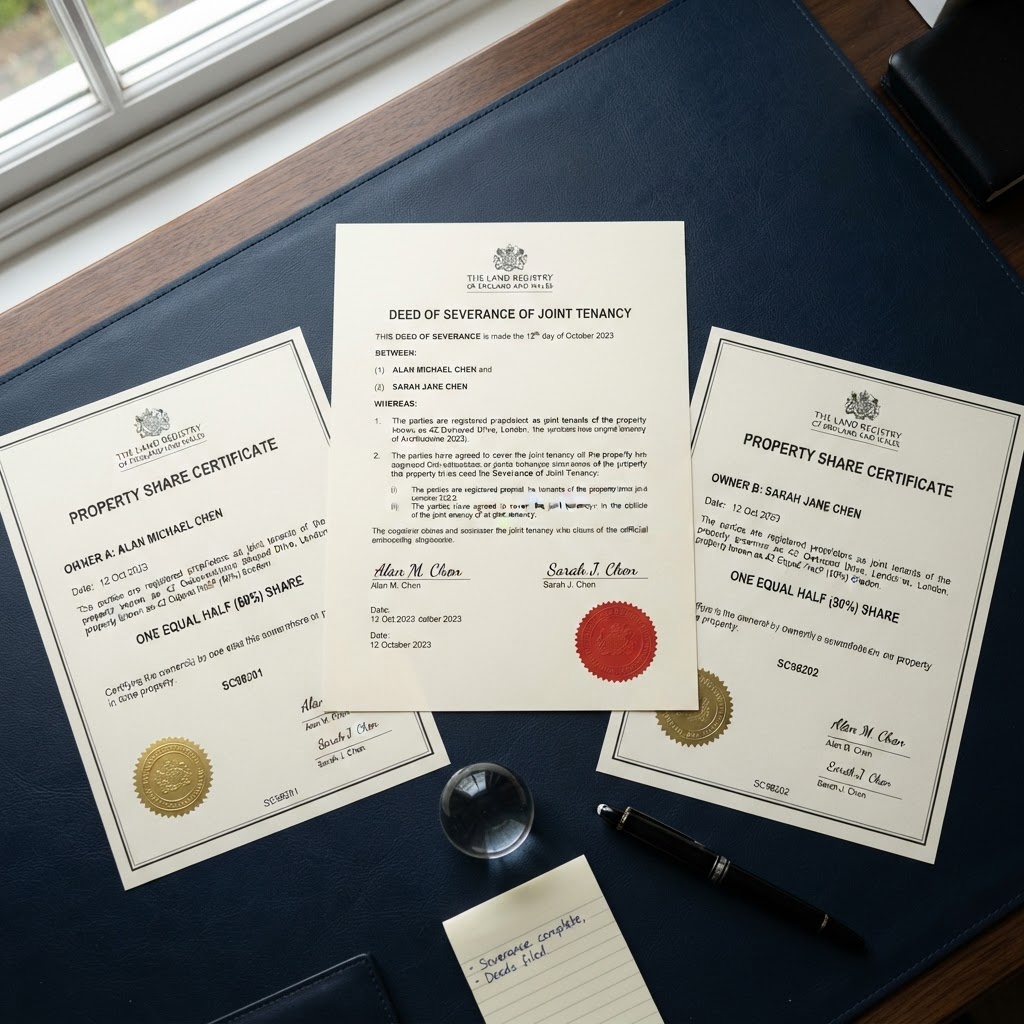
Key benefits
Enables Trust-Based Planning — Direct your share through a Property Protection Trust instead of it passing automatically to the co-owner.
Protects Against Care Fees — Ring-fences the first-to-die's share from local authority means testing if the survivor enters care.
Safeguards Children's Inheritance — Your share passes to your children, not automatically to a step-parent who may remarry.
A Straightforward Process — By mutual agreement, written notice, or course of dealing — we manage drafting and registration throughout.
Planning principle
As joint tenants, your Will has no effect on the property — severance is what makes trust planning possible.
Practical lesson
Fee: Priced as part of your Trust & Asset Protection service
7. Guardianship in Your Will
If the worst happens to you, who raises your child? Without a guardian named in your Will, a court decides — not you. A Will is the only legal way to appoint a guardian for your children.

Key benefits
You Choose Who Raises Your Child — Name the trusted family member or friend you want — not a stranger or someone the court selects.
Avoid Family Disputes — A clear appointment stops warring relatives fighting in court over your children.
Keep Your Child's Life Stable — Your chosen guardian can step in immediately, keeping school, nursery and routines intact.
Only a Will Makes It Legal — A verbal promise, a letter, or a note to a relative carries no legal weight — only your Will does.
Planning principle
Guardianship can ONLY be created through a Will — there is no other legal route.
Practical lesson
Fee: From £200
8. Executor Package
Acting as an executor is a significant responsibility most people undertake without any prior experience. Our Executor Package is a complete operational manual handed to your executor on your death. The Executor Package now includes our new coffee table book, “The Complete Guide to Estate Planning”, to read at your leisure while sipping a latte or mocha at your coffee table.
Key benefits
Complete Asset & Liability Register — Every asset and liability catalogued, valued and cross-referenced to the relevant institution.
Institution Directory — Every bank, insurer, pension provider and adviser listed with account references and contacts.
Step-by-Step Probate Roadmap — A plain-English timeline from registering the death through to final distribution.
Prepared Documentation Suite — Template letters for institutions and HMRC, plus a pre-populated probate application form.
Planning principle
The average probate process takes 9–12 months — this package removes the guesswork for your executor.
Practical lesson
Fee: Executor service-Price £150
9. Custodian — Will Storage & Management
Custodian is a new one-off will storage and management service — a secure, single-payment alternative to problematic recurring-fee storage models. Patrick D Williams Estate Planners were trained by Project Willo, the company operating the Custodian service on our behalf.

Key benefits
Document Verification — Every Will is checked for correct signatures, dates, and witnesses before it is accepted into storage.
Secure Dual Storage — A digital copy is saved in WILLO, while the physical original is lodged permanently with HMCTS.
Certificate of Deposit — Clients receive an official certificate confirming their Will is safely lodged and registered.
Full Admin Handling — We manage all paperwork, HMCTS forms, and recorded delivery on your behalf.
Planning principle
Your original Will is lodged permanently with HM Courts and Tribunals Service (HMCTS) — and you receive a certificate of deposit.
Practical lesson
Fee: Single Will £179 · Mirror Wills £239
10. The Complete Price List at a Glance
Our comprehensive price list sets out every service in one place, effective 2026. Fees are guideline figures for standard cases and are always agreed in writing before work begins.
| Service | Fee |
|---|---|
| Single Will | £200 |
| Mirror Wills (couple) | £325 |
| Guardianship in Your Will | From £200 |
| Custodian will storage — single Will (one-off) | £179 |
| Custodian will storage — mirror Wills (one-off) | £239 |
| Custodian Plus — individual (per year) | £19 |
| Custodian Plus — household (per year) | £29 |
| Lasting Power of Attorney (each) | £200 |
| Both LPAs together | £400 |
| Property Protection Trust | £550 |
| Discretionary Trust | £550 |
| Bare Trust | £550 |
| Joint Tenancy Severance | Included with Trust & Asset Protection |
| Executor Package | £150 |
Practical lesson
Prices are guideline fees for standard cases. Complex estates, bespoke trust drafting and overseas property may carry an additional charge, quoted in advance — and every fee is agreed in writing before work begins.
Professional partners — estate and letting agents, bookkeepers and accountants, mortgage brokers, and funeral directors — earn a referral reward for every client they introduce who converts, at no cost to their client. The reward is disclosed to the client, as consumer law requires.
Chapter 14
Professional Partnerships
We work alongside estate and letting agents, bookkeepers, accountants, mortgage brokers and funeral directors — earning partners a referral reward for every converted client they introduce, at no cost to the client.
1. Referral Partnerships
Our professional partnerships are built on a simple principle: you stay the professional your client already trusts, and we provide the estate-planning expertise they need. For every client you refer who converts, you earn £100 — at no cost to your client.
Who we partner with
- Estate and letting agents — your buyers and sellers are already thinking about the future of their property.
- Bookkeepers and accountants — your clients' financial records put you closest to their estate-planning needs.
- Mortgage brokers — a new mortgage or remortgage is a natural moment to review Wills and protection.
How the partnership works
- You refer the client to us for a free initial consultation.
- We handle the estate-planning work, drafting and registration.
- You earn £100 for every converted new client you refer.
- Your client pays no extra — our standard fees are unchanged.
- You stay the professional they already know and trust.
Planning principle
A good partnership is mutually beneficial: your client gets specialist estate-planning help, you add value to the service you already provide, and we do what we do best.
2. Funeral Director Partnership
Funeral directors meet families at the hardest moment of their lives. Our funeral director leaflet is therefore written around two referral moments rather than a list of services.
Two Moments Your Families Need Us
- At the time of bereavement — locating and interpreting the Will, confirming who the executors are, and guiding the family through probate, Inheritance Tax and the estate administration, with an Executor Package they can follow step by step.
- During lifetime pre-planning — funeral wishes written into a Will are not legally binding, and the executors hold the final say. We draft a Letter of Wishes that coordinates with a pre-paid plan, alongside the Wills, Lasting Powers of Attorney and trusts that protect the same family.
How We Synergise
- You stay the funeral director — we never touch your service. We visit the family at home or online, at their pace, at no cost and with no extra workload to you.
- One conversation, two needs — a family arranging a pre-paid plan is already organising their affairs, which is exactly the moment a Will, an LPA or a trust becomes the obvious next step.
- Referrals that work both ways — you pass bereaved families and pre-planners to us; we signpost clients who need a pre-paid plan or a funeral back to you. Local, reciprocal and free of any obligation.
Planning principle
Referral reward: £40 per Will · £50 per LPA · £75 per Trust — a flat fee for every client you introduce who completes an estate-planning instruction, paid promptly on completion and disclosed to your client as consumer law requires.
Practical lesson
Pre-paid funeral plan introductions run both ways at no charge. FCA rules prohibit any commission or financial inducement for referring a pre-paid plan, so that direction stays a straight reciprocal introduction.
Chapter 15
Your Practical Checklist and Next Steps
This final chapter gives you a practical preparation checklist, the key takeaways from the whole guide, and the contact details you need to take the next step.
11. Practical Estate-Planning Checklist
This masterclass concludes with a practical preparation checklist.

Asset Blueprint
Prepare a comprehensive record of:
- Property and land.
- Bank and savings accounts.
- Investments.
- Business interests.
- Foreign assets.
- Personal possessions.
- Debts and liabilities.
Digital Assets
Consider online accounts, digital businesses, cryptocurrency, cloud storage, photographs and other digital property. Digital assets should not be overlooked simply because they are not physical.
Executors
Choose appropriate Executors and consider appointing substitute Executors in case the original choices are unable or unwilling to act.
Family and Trust Strategy
Consider whether the family structure requires a straightforward Will or a protective arrangement such as a Property Protection Trust or Discretionary Trust. This is particularly important for blended families and vulnerable beneficiaries.
Excluded Family Members
Where someone intends to exclude a close family member, the reasons should be carefully considered and documented. Appropriate professional advice and supporting evidence may help reduce the risk of future disputes.
12. Key Takeaways
The central message of the masterclass is that estate planning should be proactive, personalised and regularly reviewed. The most important points are:
- Do not rely on intestacy rules to distribute your estate according to your wishes.
- Unmarried couples do not have automatic "common law marriage" inheritance rights.
- Blended families require particular care, as assets can unintentionally move outside the intended family line.
- Choose Executors carefully, recognising the responsibilities involved.
- Parents should nominate guardians for minor children.
- Understand the difference between specific, pecuniary and residuary gifts.
- Consider trusts where outright inheritance could create risks.
- Ensure the Will is correctly executed and witnessed.
- Review your Will after marriage, divorce, major family changes or significant financial changes.
- Consider testamentary capacity and evidence of wishes, particularly for later-life or potentially contentious Wills.
- Choose the type of Will according to your circumstances, rather than assuming a standard or Mirror Will is always appropriate.
- Consider digital assets and liabilities as part of the overall estate.
- Make arrangements while you have capacity rather than relying on a Statutory Will later.
Ultimately, the document presents a Will as one part of a broader estate-planning strategy. The objective is not merely to decide who receives assets after death, but to protect family members, preserve wealth, manage risks and ensure that a person's wishes can be demonstrated and implemented as effectively as possible.
Speak to Patrick D Williams Estate Planners
Whether you need a new Will, a review of an existing one, a Lasting Power of Attorney, a trust, probate support or guardianship advice, we can guide you through every stage.
07754 409085
info@patrickdwilliamsestateplanner.com
patrickdwilliamsestateplanner.com
Home & Office visits throughout Enfield & North East London. Nationwide online Teams/Zoom meetings
This guide is for general education and is not a substitute for advice tailored to your circumstances. Tax rules and rates change, and the figures shown are illustrative. © 2026 Patrick D Williams Estate Planners.
Building the guide preview
Loading fonts and photographs…

